



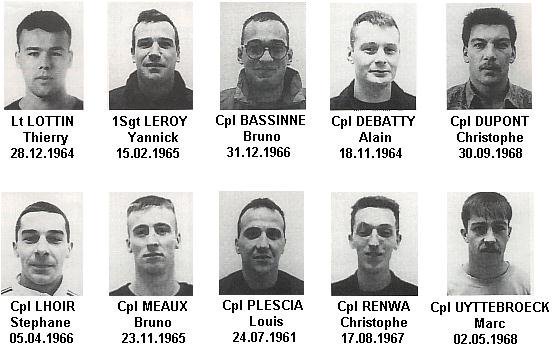
These Belgian peacekeepers lost their lives in Rwanda, killed in 1994 by the very forces that their government is courting today
In April 1994, ten Belgian peacekeepers were brutally murdered in Rwanda by an extremist Hutu regime intent on carrying out the genocide of the Tutsi. They were ambushed, disarmed, and butchered. Belgium mourned them and vowed: Never again.
Yet today, the Belgian government is actively sponsoring the ideological heirs of those same killers.
The organization in question is Jambo Asbl, a Brussels-based outfit that has become one of Europe’s most brazen platforms for genocide denial.
Jambo members do not merely dispute the details of the 1994 Genocide against the Tutsi; they systematically rewrite history, whitewash the killers (their parents in most cases), and attack the memory of the victims. They also openly support the FDLR (Democratic Forces for the Liberation of Rwanda), a US- and UN-designated terrorist group founded by former genocidaires and still active in the eastern Democratic Republic of Congo.
Meanwhile, Belgium registers Jambo Asbl as a legitimate civil society organization. Belgian taxpayers, through various grants and subsidies, indirectly fund its operations.
Belgian authorities look the other way while Jambo members walk free, hold jobs across the public and private sectors, and continue to engage in genocide denial that is, by Belgian law, a felony.
Genocide ideology is the link; genocide denial is its material expression
The men who murdered Belgian peacekeepers in 1994 were driven by a genocidal ideology. They controlled Radio Télévision Libre des Mille Collines (RTLM), which called for the extermination of Tutsi. They armed militias to that end.
Jambo Asbl harbours the same ideology and the same historical revisionism. They push a “double genocide” theory, which is nothing short of an attempt to create moral equivalence between the genocidaires and those who defeated them. They also routinely organize crowdfunding for the FDLR under the cover of humanitarian aid sent to eastern DRC.
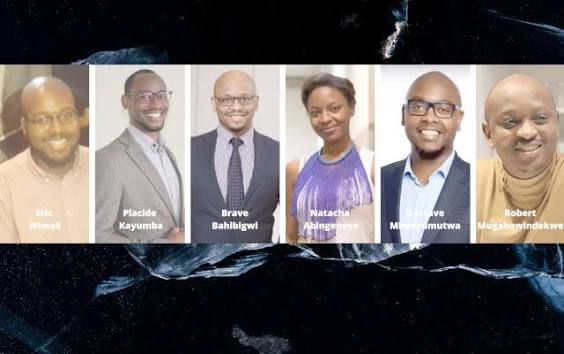
These are the leaders of Jambo Asbl who have opted to keep the genocide ideology flame burning
When Jambo members revise and minimize the genocide, they are continuing the unfinished work of the murderers.
If an organization of neo-Nazis openly revised the Holocaust and organized events to fund remnants of Hitler’s SS, would any European government register it as a civil society group? Would that government fund it? Would it allow its members to hold public employment while flouting criminal law? Of course not.
The outcry would be immediate, and rightfully so. So why Jambo? Why the double standard?
Belgian law criminalizes genocide denial. Article 1 of the Law of 23 March 1995 explicitly punishes anyone who “denies, grossly minimizes, attempts to justify, or approves of the genocide committed by the German National Socialist regime during the Second World War.”
While that law originally focused on the Holocaust, Belgium has also recognized the 1994 Tutsi genocide. The principle is: denial of judicially established genocides is a crime.
Yet Jambo members routinely revise and minimize the Tutsi genocide in public, in publications, and online. They are rarely investigated, let alone prosecuted. They move freely between Brussels, Paris, and eastern Congo. Why is Belgium’s justice system silent?
One is forced to ask: does Belgium harbor the same ideology? Or at least tolerate it so long as its targets are not European?
Accountability for the victims
Belgians should be outraged, not only because their government is violating its own laws, or because it is sponsoring a genocide denial outfit, but because every euro that flows to Jambo, every official registration, every act of bureaucracy that legitimizes this outfit, dishonors the memory of the ten Belgian peacekeepers murdered in 1994.
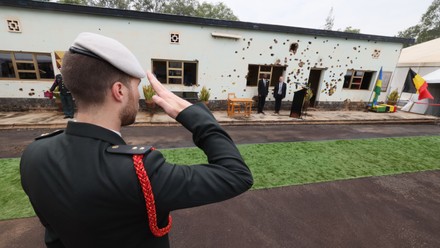
Image ref 136871247. Copyright Shutterstock No reproduction without permission. See www.shutterstock.com/license for more information.
Those peacekeepers were killed by men who denied the humanity of the Tutsi. Jambo members spent years denying that the genocide ever occurred. They then tried to invert responsibility, blaming the RPF. More recently, in a clear attempt to minimize the genocide against the Tutsi, they have resorted to pushing a theory that places killers and those who stopped the genocide on the same moral footing.
The question to the Belgian government is simple: Why do you still register Jambo Asbl as a civil society organization? Why do you not prosecute its members for genocide denial? And why should the world believe you have learned anything from 1994?
If Belgium cannot answer, then it has chosen a side and it is not the side of the victims, nor of its own fallen peacekeepers.
