



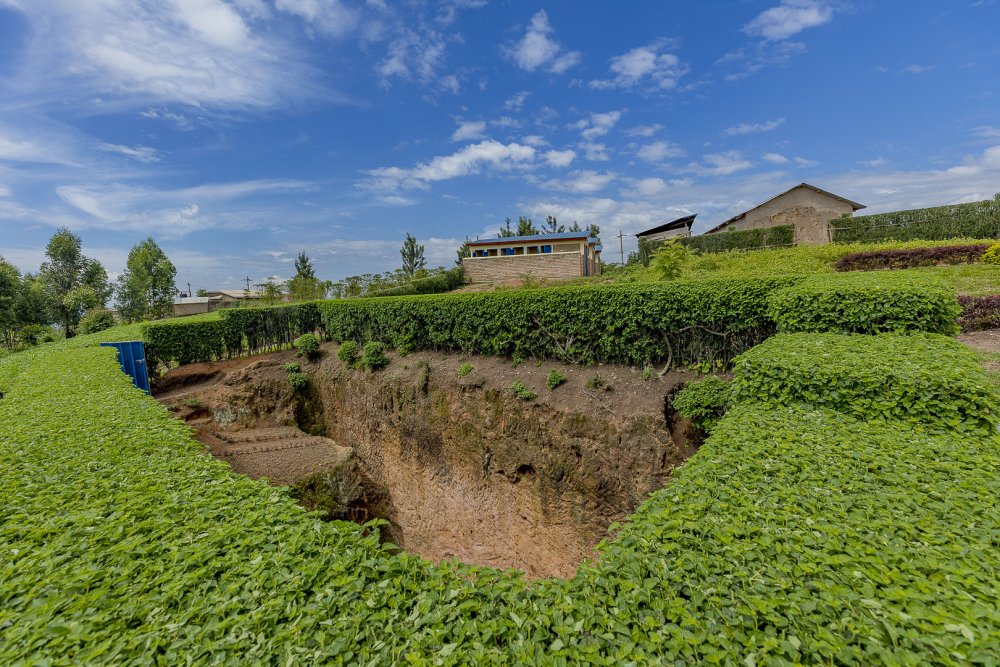
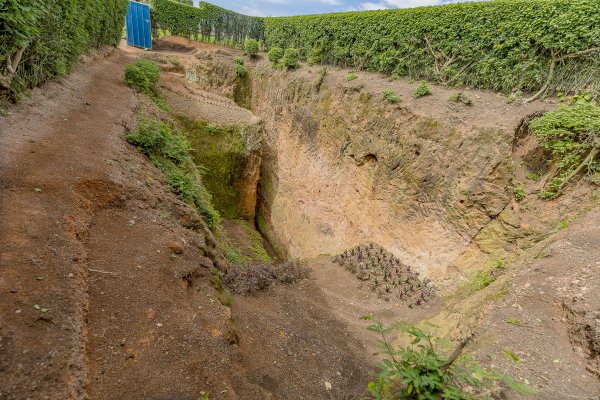
The pit has been kept intact to keep the memory of the victims as a testament that Never Again
Ruhango District, Rwanda — Long before the killing began in 1994, a pit had already been dug.
In the hills of what was then Ntongwe Commune, local authorities oversaw the excavation of a large trench. Residents were told it would serve as a latrine for a nearby school. But survivors say its true purpose was far darker.
Ntongwe Commune is what forms Kinazi and Ntongwe sectors, in Ruhango District, Southern Province. It is about 100km from Kigali.
By the time the 1994 genocide against the Tutsi unfolded, the pit had become one of the largest mass graves in the region. More than 60,000 bodies were later exhumed from it.
The site came to be known not only for the scale of killing, but for what stood above it.
A chair.
Survivors call it “Pilate’s chair.” (Intebe ya Pilato)
They say it was placed there by Nsabimana Jacques, a primary school teacher and local leader of the CDR party militia.
This was Coalition for the Defence of the Republic, a far-right extremist Hutu Power political party which was a splinter faction of ruling MRND party of President Juvénal Habyarimana.
Nsabimana sat on it beneath a tree, overlooking the pit, as victims were brought before him.
“Anyone brought there had to pass in front of him,” said Marie Josée Ntakirutimana, a coordinator Ibuka, umbrella organization for survivors in Kinazi. “He would ‘judge’ them before they were killed or thrown into the pit. That is why we call it Pilate’s chair.”
But the story of the pit begins earlier.
According to survivors, its excavation dates back to around 1992. It was initiated under the authority of the then Bourgmestre of Ntongwe Commune, Charles Kagabo.
The project was presented publicly as routine infrastructure. In reality, survivors say, it formed part of early preparations for mass killing.
“This was not something that happened suddenly,” Ntakirutimana said. “The place where people would be thrown had already been chosen.”
During the genocide, Tutsi who had fled to the area were rounded up. Many had come from neighboring regions, believing they might find safety. Instead, they were killed and dumped into the pit in large numbers.
Célestin Nzigiyimana, a survivor from the area, recalls how the violence unfolded with the involvement of militia and local officials. He said some attackers came from across the border in Burundi and encouraged others to participate.
Local authorities played a central role, he said, including Nsabimana and Bourgmestre Kagabo, who is accused of gathering Tutsi at the commune offices before they were killed.
What happened at the site has since become a symbol of how the genocide was organized — not only through violence, but through prior planning.
A site of memory and justice
Today, the remains exhumed from the pit were moved to the Kinazi Genocide Memorial, where around 65,000 victims from the Amayaga region are laid to rest.
Many of those responsible for the killings have been prosecuted. But some suspects remain at large.
Nsabimana Jacques is believed to still be in Rwanda, in the Bunyambiriri area. Kagabo Charles is thought to have fled, possibly to the Democratic Republic of the Congo or Burundi.
Government says efforts to track down genocide suspects continue. The Ministry of Justice has sent more than 2,000 case files to 33 countries to assist in arrests and prosecutions.
For survivors, the memory of the site remains vivid.
They remember not only the killings, but what came before them.
A pit dug in advance.
A chair placed above it.
And a system that turned preparation into mass death.
Editor: Photos by IGIHE
