



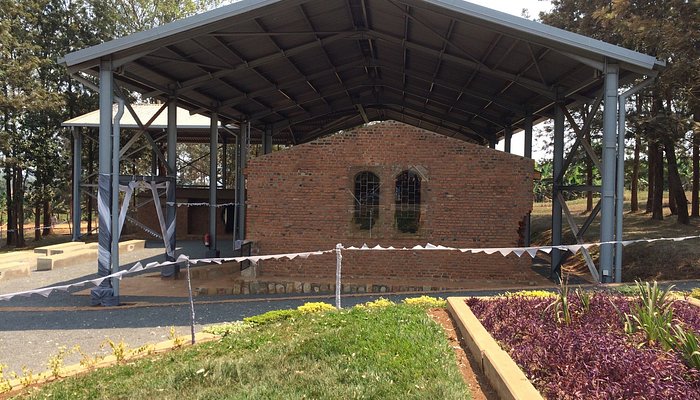
Ntarama Catholic Church, where thousands were killed during the 1994 Genocide against the Tutsi, now stands as a memorial site of remembrance.
In the early days of April 1994, as violence spread rapidly across Rwanda, some communities in Bugesera did not immediately yield to the genocide. In villages surrounding Ntarama Catholic Church, groups of elderly men—joined by teenage boys and girls—attempted to resist advancing militias using whatever they could find: stones, bows and rudimentary tools.
It was not an organised defence, but a desperate effort to protect their families against attackers armed with guns and grenades. For a brief moment, that resistance slowed the advance. But it could not hold.
Among those who witnessed these early efforts was Adeline Munganyinka, then a nine-year-old schoolgirl. Her father and elder brother were among those who stood at the front, trying to prevent militias from reaching their homes.
“They knew they could not match guns. But they still tried to defend us so we could escape. For a brief moment, that resistance slowed the attackers. But it did not last,” she recalls.
When resistance collapsed
The turning point came when armed elements, including a local policeman, intervened and opened fire on the defenders. The introduction of gunfire shattered the fragile line of resistance. Soon after, militias advanced, attacking homes and forcing families to flee.
What followed was a mass movement toward Ntarama. Thousands, carrying children and whatever belongings they could manage, made their way to the church, believing it would offer protection. Munganyinka’s mother gathered her children and joined the поток of families heading there.
This belief was rooted in history. During previous waves of violence, churches had often been places of refuge. But in 1994, that assumption would prove tragically misplaced.
Bugesera itself had long been shaped by marginalisation. Many Tutsi families in the area had been forcibly relocated there in the 1960s under discriminatory state policies that isolated them in harsh, underdeveloped conditions.
The region, then dominated by dense forest and swamp, was associated with hardship, including the prevalence of tsetse flies that spread sleeping sickness. Over time, social and political exclusion hardened into open hostility, with repeated threats and attacks against Tutsi communities.
By 1994, the violence that unfolded was not spontaneous—it was the culmination of years of dehumanisation, preparation and division.
Inside Ntarama Catholic Church, thousands gathered in uncertainty. Some were already injured. Others tried to maintain calm through prayer. Food was scarce, but what little was available was shared. Despite the fear, many still believed the church would not be violated.
That belief did not last.

Adeline Munganyinka speaks on a KT Radio show. She was nine years old during the 1994 Genocide against the Tutsi.
The attack on Ntarama
On April 15, 1994, attackers surrounded the church and launched a coordinated assault.
“We thought the church would keep us safe. Grenades were thrown into the crowds, followed by gunfire. Those outside were hit first, while those inside were trapped,” Munganyinka recalls.
She remembers the moment the violence escalated.
“Something was thrown into the crowd and it exploded. People died instantly.”
Soon after, attackers forced their way inside and began killing those sheltering there.
In the chaos, Munganyinka became separated from her family. Her mother had moved toward the altar, where many had gathered. She tried to reach her, calling out repeatedly.
“I kept shouting ‘Mama,’ but every child was calling for their mother. I even called her by name, hoping she would hear me,” she says.
From a distance, she could see her—but the noise and confusion made it impossible to reach her.
Moments later, an explosion tore through that area, collapsing part of the wall. It was the last time she saw her mother.
As the attack intensified, survival became instinctive. Munganyinka moved through the crowd and eventually remained hidden beneath bodies, lying still as the killings continued around her.
Life after survival
When the attackers withdrew, she emerged into devastation. She had survived by remaining concealed until the violence subsided.
But the danger did not end there.
Survivors fled once again, moving between hiding places, including nearby swamps, where further killings took place.
The loss within her family was profound. Out of twelve children, only five survived.
In the aftermath of the Genocide against the Tutsi, survival marked the beginning of another struggle—the long process of rebuilding a life from loss.
For Munganyinka, returning to school became part of that journey, supported by broader national efforts to restore stability and rebuild communities.
Over time, she rebuilt. Today, she is a mother, raising her children in a country that has undergone profound transformation over the past three decades.
“We are here now, even though our parents are no longer with us. We moved forward, we studied, and we built our lives. We are living testimony. People should come, see, and understand,” she says.
At Ntarama, the history of April 1994 remains visible. The site stands not only as a place of remembrance, but as a record of loss—and of the final, desperate efforts of those who tried to resist.
For survivors like Munganyinka, it is a reminder not only of what was taken, but of what endured.