



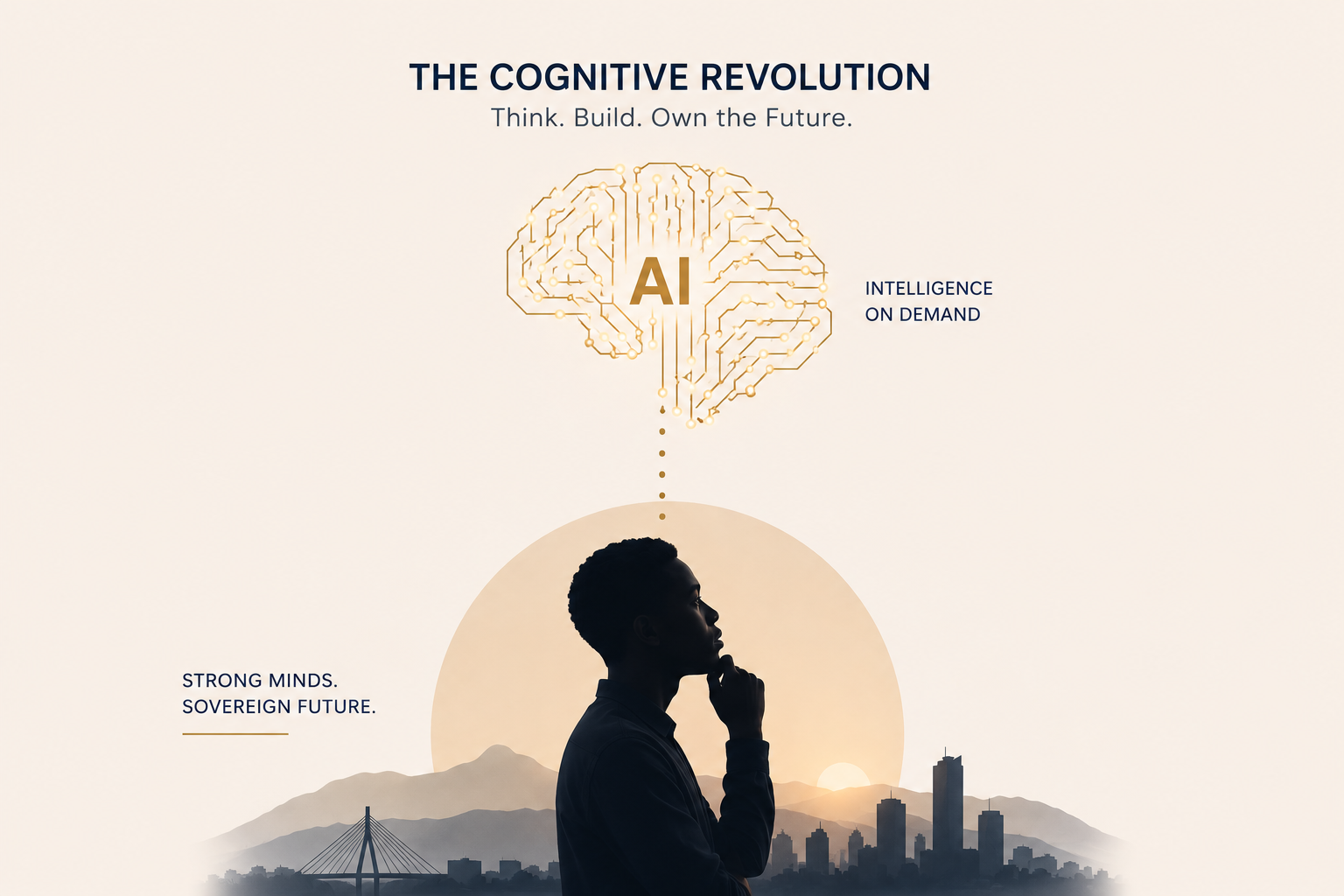
Every technological revolution changes what humanity can do. The cognitive revolution changes something deeper: what humanity needs to think about for itself.
Artificial intelligence is no longer simply a machine that performs tasks. It can explain, translate, reason, write, analyse, teach, code and increasingly participate in decisions once reserved for humans. East Africa is already using it. The question is not whether we will adopt AI. It is what happens to a society when intelligence itself becomes a service available on demand.
For centuries, education was built around acquiring knowledge. Students memorized facts, learned procedures and developed judgement. AI changes that equation. Information is becoming abundant. Independent thought, judgement, creativity and the ability to ask better questions are becoming more valuable.
This creates a paradox for East Africa.
We need AI because it can help address shortages of teachers, doctors, engineers, researchers and specialized expertise. It can bring capabilities once concentrated in wealthy economies closer to ordinary citizens. But the same technology can weaken the capabilities we need if we adopt it without thinking.
A student who uses AI to understand mathematics may become more capable. A student who uses it to avoid thinking may become less capable while appearing more productive.
That distinction could define our education systems.
East Africa has begun responding through national AI strategies and regional initiatives. But policy is only the beginning. The deeper question is whether Africa will become a society that uses intelligence produced elsewhere or one that produces its own.
Much of the AI we consume is built on foreign models, foreign compute and foreign infrastructure. Our applications may be African, our users African and our problems African, yet the underlying intelligence can remain elsewhere.
That is not necessarily wrong. It is simply the architecture of today’s AI economy. But architecture determines power.
If we do not build compute, research institutions, datasets, models, laboratories and infrastructure of our own, we risk becoming highly efficient consumers of other people’s intelligence.
There is another danger. Africa possesses knowledge that was rarely written into textbooks: agricultural practices, indigenous medicine, languages, oral history, craftsmanship, architecture, folklore and systems of community organisation. AI could preserve this knowledge. It could also flatten it.
If African knowledge enters machines only after being interpreted through external datasets and frameworks, future generations may inherit an algorithmic version of Africa rather than Africa itself.
This is why the AI revolution is ultimately philosophical.
What should machines do for us, and what must humans continue doing for themselves?
East Africa should not merely teach people how to prompt machines. We should teach people how to think with machines without surrendering the responsibility to think.
We should build African AI research institutions, sovereign compute infrastructure, local datasets, African language models and universities where research matters as much as teaching.
The objective is not to resist artificial intelligence. It is to ensure that when intelligence becomes infrastructure, East Africa is not merely connected to it. East Africa owns part of it.
The cognitive revolution has begun.
The question is whether we will merely consume its intelligence, or help define what intelligence becomes.
James Kaliisa is Co Founder & CTO of Nexus Inc., a Rwandan deep tech company building sovereign artificial intelligence infrastructure and digital systems for Africa.
