



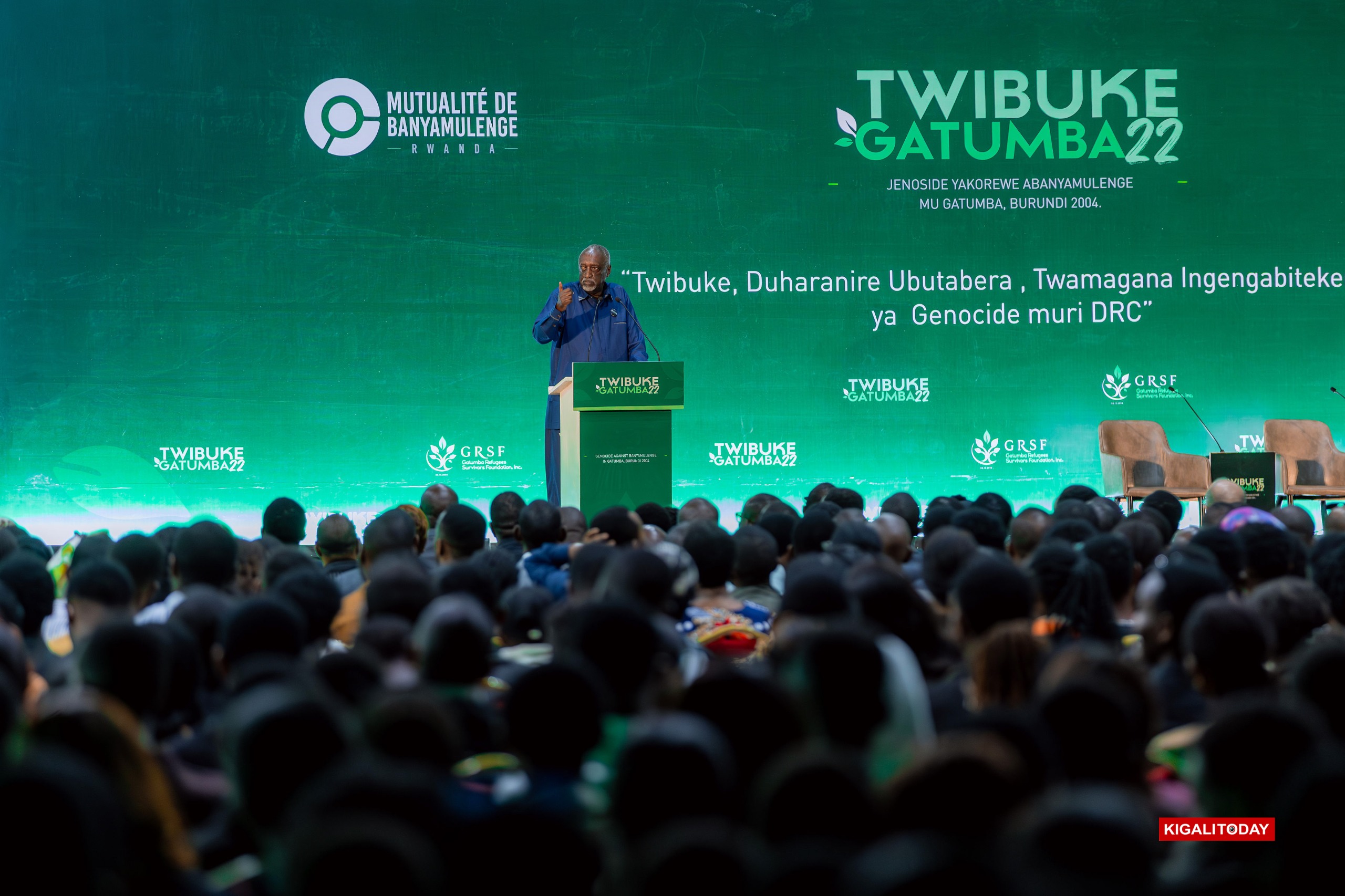
From across the global, and refugee camps in Rwanda, the Banyamulenge community came together to reflect on the horror that shook them. They are still awaiting answers from an indifferent international order
Twenty-two years ago today, on August 13, 2004, 152 Congolese refugees were massacred at the Gatumba refugee camp in Burundi. Most of the victims were Banyamulenge, Congolese Tutsi from South Kivu who had fled the violence of eastern Congo and crossed the border into Burundi in search of safety.
They were killed in a place where they had every reason to believe they would be protected.
The massacre shocked the region and reverberated across the world. The United Nations condemned it, investigated it and called for those responsible to be brought to justice. The Security Council urged Burundi and the Democratic Republic of Congo to cooperate with the investigation and warned that the cycle of atrocities and impunity in the region had to end.
Those words mattered. But twenty-two years later, they also leave us with an uncomfortable question: What is the value of international condemnation when justice never follows?
The question is not whether the world knew what happened at Gatumba. It did.
The more consequential question is whether the response was forceful enough to make those responsible understand that the deliberate slaughter of civilians would carry consequences.
It was not.
There was, in fact, remarkably little ambiguity about who initially claimed responsibility for the attack. Soon after the massacre, PALIPEHUTU-FNL publicly acknowledged that it had carried it out. Its spokesman at the time, Pasteur Habimana, told foreign media that the FNL was responsible and sought to justify the assault by claiming that the camp was sheltering combatants. Human Rights Watch’s investigation concluded that the FNL was the chief force involved in the slaughter and found Habimana’s initial declaration of responsibility credible. A young FNL combatant also confessed to participating in the killings.
The United Nations investigation examined the possible involvement of other armed actors as well, leaving questions about the full chain of command and individual responsibility that, ultimately, could only be settled through judicial process.
And therein lies the deeper failure of Gatumba.
The issue is no longer simply whether the world knew which armed movement had claimed responsibility for the attack. It did. The more troubling question is why, despite that public claim, subsequent investigations and the issuance of arrest warrants, no meaningful prosecution of those ultimately responsible for the massacre followed.
In 2004, Burundian authorities issued arrest warrants for FNL leaders Agathon Rwasa and Pasteur Habimana. Neither was arrested. Twenty years later, Human Rights Watch reported that Rwasa had never been arrested and that a judicial case announced in 2013 concerning alleged war crimes and crimes against humanity committed at Gatumba had been delayed indefinitely. New complaints filed on behalf of victims and survivors in Burundi and the Democratic Republic of Congo again named Rwasa and Habimana.
This may be the most painful paradox of the Gatumba story.
For years, Banyamulenge survivors, relatives of those killed, community organizations and others who have supported their pursuit of justice have continued to ask for accountability. Yet time, which is so often invoked as a solvent for grief, has not dissolved their demand for justice.
Instead, the years have accumulated.
Meanwhile, the two men against whom arrest warrants were issued in the immediate aftermath of the massacre have continued to live in freedom. Rwasa has remained a prominent figure in Burundian politics, while Habimana has also remained at liberty.
That contrast is difficult to explain to the families of the dead.
The victims cannot speak for themselves. Their relatives have spent two decades carrying the memory of the massacre and asking for justice, while those publicly associated with it have had the opportunity to live their lives, participate in political life and defend themselves against the allegations.
That is not a finding of guilt. Only a competent court can establish individual criminal responsibility.
But neither should the absence of prosecution be mistaken for exoneration.
Twenty-two years after Gatumba, the victims are still asking for justice.
That is not closure.
It is an unfinished promise.
Gatumba’s Lesson Is Still Relevant
The significance of Gatumba extends far beyond the 152 people who were killed that night. It revealed, with devastating clarity, the danger of transforming ethnic identity into a security accusation.
The victims were civilians.
Their ethnicity did not make them combatants.
Whatever political or military activities individuals from their broader community may have been involved in, the refugees at Gatumba were entitled to protection. Their humanity was not conditional upon the conduct of others who happened to share their identity.
That principle remains painfully relevant in eastern Congo today.
In April 2026, Human Rights Watch reported that civilians in the South Kivu highlands remained in grave danger. It documented the deaths of dozens of Banyamulenge civilians, most of whom were simply tending cattle in Minembwe and in parts of Fizi territory, in apparent drone attacks. It also documented the destruction of homes and livestock, restrictions on humanitarian access and abuses committed against innocent civilians.
The mere fact that these attacks against civilians are being carried out in the presence of government forces or, in some instances, with their direct or indirect involvement raises serious concerns. This is particularly troubling given that Burundian forces currently fighting alongside government troops in the Democratic Republic of the Congo have, at various points, themselves been accused of taking sides in conflicts rather than fulfilling their fundamental responsibility to protect civilians.
That uncertainty is precisely why such incidents require independent investigation.
The same standard must apply to everyone.
If FARDC or Wazalendo groups commit abuses, investigate them. If Burundian forces operating alongside Congolese forces are accused of violations, those allegations should likewise be examined independently.
The principle cannot be ethnic.
It must be legal.
This is where the international community risks repeating the failure of Gatumba.
The region has witnessed too many atrocities followed by condemnation, promises of investigation and, eventually, silence. Political circumstances change. Armed groups become negotiating partners. Governments acquire new priorities. International attention moves elsewhere.
The victims remain.
Impunity does more than deny justice to the dead. It instructs the living.
It tells armed actors that political usefulness may, in time, matter more than criminal responsibility. It tells communities that the state may not protect them. And it encourages vulnerable populations to seek protection from armed organizations, creating yet another generation of insecurity.
That is how impunity reproduces itself.
Justice, therefore, should not be treated as something that comes only after peace.
In the Great Lakes, “later” has too often become another word for “never.”
Twenty-two years after Gatumba, the international community cannot bring the victims back. But it can still decide what their deaths mean.
It can insist upon credible investigations. It can preserve evidence, protect witnesses and support survivors. It can demand accountability regardless of a perpetrator’s ethnicity, political connections or military alliances. And where the evidence is sufficient, it can insist upon prosecution.
Most importantly, it can apply to today’s victims the same principle it claimed to defend in 2004:
Civilians are civilians, whoever they are.
Gatumba should not be remembered as an argument for another cycle of revenge. Revenge is not justice, and collective punishment is not accountability.
It should instead be remembered as a warning about what happens when communities are collectively blamed for the ethnic identity or actions of armed actors, and when those who perpetrate atrocities discover that political circumstances may eventually provide them with shelter from the consequences of their crimes.
The international community condemned Gatumba.
It was right to do so.
But condemnation was only the beginning.
Twenty-two years later, the question is whether the world has learned the lesson that condemnation alone does not deter perpetrators.
The victims of Gatumba deserve more than remembrance. The civilians living today in Minembwe and across South Kivu deserve more than another promise that their suffering will be investigated.
They deserve protection.
They deserve accountability.
And they deserve to know that when the international community says “never again,” it means something.
Because if condemnation is not followed by justice, it may satisfy the conscience of the world.
It will not deter the next perpetrator.
Sylivanus M. Karemera is Station Manager, KT Radio 96.7FM, which is under Kigali Today Ltd
