



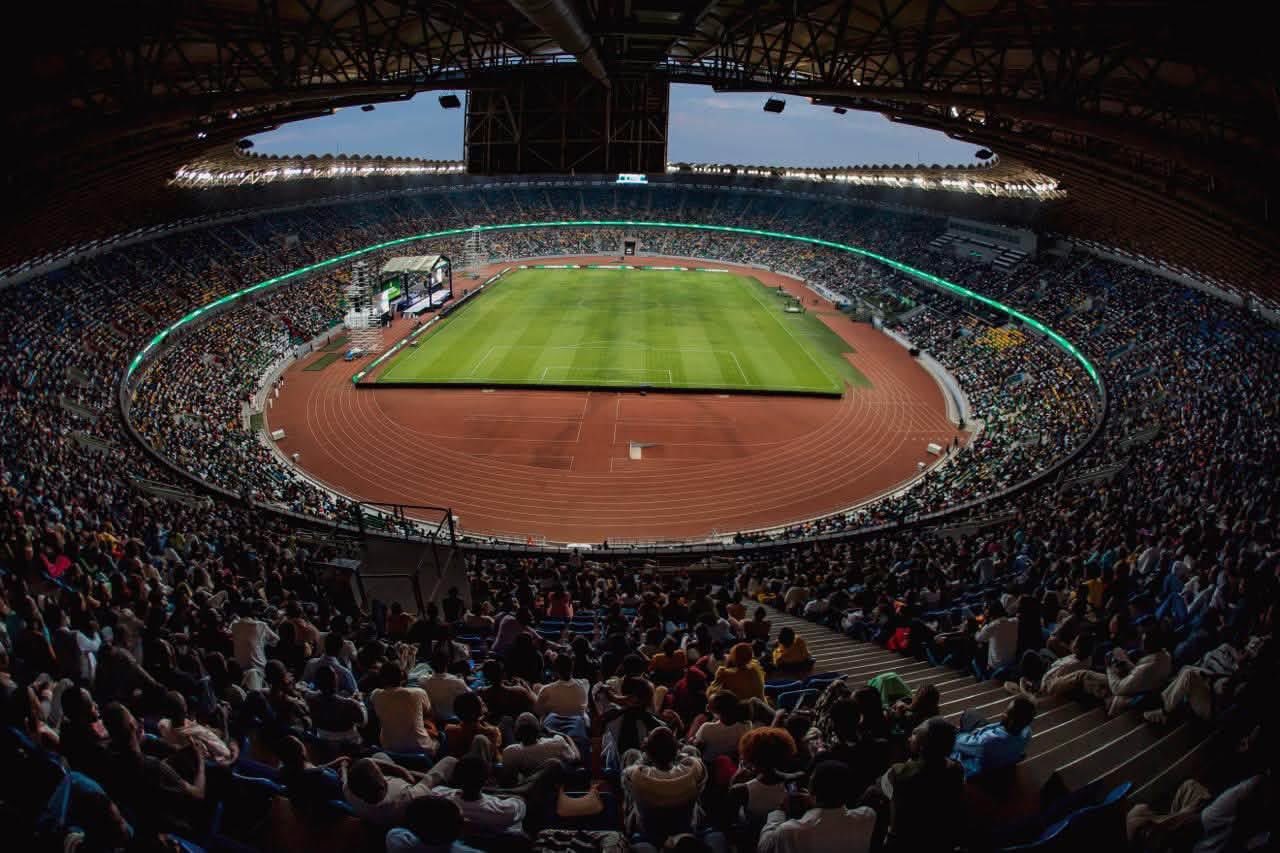
The Amahoro Stadium was packed to capacity by the faithfuls
A nation can spend a day giving thanks and still have reason to reflect on what comes next.
That spirit of reflection was present at Rwanda Shima Imana 2026, where Christians from different churches and denominations gathered at Amahoro Stadium for prayer and thanksgiving.
But a national gathering of this kind can be more than a celebration of what has already been achieved. It can also be a moment to ask what must be protected, what must change and what kind of country the present generation intends to leave behind.
That spirit was reflected in the remarks of many of the religious leaders who spoke during the gathering, as they repeatedly gave thanks to God for what Rwanda has achieved over the past 32 years, particularly the country’s peace, unity and progress.
That is where the remarks of Prime Minister Dr Justin Nsengiyumva deserve particular attention.
As guest of honour, the Prime Minister spoke about Rwanda Shima Imana not simply as a religious gathering but as an opportunity to consider the relationship between faith and the broader work of nation-building. “Rwanda Shima Imana is an opportunity to reaffirm the importance of the partnership between Government and religious organizations.”
It is a simple point, but an important one. Governments can build institutions, formulate policies and provide public services. They can create the conditions for development. But they cannot, by themselves, shape the character of a society.
That work also takes place in families, schools, churches and communities.
The Prime Minister recognised this when he said:
“The achievements we celebrate today would not have been possible through Government’s efforts alone.”
He went on to acknowledge the contribution of religious organisations to “shaping Rwandans with strong values” and promoting love, unity, peace, forgiveness and patriotism.
Those values matter beyond the walls of a church. They are part of the social capital that allows a country to hold together. Economic progress can improve living standards, but it cannot by itself create trust between people. Infrastructure can connect communities, but it cannot teach people how to resolve disagreements. Laws can establish boundaries, but they cannot replace conscience.
A country’s future is ultimately carried by people.
And that brings the conversation to Rwanda’s young people.
Young Rwandans are often described as the country’s future. The phrase is familiar, but it can obscure an important reality: young people are not simply waiting to become part of Rwanda’s story. They are already shaping it through their choices, ambitions, relationships, work and influence on one another.
Fanny Munyana, reflecting on the meaning of Rwanda Shima Imana as a young Rwandan, connected thanksgiving with that responsibility.
Munyana is a finance professional whose perspective brings another dimension to the conversation about young people’s responsibility and Rwanda’s future.
For her, the occasion is about thanking God for “the gift of our country, its peace, unity, and progress.”
But gratitude, in her view, must lead somewhere.
She spoke about the responsibility of encouraging young people to avoid ibiyobyabwenge, make healthy choices and support one another.
“As youth, we are the ones who are going to lead this country in the days to come.”
That statement should be taken seriously.
If young people are expected to lead tomorrow, then society must prepare them today. Education is essential, but education alone is not enough. Young people also need skills, mentorship, opportunity, family support and a sense that their lives have purpose.
This is particularly important when discussing drug and substance abuse.
It is easy to frame substance abuse as a problem of individual behaviour and to respond by simply telling young people what they should not do. But the problem is more complicated. Harmful substance use can disrupt education, damage relationships, undermine productivity and narrow a person’s future possibilities.
Prevention therefore has to be about more than prohibition. It must also be about creating alternatives meaningful education, employment, sport, creativity, entrepreneurship, mentorship and community life.
Young people need something worth protecting.
They also need to be part of the solution.
Calvin Mutsinzi approaches that responsibility through media and digital communication. He believes his contribution to Rwanda’s development can come through the skills he has acquired in those fields.
Mutsinzi is a communications specialist and entrepreneur whose perspective reflects the growing role of media, communication and digital platforms in shaping society.
“My contribution to Rwanda’s development is through using my skills, especially in media, communication and digital platforms.”
His perspective reflects a reality that cannot be ignored. For today’s young people, the public square is no longer only a physical place. It is also the digital world.
A phone can be a classroom, a newsroom, a marketplace or a source of influence. A young person can educate a peer, promote a business, tell a positive story or spread harmful information within minutes.
Mutsinzi believes young people should use that influence to “share positive stories, inspire other young people and promote messages that build our society.”
There is considerable wisdom in that approach. Young people can influence one another in ways that formal institutions sometimes cannot. Peer influence can normalise harmful behaviour, but it can also encourage discipline, ambition and healthier choices.
This is why the Prime Minister’s call for partnership should be understood as more than a formal recognition of religious organisations.
The responsibility is shared.
Government has a role in creating effective policies and systems. Religious organisations can contribute moral formation and community support. Families provide guidance and stability. Schools cultivate knowledge and critical thinking. Communities create belonging. Young people themselves must exercise judgement and take responsibility for their choices.
No single institution can carry the entire burden.
There is also a broader lesson here about patriotism.
Patriotism is easy to express during moments of celebration. It is more demanding in ordinary life. It is easy to speak about unity from a stage; it is harder to practise it when people disagree. It is easy to praise peace; it is harder to protect peace through patience, forgiveness and restraint.
The same is true of gratitude.
To be grateful for peace is to accept some responsibility for preserving it. To be grateful for progress is to ask how that progress can be sustained. To celebrate young people is to invest in their ability to become responsible citizens.
And to give thanks for what Rwanda has received is also to ask what the present generation will give in return.
That may be the deeper meaning of Rwanda Shima Imana 2026.
The gathering was an occasion of faith, but its implications reach into the wider questions of citizenship, youth, family and national responsibility. Its significance will ultimately depend not on what was said inside Amahoro Stadium, but on what happens outside it.
Will families have more honest conversations with young people? Will institutions work more closely to prevent substance abuse? Will young people use their influence to encourage one another? Will society provide them with genuine opportunities to build meaningful lives?
Those questions are harder than the celebration itself.
They are also more important.
Thanksgiving looks backward with gratitude. Responsibility looks forward with purpose.
For Rwanda, the two should remain inseparable. The country young people inherit tomorrow will be shaped not only by the achievements of previous generations, but by the choices being made today.
Perhaps the most meaningful way to thank God for the Rwanda we have is to accept responsibility for the Rwanda we are still building.
