



KIGALI, Rwanda — Rwanda should ensure that it is included in the expanding Lobito Corridor, an Indian think tank has recommended, as the country seeks to turn its mineral wealth, manufacturing capacity and strategic location into a much larger economy over the next decade.
The recommendation by the Observer Research Foundation, or ORF, comes at a particularly significant moment.
Rwanda is already pursuing railway links to Tanzania and Uganda, while a separate railway plan through eastern Congo — connecting Kigali to Goma, Walikale and Kindu — has gained renewed relevance as Rwanda and the Democratic Republic of Congo pursue a broader economic integration framework under the Washington peace process.
At the same time, the Lobito Corridor has become one of the United States’ most important infrastructure and critical-minerals initiatives in Africa.
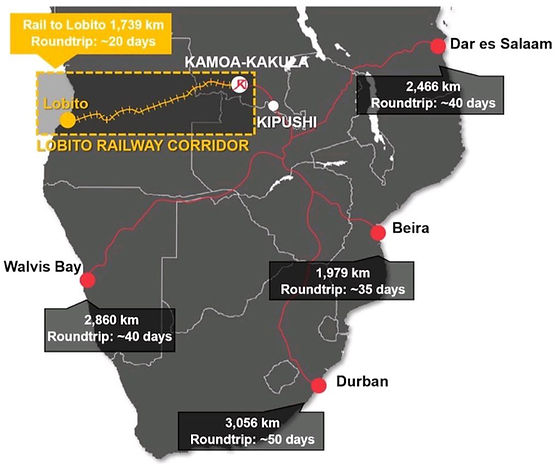
The corridor links the Atlantic port of Lobito in Angola with the mineral-rich regions of southern Congo and Zambia. Washington has described the project as a flagship example of its Partnership for Global Infrastructure and Investment, supporting transport infrastructure while seeking to build wider supply chains in minerals, agriculture, energy and manufacturing.
In 2023, the United States, European Union, Angola, Congo and Zambia, together with the African Development Bank and African Finance Corporation, signed an agreement to develop the corridor and a new Zambia-Lobito railway.
The United States called the planned railway the most significant transport infrastructure it had helped develop in Africa in a generation.
For Rwanda, the question is no longer simply whether to find another route to the ocean.
It is whether to position itself inside a much larger economic system being built around African critical minerals, regional infrastructure and U.S.-backed global supply chains.
A U.S.-backed corridor
The Lobito Corridor was originally conceived as a route for moving copper and cobalt from the Congo and Zambia to the Atlantic.
But the U.S. and its partners have sought to make it much more than a railway.
The European Union describes the corridor as an economic route connecting southern Congo and northwestern Zambia to global markets through Angola. Its flagship programme includes construction of the Zambia-Angola railway, rehabilitation of the Congolese railway, upgrading of the Angolan railway, trade facilitation, agricultural value chains, renewable energy, education and jobs, as well as critical-mineral supply chains.
Washington has also backed the extension of the corridor toward Zambia. The United States has described the planned Zambia-Lobito railway as part of a vision for an open-access rail connection between the Atlantic and Indian oceans.
That gives the project significance well beyond the three countries through which its core railway currently runs.
For Rwanda, access could potentially provide an additional western route for exports while placing the country closer to a U.S.-backed network built around some of the world’s most important supplies of copper, cobalt and other critical minerals.
Rwanda is already in the picture
The striking part is that Rwanda does not have to start from scratch.
The Regional Economic Integration Framework agreed by Rwanda and Congo as part of the Washington peace process calls for the two countries to work with the United States and other international partners on future connections to the Lobito Corridor. The framework covers infrastructure, mineral supply chains, trade, energy, tourism and other areas of cross-border economic cooperation.
The economic framework therefore envisages something broader than simply moving minerals.
It seeks to build an integrated regional economy in which infrastructure, mineral processing, trade and private investment reinforce one another.
That is strikingly close to the economic architecture proposed by ORF.
What the Indian think tank is proposing
ORF’s recommendation is part of a much broader 10-year economic roadmap for Rwanda.
The think tank argues that Rwanda should not remain primarily a producer and exporter of raw materials. It should move further up the value chain, particularly in critical minerals, by developing processing, refining and manufacturing capacity.
The research sees opportunities in mineral processing, agriculture and agro-processing, manufacturing, digital services, tourism, healthcare and education.
It also proposes stronger digital public infrastructure, greater use of artificial intelligence and policies inspired by India’s experience with industrial incentives.
One proposal is particularly unusual: creating a “gig economy” around critical minerals.
Instead of limiting mining-related employment to permanent workers employed directly by mining companies, Rwanda could train and certify independent specialists to provide services such as mineral traceability, environmental monitoring, due diligence, surveying and other compliance work.
The idea is to create an ecosystem of specialised businesses and workers around the mining industry.
A $42.89 billion economy
The recommendations are designed around a much larger economic target.
ORF projects that Rwanda’s economy could grow from about Rwf 24 trillion ($16.3 billion) to $42.89 billion by 2035 — effectively tripling in a decade.
At first glance, that sounds like an unusually ambitious projection.
But when placed beside Rwanda’s own planning documents, it appears less radical.
Rwanda’s Vision 2050 has long targeted upper-middle-income status by 2035, with average annual GDP growth of at least 12 percent over the longer period. Its current National Strategy for Transformation, NST2, targets average real GDP growth of about 9.3 percent a year from 2024 to 2029, rising to 11.5 percent by 2029.
In that context, ORF’s projection is broadly consistent with the trajectory Rwanda itself has established.
Indeed, in some respects, the government’s long-term ambition is even more demanding.
NST2 seeks to transform the structure of the economy, with manufacturing, services, agriculture, exports and private investment among its principal engines of growth.
The government is targeting stronger manufacturing, higher-value agricultural production, expanded exports and more private-sector investment.
ORF’s roadmap therefore appears less like an alternative to Rwanda’s development strategy than an external proposal for how some of those ambitions could be pursued.
The railway question
The most important question concerns infrastructure.
Rwanda is already investing political capital in its existing transport corridors.
The country has long pursued the Isaka-Kigali standard-gauge railway, which would connect Kigali to Tanzania’s railway network at Isaka and then to the port of Dar es Salaam.
Rwanda is also linked economically to the Northern Corridor, running through Uganda toward Kenya’s port of Mombasa.
Both routes provide access to the Indian Ocean.
That raises an obvious question about the Lobito proposal: Why should Rwanda pursue another, much more distant western railway connection when it is already working toward railway links through Tanzania and Uganda?
The Indian Think tank argues that Rwanda should diversify its trade routes because congestion and disruptions on existing corridors can impose costs on a landlocked economy.
But it does not provide a detailed cost-benefit comparison between: Kigali–Isaka–Dar es Salaam and Kigali–Uganda–Mombasa, on one side, and a future western connection into the Lobito network on the other.
It does not give a Rwanda-specific cost for connecting to Lobito, nor does it provide detailed estimates of the distance, cargo volumes or transit costs that would make such a connection commercially viable.
That is an important gap.
The missing link may already be on Rwanda’s map
There is, however, another railway proposal that changes the equation.
Rwanda has previously studied a route running from Kigali through Goma, Walikale and Kindu in Congo.
The government has described the Kigali-Goma-Walikale-Kindu railway as part of wider plans to improve regional connectivity, while Rwanda’s own planning documents have listed it alongside the Isaka-Kigali SGR.
A western railway through eastern Congo would not itself reach Lobito.
But it could provide a more direct physical connection between Rwanda and Congo’s wider railway system, potentially creating a building block for deeper integration into Central African transport networks.
That makes the Washington economic framework particularly relevant.
Rather than replacing Rwanda’s existing railway plans, the emerging architecture could eventually connect several systems:
Kigali → Isaka → Dar es Salaam
Kigali → Uganda → Mombasa
and potentially:
Kigali → Goma → Walikale → Kindu → wider DRC network → Lobito.
The three routes would serve different strategic purposes.
The first two provide established Indian Ocean gateways.
The third could provide access to the Atlantic and, more importantly, to the mineral and industrial networks being developed around the Lobito Corridor.
Not a replacement for Tanzania
This distinction is important.
The ORF report should not necessarily be read as telling Rwanda to abandon its Central Corridor plans.
The stronger interpretation is diversification.
Rwanda would retain its routes to Dar es Salaam and Mombasa while seeking a third strategic option toward the Atlantic.
That would make Rwanda less vulnerable if one corridor became congested, politically disrupted or commercially uncompetitive.
The Washington economic framework itself points in this direction. It calls for stronger regional infrastructure and transport links rather than prescribing a single route for Rwanda’s trade.
Why minerals are at the centre
The Lobito proposal makes greater sense when viewed through the critical-minerals strategy.
The corridor’s central economic rationale is the mineral wealth of Congo and Zambia.
The United States has made diversification of critical-mineral supply chains a major economic and strategic priority. Its Minerals Security Partnership, which includes India among its participating countries, promotes investment in mineral projects that meet environmental, social and governance standards and encourage local value addition.
Rwanda, meanwhile, has been seeking to move beyond simply exporting minerals.
ORF argues that the country should process more of what it extracts and use those materials to support manufacturing.
That would potentially give Rwanda a role not merely as a mining country, but as a processor, manufacturer and services hub within a regional critical-minerals economy.
And the Washington economic framework similarly calls for more transparent mineral supply chains and greater industrial integration.
The overlap is difficult to miss.
An Indian think tank with deep Rwanda links
The choice of Rwanda by ORF is also not random.
The foundation has maintained close institutional links with the country for years.
In 2019, ORF worked with the Government of Rwanda and the Rwanda Convention Bureau to launch the Kigali Global Dialogue, a policy forum bringing together governments, academics, business leaders and civil society.
Former Prime Minister, Dr Edouard Ngirente, met ORF President Samir Saran during the inaugural dialogue, and the two sides discussed a potential partnership between the foundation and the Rwandan government. Rwanda’s Convention Bureau signed a memorandum of understanding with ORF for the initiative.
The dialogue was held again in 2021 and 2022 and later involved the Rwanda Governance Board, Rwanda Convention Bureau and other partners. Its themes have included critical minerals, connectivity, artificial intelligence, investment and development partnerships.
President Paul Kagame also addressed ORF’s Raisina Dialogue in India in April 2021. He thanked Prime Minister Narendra Modi, the Indian government and ORF for the invitation and said that relations between India and Rwanda were flourishing, with the two countries collaborating on infrastructure and development initiatives. He specifically cited the Kigali Global Dialogue as an example of the relationship.
The relationship is therefore not simply between an Indian think tank and a country it has recently selected for a case study.
It has developed over years of policy engagement.
Rwanda’s ambitions are already bigger
In that context, the ORF report’s most interesting feature may not be its economic target.
Rwanda’s government already has a highly ambitious growth strategy.
The country’s own plans call for rapid industrialisation, higher exports, greater private investment, digital transformation and improved regional connectivity.
The ORF report largely reinforces those objectives.
Where it adds something more unusual is in its attempt to connect them into a single international strategy:
critical minerals
→ processing
→ manufacturing
→ regional infrastructure
→ Lobito
→ global markets.
That is a more expansive conception of Rwanda’s role in the region than simply becoming an efficient landlocked economy.
The cost remains unanswered
The biggest unanswered question is therefore not whether the Lobito idea fits Rwanda’s ambitions.
It does.
The question is how much it would cost to make it real.
ORF does not provide a detailed price tag for Rwanda’s future connection to the corridor.
Nor does it establish whether such a connection would be cheaper or more commercially attractive than expanding the country’s existing railway connections through Tanzania and Uganda.
That calculation will matter.
A railway connection through eastern Congo to a distant Atlantic corridor would require substantial infrastructure, cross-border agreements and reliable cargo flows.
The economic case would have to be demonstrated rather than assumed.
But the political case has already moved considerably further.
Rwanda and Congo have placed future Lobito connectivity inside their economic integration framework. The United States and its partners are investing heavily in the corridor. And the project is evolving from a railway into a broader economic network built around infrastructure, trade, minerals and industrialisation. (State Department)
For Rwanda, the question is therefore no longer simply whether it should look west.
It is whether it can use its existing railway ambitions to become part of a much larger economic system that is being built across Central and Southern Africa.
The Indian think tank’s message is straightforward:
Rwanda should make sure it has a seat at that table.
And given that the country’s own development strategy already envisions a much larger economy, the ORF study appears less to be proposing a new destination than identifying another possible route to one Rwanda has already chosen.
