



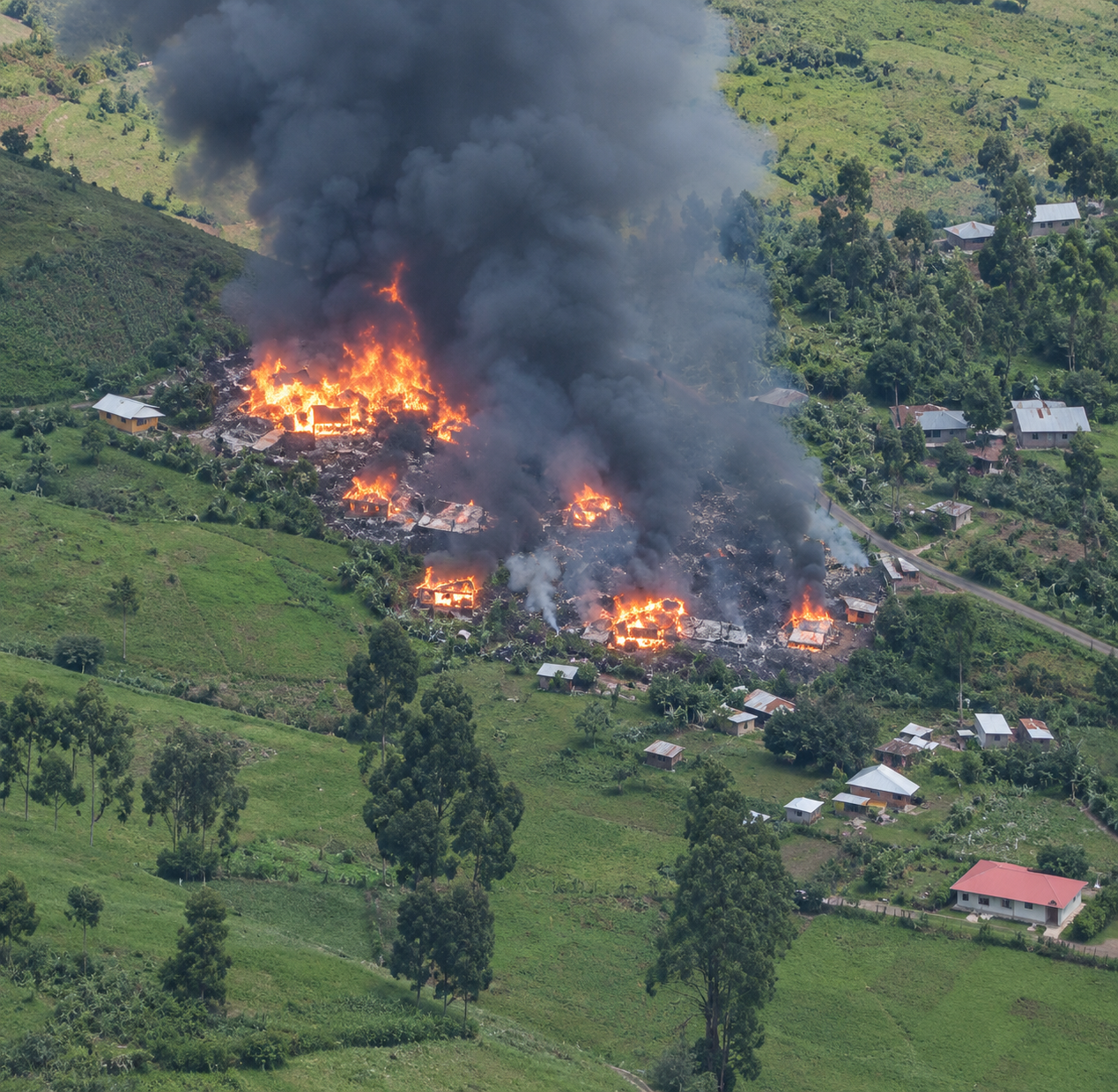
For three days starting October 2, 2023, the FDLR militia attacked Nturo village in Masisi, eastern DR Congo. Following the withdrawal of M23 rebels, the militia burned down over 300 homes belonging to the local Congolese Tutsi community.
For more than two decades, the United Nations has maintained a major peacekeeping presence in the eastern Democratic Republic of Congo (DRC), first through MONUC and, since 2010, through MONUSCO.
Yet a fundamental question remains: has the international community given sufficient attention to the security of Congolese Tutsi communities that have repeatedly faced violence, displacement and discrimination?
MONUC was established in 1999 following the Lusaka Ceasefire Agreement and was subsequently given increasingly extensive responsibilities. In 2010, it became MONUSCO, with a mandate that explicitly included protecting civilians under imminent threat of physical violence.
Yet despite serious reports by UN bodies documenting attacks affecting Banyamulenge and other Congolese Tutsi communities, the pattern of violence has persisted.
UN reports have documented civilians being killed, villages destroyed or burned, populations forcibly displaced, and the spread of sustained hate speech and incitement. Since 2017, more than 650 villages have reportedly been destroyed or burned.
The problem, therefore, is not the absence of a formal mandate. It is whether that mandate has been enforced at all.
The history of Congolese Tutsi communities, including the Banyamulenge, demonstrates that their vulnerability is not a recent development. UN documentation has recorded decades of discrimination, disputes over citizenship and identity, property seizures, threats and attacks against Tutsi communities in eastern DRC.
This history matters because security cannot be understood solely through the activities of armed groups. It also requires examining the political and social conditions that make particular communities vulnerable.
The international response has often been framed primarily around defeating armed groups and preserving the territorial integrity of the DRC.
Yet this approach overlooks a fundamental question: what happens when members of a particular community believe that neither the state nor international institutions can guarantee their physical security, citizenship or equal protection under the law?
The UN itself has acknowledged the dangers of ethnic violence. In 2022, the UN High Commissioner for Human Rights and the UN Special Adviser on the Prevention of Genocide, Alice Wairimu Nderitu warned about escalating hate speech and incitement to discrimination, hostility and violence, particularly against Kinyarwanda-speakers, amid rising tensions surrounding the M23 rebellion.
There is also a wider refugee dimension. UNHCR reported that more than 883,000 Congolese refugees and asylum seekers were collectively hosted by Uganda, Burundi, Rwanda, Zambia and Tanzania at the end of 2024.
While the Congolese displacement crisis affects communities across the country, the continued exile of Congolese Tutsi populations raises a broader question about the failure to establish durable security conditions that would allow refugees to return safely.
The treatment of Banyamulenge refugees illustrates the stakes. In 2025, UN human rights documentation raised concerns about reported discrimination affecting Banyamulenge in the DRC.
It also recalled the 2004 Gatumba refugee camp massacre, in which more than 150 civilians, mostly Banyamulenge, were killed. The unresolved nature of such episodes underscores the long-term consequences of impunity.
If the Security Council wants sustainable peace in eastern DRC, it cannot treat ethnicity, citizenship and, more broadly, identity-related grievances as secondary issues.
Protecting Congolese Tutsi civilians should not depend on whether their security concerns happen to align with the interests of Kinshasa, AFC/M23 or any other political actor.
The central test for the international community is therefore straightforward: can it protect every Congolese community equally, including those whose security concerns are politically uncomfortable or contested by the state?
Until that question is confronted honestly, two decades of UN peacekeeping will continue to produce a cycle in which violence is repeatedly managed without addressing the underlying grievances that allow it to return.
Sustainable peace will require more than military deployments and diplomatic declarations.
It will require equal protection, accountability, and credible guarantees of security and citizenship for every community in eastern DRC.
