



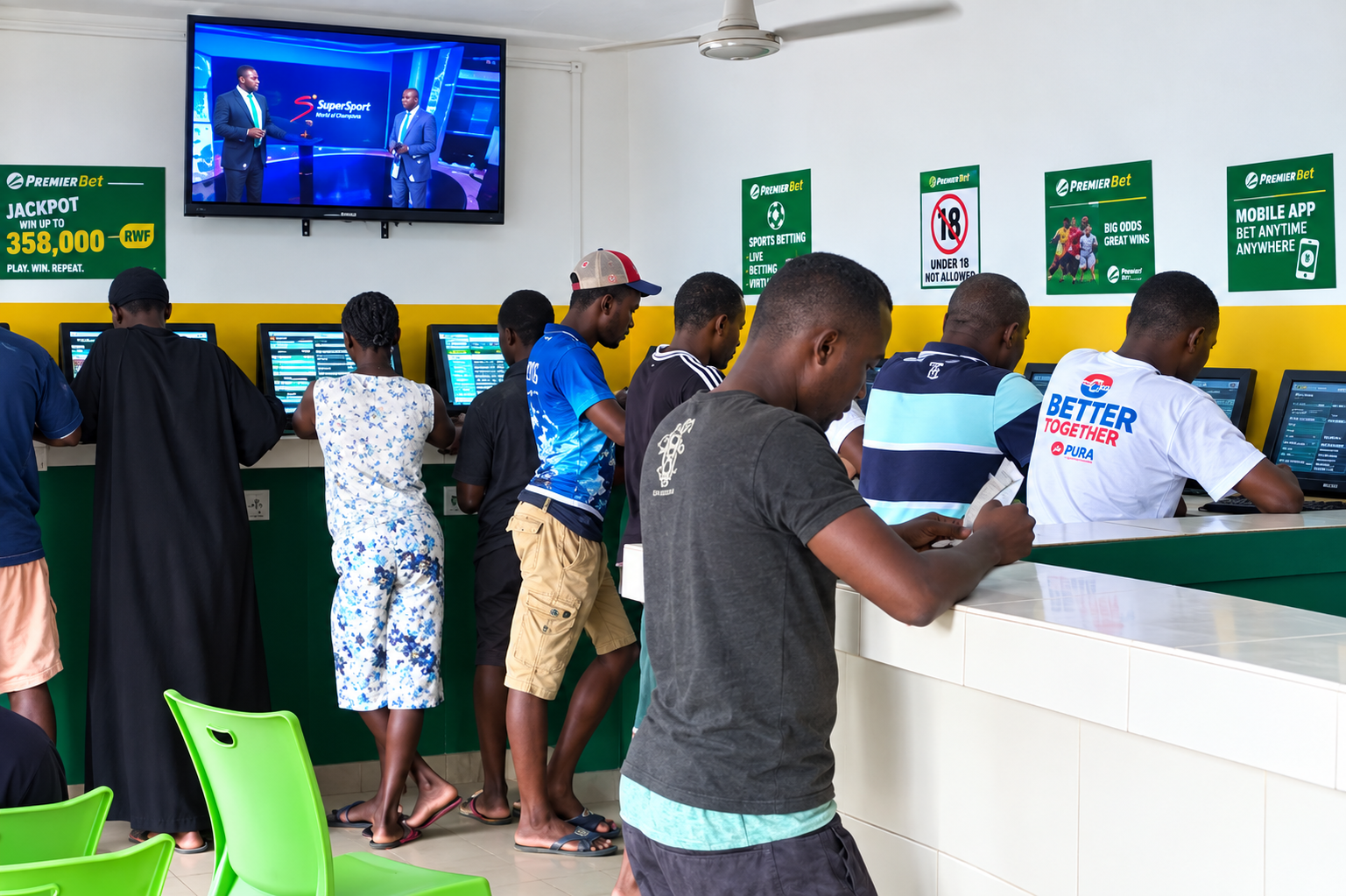
Rwanda has spent the past two years tightening the rules around betting and gambling.
Taxes have been raised sharply. Licensing has become more selective. Unlicensed betting machines have been seized and destroyed. Some betting shops have been closed.
Yet urusimbi, the Kinyarwanda term commonly used for betting and gambling, remains a social problem.
The government now appears ready to take further action.
On October 2, 2026, Prime Minister Dr. Justin Nsengiyumva told Parliament that the government would strengthen measures against gambling and betting.
His remarks followed concerns raised by Senator Charles Murigande, who said urusimbi is impoverishing Rwandans and affecting families.
Murigande said the problem was not limited to people with little income. He pointed to working parents who, despite having jobs, struggle to pay school fees because money is being spent on betting.
He also linked betting to family breakdown.
The senator compared the situation with the government’s efforts against illicit alcohol, suggesting that urusimbi requires a similarly forceful response.
Nsengiyumva acknowledged that the government is aware of the problem.
He said authorities have already taken some measures, including closing betting shops, but these actions have not eliminated the problem.
The government, he said, would examine what more could be done.
That admission is significant.
It suggests that Rwanda’s increasingly strict regulatory approach has not yet achieved its broader objective of reducing the social harm associated with betting.
A tougher regulatory regime
The latest political discussion comes after a major restructuring of gambling regulation.
In 2024, the Rwanda Development Board took over responsibility for gambling oversight and introduced a National Gambling Policy.
The policy was designed around three broad objectives: reducing social harm, increasing government revenue and strengthening control of the industry.
Licensing of gambling operators was temporarily paused while the regulatory framework was being rebuilt. Licensing resumed in 2025 under the new system.
At the same time, the cost of operating a betting business increased substantially.
The tax on operators’ gross gaming revenue was increased from 13% to 40%.
The withholding tax on betting winnings was also increased, from 15% to 25%.
The measures were presented partly as a way of discouraging excessive gambling while also increasing tax revenues from the industry.
But the higher taxes also raised concerns among lawmakers and industry observers.
Some Members of Parliament warned that excessively high taxes could have the opposite effect, pushing gamblers and operators towards unlicensed platforms or betting services outside Rwanda.
That creates one of the central difficulties for policymakers.
The more expensive and restrictive the legal market becomes, the greater the incentive can be for some players to look for alternatives outside the regulated system.
Taking gambling off the streets
The government has also moved against physical gambling machines.
Unlicensed slot machines, commonly known as ibiryabarezi, have been a particular target.
In September 2025, authorities announced plans to dismantle and recycle more than 7,000 unlicensed machines.
About 1,000 machines operated by foreign companies were also given until December 2025 to leave the market.
Under the new regulatory framework, slot machines are expected to operate inside licensed casinos rather than being scattered through ordinary commercial spaces.
The policy is aimed at reducing easy access to gambling, particularly in neighbourhoods where betting machines can be found close to homes, shops and other places used by young people.
But the crackdown on physical machines has not removed betting from society.
Instead, much of the activity has moved into an environment that is harder to see.
Betting has gone digital
The modern betting industry is no longer dependent on a betting shop or a machine on a street corner.
A person can place a bet from a mobile phone.
This changes the nature of the problem.
Closing a shop can remove a physical betting point. Seizing a machine can eliminate one source of gambling.
But a smartphone can put a betting platform in a person’s pocket throughout the day.
The issue therefore extends beyond licensing premises.
It involves how easily people can access betting, how frequently they are exposed to betting advertisements and how much money they are prepared to spend in pursuit of winnings.
This also makes enforcement more complicated.
The government can regulate licensed operators inside Rwanda. But online betting can potentially involve offshore platforms and other services that are more difficult to control.
This is one reason why higher taxes and tougher licensing alone may not solve the social problem.
Selective licensing
Rwanda has also become more selective about which gambling businesses are allowed to operate.
In July 2026, Betway, ElephantBet and ForteBet received new licences covering sports betting, with some also receiving casino-related permissions.
But licensing has not meant that operators can freely expand into other forms of gambling.
Days after receiving the new licences, Rwanda Development Board suspended Baron Sports Gaming, which operates under the name Forzza, after finding that it was offering casino-style games outside the scope of its sports-betting licence.
The company was also ordered to remove related advertising.
Earlier, Premier Bet’s licence was not renewed in 2024.
The message is increasingly clear: being allowed to operate one form of gambling does not automatically give an operator permission to offer another.
But regulation is not the same as prevention
This is where Rwanda’s betting problem becomes more complicated.
The government can increase taxes.
It can make licences more difficult to obtain.
It can close shops.
It can remove machines.
It can punish operators that breach their licences.
But none of these measures necessarily answers the question of why people continue to gamble.
For some, betting is entertainment.
For others, it has become a regular source of financial risk.
The attraction is simple: a relatively small amount of money can appear to offer the possibility of a much larger return.
For people under financial pressure, that promise can be particularly powerful.
The danger comes when betting stops being entertainment and becomes a perceived solution to financial problems.
A person who loses money may respond by betting again in an attempt to recover the loss.
Another loss can lead to another bet.
That cycle can turn relatively small amounts into significant financial damage.
And the consequences do not necessarily end with the individual gambler.
They can reach spouses, children and other members of the household.
This is the concern now being raised at the highest levels of government.
The bigger question
Rwanda’s experience raises a question that goes beyond taxation and licensing.
Can regulation reduce the social harm of betting if demand for gambling remains strong?
The evidence from the government’s own recent actions suggests that regulation has contained some parts of the industry, but has not eliminated the underlying problem.
The government has already described the need to discourage harmful gambling.
Yet betting remains sufficiently widespread for Parliament to raise concerns about parents struggling to pay school fees and families being damaged by gambling.
That means the next phase may have to look beyond the gambling companies themselves.
It could involve stronger consumer protection, restrictions on advertising, greater attention to young people’s exposure to betting, tighter monitoring of online gambling and better public education about gambling losses.
It could also require better data on the scale of gambling-related financial and social harm.
The government now faces a difficult balance.
It wants to collect revenue from a legal industry while reducing the harm that industry can cause.
It wants to keep gambling within a regulated framework without encouraging an underground market.
And it wants to protect families without necessarily banning an activity that remains legal under certain conditions.
For now, Rwanda has not announced a nationwide ban on licensed betting.
Instead, the direction is towards tighter control.
But Prime Minister Nsengiyumva’s statement suggests that the government itself recognises that the measures already taken have not been enough.
The taxes are higher.
The rules are tougher.
The machines are being removed.
Licences are being scrutinised.
Some shops have been closed.
Yet urusimbi remains.
And increasingly, the debate is no longer simply about how to regulate Rwanda’s betting industry.
It is about how to prevent gambling from becoming a deeper societal crisis.
