


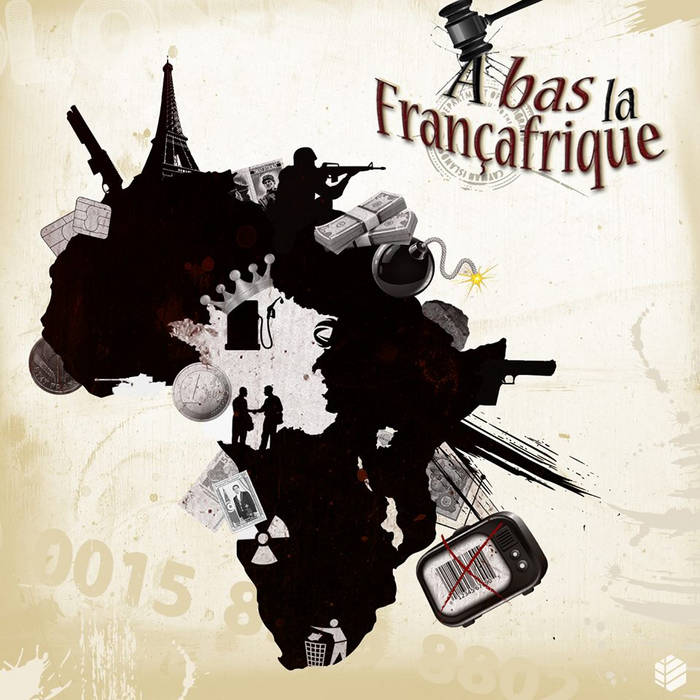
Artwork for “France Afrique” by Skalpel and Ken Kiz, produced by Destru. Released in 2013 on the compilation À Bas La Françafrique, the militant rap track belongs to a protest project against France’s lingering political and economic influence in Africa. Rwanda cannot be party to this chaotic and arrogant posturing
In Rwanda, dignity is not a word of convenience, much less a formula reserved for official speeches. It has a name: Agaciro. And behind that word lies a political philosophy that President Paul Kagame has never ceased to remind Rwandans of: no one is going to grant them their dignity. It cannot be secured through the favour of the powerful, the generosity of donors or the approval of foreign capitals. It is built through self-respect, collective responsibility and the determination to take charge of one’s own destiny.
Agaciro begins with refusing to make one’s difficulties someone else’s responsibility. It means not waiting for an external power to prescribe solutions, set priorities or decide one’s future on one’s behalf. Assistance can support a country; it cannot substitute for its own will. A partnership can be invaluable; it gives no one the right to dictate another country’s choices or dispose of its sovereignty.
This understanding extends beyond Rwanda’s borders. It poses a fundamental question for Africa as a whole: what is the point of independence if the most consequential decisions remain subject to the judgement, preferences or dictates of those who, until not so long ago, administered the continent?
Julius Nyerere was already denouncing this in 1978: “The habit of regarding Africa as an appendage of Western Europe has not yet been broken.” Nearly half a century later, that habit has not entirely disappeared. It has simply learned to speak the language of cooperation.
Rwanda’s position in Phnom Penh was about more than preserving Louise Mushikiwabo’s place at the helm of the OIF. It was about defending Agaciro in its fullest sense, not only for Rwanda but for Africa as a whole. Refusing to let the destiny of a multilateral Francophone institution be dictated by unilateral calculations is a rejection of political tutelage in all its forms.
This demand is hardly new. Louise Mushikiwabo had already embodied it with remarkable clarity in November 2014, when she openly expressed her indignation at François Hollande’s attitude during his visit to Dakar, where he had come to “tell Africans” what they should do.
“When he says, ‘I have come to Dakar to tell Africans’, I find that unacceptable! We are in 2014!” she declared.
Her words condemned the imperious reflex through which France presumed to reserve for itself the right to exercise a veto and dictate terms to Africa. Upon taking the helm of the OIF, her broader mission was precisely to sever that umbilical cord to another age.
It was in this spirit that, in 2022, Mushikiwabo oversaw institutional reforms designed to establish consensus while preserving the option of a vote whenever consensus proved impossible, a democratic safeguard that some, Emmanuel Macron among them, subsequently sought to trample upon.
It is precisely within this historical context that Emmanuel Macron’s gamble in Phnom Penh must be understood. By intervening in the process of selecting the head of the OIF, the French president appeared to be betting on an old political mechanism: that African leaders would eventually fall into line with decisions made in Paris. He seems to have misjudged the people he was dealing with.
Yet Macron had already been given an opportunity to understand President Kagame. In May 2021, in Kigali, the Rwandan president acknowledged him as a leader who listens and is prepared to support Africa on the basis of choices made by Africans themselves. Kagame stressed that the progress achieved between the two countries had been made possible by the good faith of both parties.
Kagame’s words were no passing diplomatic compliment. They were a statement of the conditions on which a lasting relationship must be built.
Trust cannot be decreed, and cooperation does not make one partner superior to the other. Kagame had previously made this point unmistakably clear in Le Monde on 17 May 2021: “France, like other former colonial powers, must adopt a different approach to its relationship with Africa and create a different environment. What is needed is a partnership, not the supervision of an inferior member.”
This is also the meaning of Olivier Nduhungirehe’s declaration: “The OIF is not Françafrique!” An organisation bringing together sovereign states cannot be treated as an extension of any one country’s foreign policy or sphere of influence.
In Phnom Penh, the 37 countries were adamant that they would vote for Mushikiwabo if given the opportunity. They ultimately endorsed a one-year transitional compromise, not Mushikiwabo’s removal. That distinction matters: it makes clear that the process did not produce the outcome some had sought to impose.
In any case, the standoff served as a reminder that Agaciro does not mean Africa should turn its back on the world, nor does it mean rejecting partnerships. It means entering into them as a free and self-determining actor, not as a docile recipient of decisions made elsewhere. It is a demand for dignity; this is what some have yet to understand that, the continent does not need to change its guardian. It simply needs to stop looking for one.
