




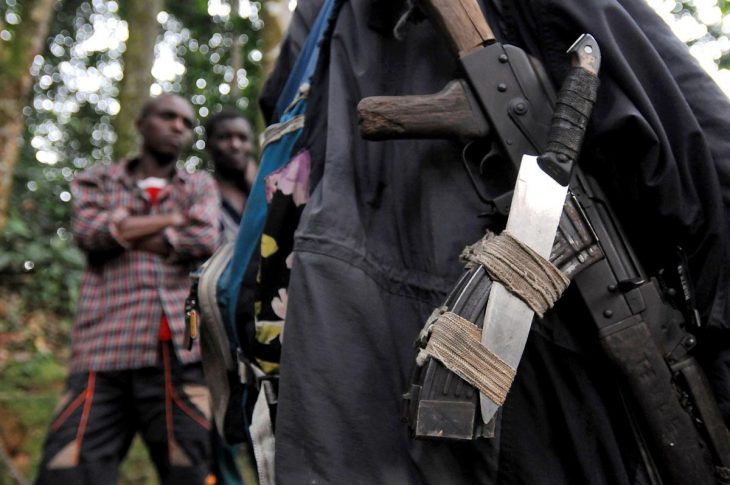
These are FDLR militia in one of their hideouts in DR Congo’s jungles. We have never seen any reporting that clearly describes them as “Congolese-backed” despite all the evidence available
Human life without words is unimaginable, rarely however, have words been burdened with more expectation than the recent adoption of the description for the AFC/M23 (Congo River Alliance) rebel movement. Seemingly out of no where, suddenly news organisations no longer referred to AFC-M23. Instead, as though acting on automated instructions, they ostentatiously parrot “Rwanda-Backed M23,” at every mention of the rebel group. But by whom are they programmed and why?
We can almost trace the moment when has become a concerted effort to tie the rebel movement to Rwanda began. The Democratic Republic of Congo (DRC)’s politicians and their supporters, of course, long ago made what seemed a strategic decision not to acknowledge the very existence of M23, variously calling the group terrorists, Rwandans or both.
It is a position rendered ludicrous by the fact that as now, the DRC is in negotiations with the rebel alliance albeit mediated by a third party, the state of Qatar. Indeed, the very name M23, or March the 23rd Movement, is derived from an earlier agreement signed on 23rd March 2009, between the Congolese government and the National Congress for the Defence of the People (CNDP), which would become M23. The group relaunched their armed struggle as M23, because, it asserted, with ample justification that the Congolese government had reneged on implementation of the March 23rd agreements.
And where the government in Kinshasa faces so does its Western supporters, whether in media, political or diplomatic circles.
It would not be long before France began echoing Kinshasa and insisting that M23 was “Rwanda backed.” The claim was first made through Radio France Internationale (RFI), by French foreign ministry spokesperson, Anne-Claire Legendre. French media then took up their government’s narrative as though it were indisputable fact. In 2024, at a press conference with DRC president Felix Tshisekedi, France’s Emmanuel Macron, reiterated the claim that Rwanda was behind M23.
Belgium went even further than France, calling for sanctions against Rwanda, recommending to the DRC government that it file a complaint against Rwanda with the ICJ (International Court of Justice). Belgium’s tireless anti Rwanda campaign has been so sustained and extensive, it would require several articles all of its own.
The campaign’s narrative is noticeably designed to be favourable to Felix Tshisekedi’s government in Kinshasa. France and Belgium’s diplomatic efforts on his behalf reached fever pitch in January of this year, with M23’s capture of the city of Goma.
Using its position as a permanent member of the United Nations Security Council (UNSC), France tabled a motion that Rwanda should be singled out and condemned for its alleged support of M23. “We should call a cat a cat” declared Ambassador Nicholas de Riviere for France.
The Ambassador did not get the exact wording he had sought, but from then on, the term “Rwanda-Backed M23,” would become the required form to describe the rebel group, in all Western newsrooms. The words are applied almost religiously, as though M23 would not exist but for Rwanda. And that of course, is one of the messages the term is intended to convey.
But much more is expected of the words “Rwanda-Backed.” The word is one weapon in an armoury of incidious intent to cleave the crisis from its root causes.
Rather than look at the underlying reasons for the conflict, a convenient claim to serve as a distraction, is that Rwanda wants to “loot Congo’s minerals.”
Rather than look at Congo’s decades’ old persecution of its Kinyarwanda-Speaking community, which led their taking up arms in protection of their families, the term diverts all to think of “Rwanda looting minerals.”
Think of “Rwanda looting minerals,” especially every time some poor unfortunate soul is set upon by government supporters, beaten into semi-consciousness, burned alive and cannibalized, for the crime of being Tutsi. Burned alive and cannibalized. It is worth repeating if only to protect the mind from normalising the unimaginable horror, as have the perpetrators and all those who shill for them.
When the grotesquely named “Democratic Forces for the Liberation of Rwanda” (FDLR), in reality an armed group formed by the planners and perpetrators of the 1994 Genocide Against Tutsi, launch their regular incursions into Rwanda, from the DRC, flag up the claim of “Rwanda looting minerals,” to explain Rwanda’s defensive measures against the attacks, a number of which have been deadly.
Perhaps one of the most disquieting aspects of the use of a term that is clearly intended to mislead, is that the media has simply adopted it without question. It is yet further evidence that to be reliably informed about the DRC crisis, as on many other African issues, it is best to question any and all information that comes through mainstream media outlets.
In particular, any appearance of the words “Rwanda-Backed M23,” should trigger the question of what that story story is attempting to conceal, be an alert to the viewer, reader or listener, that they are being misdirected away from the true causes of the DRC crisis. It is instructive that anti Rwanda voices have already begun to scornfully dismiss Rwanda’s consistent call for the world to address the root causes of that crisis.
