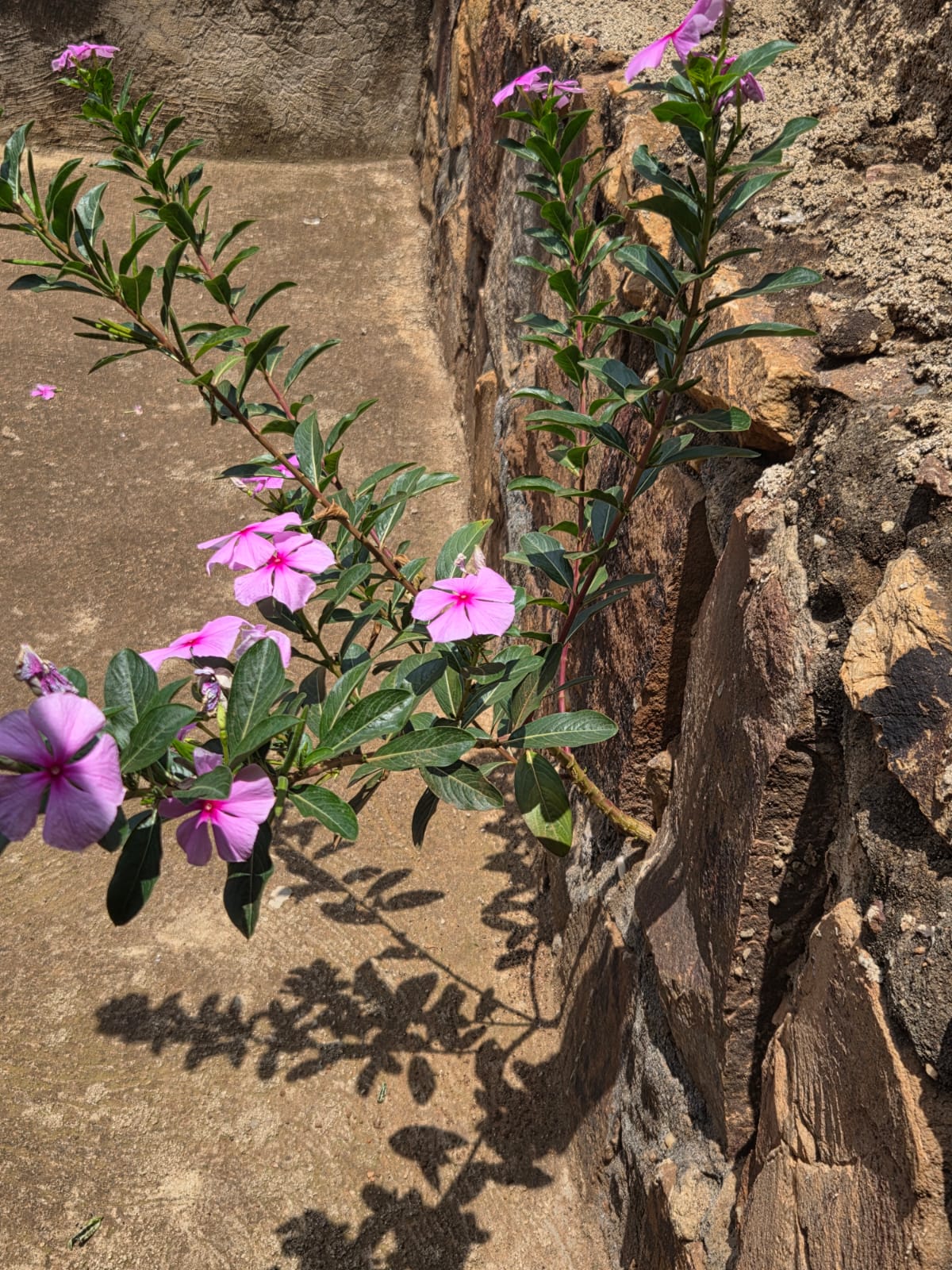
Imagine a flower growing out of concrete and stone
This past weekend, I visited a relative in Gikondo – a Kigali city suburb, with my family. We often spend weekends with relatives, cherishing quality family time and reinforcing the bond that holds us together.
Yet, what caught my attention that day was not the conversations, not the meal we shared, and not even the children’s playful laughter. It was something small, fragile-looking, and yet profoundly inspiring: a flower.
As I walked around the compound, my eyes landed on this beautiful flower swaying in the breeze. It had striking purple leaves and looked vibrantly healthy, almost as if it was dancing with life.
But what fascinated me most was not its beauty—it was where it was growing. The flower had forced its way up between rough concrete and heavy stones that made up the fence. There was no fertile soil, no obvious source of water, and certainly no tender gardener’s hand to care for it.
Yet, against all odds, the flower had not only survived but thrived.
At some point, our children, who were equally amazed by its charm, tried to pick its purple leaves. Their innocent curiosity saw only a plaything, something to touch and carry away. But I quickly stopped them, asking that we leave the flower untouched—at least for that Sunday evening moment.
Deep inside, I felt a strong urge to protect it, not just because it was beautiful, but because it deserved to keep living and teaching us its silent lesson of resilience.
In that moment, I felt like the flower was speaking directly to me. It was teaching me about resilience, strength, and the paradox of fragility.
Something so delicate-looking could endure the harshest of conditions and still bloom. It reminded me of Rwanda itself.
And a day later, on Monday this week, to be precise, President Paul Kagame delivered a powerful message to over 6,000 officers of the Rwanda Defence Forces (RDF), the Rwanda National Police (RNP), and the Rwanda Correctional Services (RCS) who had completed military career courses at Gabiro Military Barracks.
Kagame’s message, though focused on national security, echoed the very lesson I was seeing in that flower.
The President reminded the officers—and by extension, all Rwandans—that survival in a hostile environment requires resilience, vigilance, and readiness for tough times. Rwanda, he said, is surrounded by neighbors that are not always friendly, and constantly faced with geopolitical challenges. To survive and thrive, Rwandans must always be prepared, just like that flower clinging to life between concrete and stones.
A flower between stones and a nation among enemies
At first glance, the flower on my relative’s fence and Rwanda’s geopolitical struggles might seem like two completely unrelated stories. But if you look deeper, the symbolism is striking.
The flower grew in a place where it was not supposed to grow. There was no soft soil to nourish its roots. The stones around it were heavy, the concrete unforgiving. Yet, it found a tiny crack, a little space to push through, and from that small chance, it built its life.
In the same way, Rwanda is a small country, with no access to the sea, limited resources, and a tragic history that nearly wiped it off the map three decades ago. The genocide against the Tutsi in 1994 left the country shattered, much like a flower trampled underfoot.
The enemies of Rwanda expected it to remain buried under concrete—broken, divided, and lifeless. But, against all odds, Rwanda pushed through. It found cracks of opportunity where others saw impossibility. And from those cracks, it has grown into a nation admired for its order, security, and resilience.
Kagame’s call for readiness
In his Gabiro message, Kagame was not exaggerating Rwanda’s challenges. He was issuing a sober reminder: survival requires constant readiness. He told the officers that Rwanda must expect enemies at any time and from any direction. That is not distrust; it is reality.
Being landlocked, Rwanda depends heavily on its neighbors for access to international trade routes. But those same neighbors sometimes use this geographical vulnerability to exert pressure or even threaten Rwanda.
Add to that the regional instability—from conflict in eastern DRC to unpredictable politics in other parts of the Great Lakes region—and it becomes clear why Rwanda cannot afford to be complacent.
Just like the flower must constantly endure the pressure of stones pressing against its roots, Rwanda must live with the weight of being surrounded by uncertainty and hostility. But Kagame’s message was that we cannot simply endure—we must thrive. That is why he told the officers to remain vigilant, disciplined, and committed, because the survival and progress of the nation depends on such resilience.
Lessons from the Flower
Looking again at the flower, I could see three lessons that connect directly to Kagame’s message and to Rwanda’s story.
Growth requires persistence – the flower did not choose where it was planted. Life forced it into a crack between stones. But it did not give up. It persisted until it broke through. For Rwanda, history handed down a similarly tough environment. Genocide against the Tutsi, hostility from neighbors, and geographical disadvantage were the stones and concrete. Yet, Rwanda persisted. It chose life over despair, progress over stagnation, unity over division.
Beauty can emerge from hardship – what made the flower so striking was not only its resilience but also its beauty. It was not merely surviving—it was thriving, spreading its purple leaves proudly. Rwanda’s story mirrors this. From the ashes of genocide, the country has rebuilt itself into one of Africa’s most admired nations. Its cities are clean, its systems orderly, and its people increasingly united. It is proof that beauty can rise from the harshest of conditions.
Fragility is not weakness – the flower looks fragile. A child could pluck it in seconds. The wind could bend its stem. Yet, its fragility does not mean weakness—it means adaptability. Fragility forces it to be flexible, to bend rather than break, to adjust rather than perish. Rwanda, too, may seem small and fragile compared to its larger neighbors, but its adaptability has been its greatest strength. By relying on innovation, good governance, and discipline, Rwanda has been able to turn its vulnerabilities into strengths.
A collective duty
But Kagame’s message was not just for the military officers. It was for every Rwandan. Just like the flower’s survival depends on its determination to push against stones, Rwanda’s survival depends on the determination of its people to remain resilient. Security is not just the job of the army or the police—it is a collective duty.
Every Rwandan has a role to play: parents raising disciplined children, teachers instilling values, farmers working hard to feed the nation, entrepreneurs finding ways to innovate, and leaders making wise decisions.
When Kagame calls for readiness, he is not only speaking about guns and uniforms. He is speaking about mental readiness, economic readiness, and moral readiness.
And perhaps this is why I instinctively stopped my children from plucking that flower’s leaves. In that simple act of protection, I was reminded that resilience needs guardianship. Just as I wanted my children to leave the flower intact so that it could keep blooming, every Rwandan has a responsibility to safeguard the progress our country has made.
The danger of forgetting
There is, however, a danger we must guard against: forgetting how fragile our progress is. If the flower were to stop adapting, stop pushing its roots deeper, it would wither quickly under the weight of the stones. In the same way, if Rwandans were to become complacent, divided, or careless, the progress we have made could easily be lost.
Enemies of Rwanda do not rest. Some want to distort our history. Others want to destabilize our borders. Still, others want to exploit our geographical vulnerabilities. Kagame’s reminder is clear: we must always expect challenges, and the best way to face them is to remain prepared.
A nation’s flower
In many ways, Rwanda itself is that flower on the fence in Gikondo. Small but striking, fragile-looking yet strong, planted in tough conditions but determined to bloom. Its story inspires not only Rwandans but also the world. For those who visit Kigali today, the transformation is almost unbelievable. But for those who lived through the dark days, the lesson is clear: resilience is not a choice—it is survival.
Kagame’s leadership has been about nurturing that spirit of resilience. He knows the stones are still pressing, the concrete is still hard, and the winds are still strong. But he also knows that if Rwanda holds on to its discipline, unity, and vigilance, the flower will continue to bloom.
Choosing to bloom
As my family and I left our relative’s home that day, I looked once more at the flower. I realized that what it represented was more than just survival—it was the choice to bloom where life plants you, no matter how harsh the environment.
That is Rwanda’s story. That is Kagame’s message. And that is the lesson for every Rwandan: to bloom, to thrive, to stand tall and beautiful, even when the world expects you to wither.
We are that flower. And as long as we remain resilient, adaptable, and united, no stone, no concrete, no enemy, will stop us from blooming.
The Writer is the Editor-in-chief of Kigali Today Ltd, the parent company of KT Radio 96.7FM (plus for 4 other provincial channels), KT Press and KigaliToday.com