



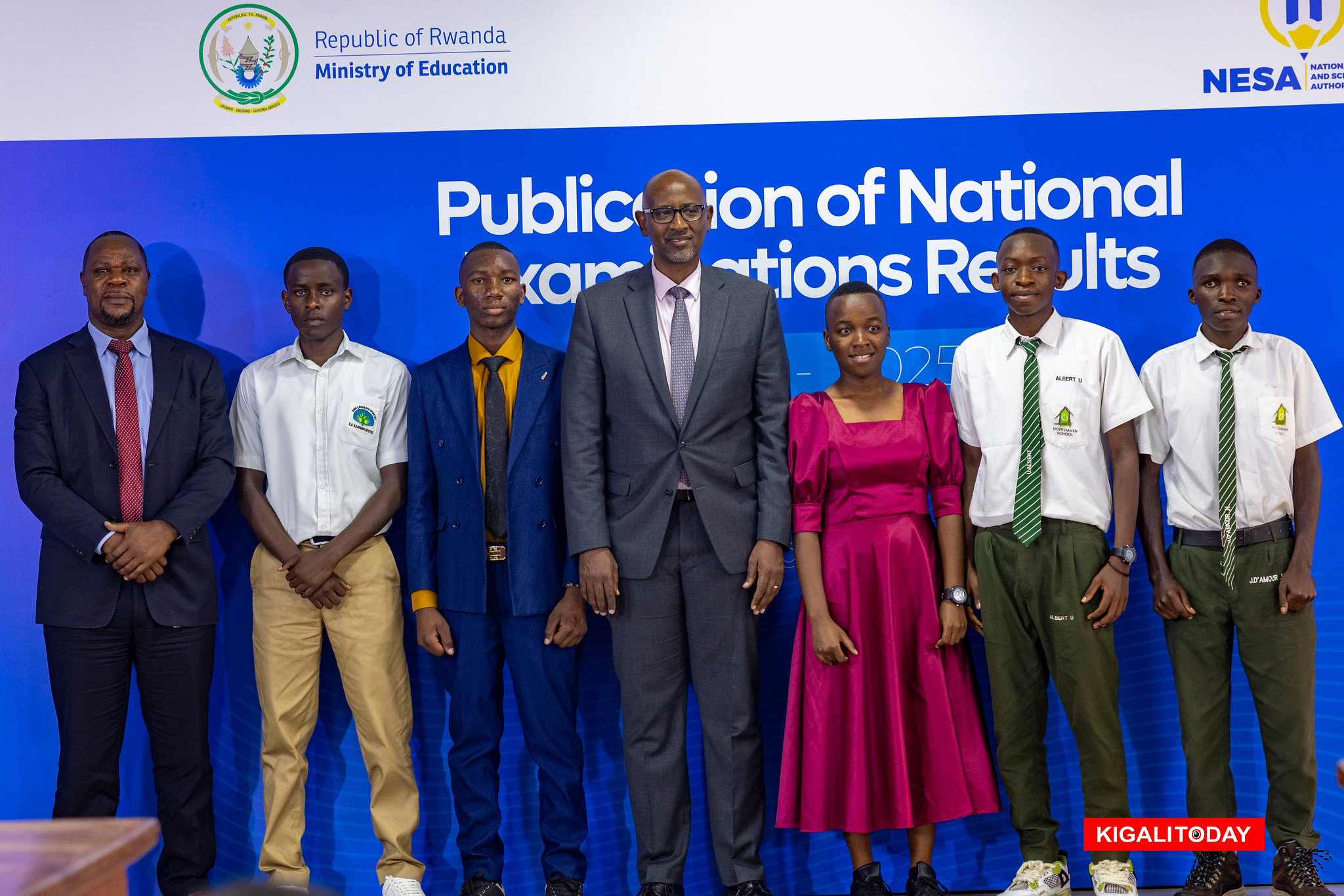
Education Minister Joseph Nsengimana (Center) and Dr. Bernard Bahati, the Director General of the National Examination and School Inspection Authority (NESA) pose for a photo with the best students from PLE and O’Level 2024-25
Kigali, Rwanda — Mathematics and Physics have emerged as the lowest-performing subjects in Rwanda’s schools, with fewer than three in ten learners passing them at both primary and lower secondary levels, according to the 2024/25 national examination results released Tuesday.
Only 27% of primary pupils (PLE) passed Mathematics, while just 27.55% of learners in lower secondary (O’Level) managed to pass Physics, figures the Ministry of Education described as “alarming” and requiring urgent intervention. This means those who managed to get the 50% and above marks.
“These are not encouraging numbers,” said Education Minister Joseph Nsengimana. “That is why in the new capacity-building program, we will put strong emphasis on Mathematics. Physics, too, is trending at similar levels, and it shows us clearly where our focus must be.”
The Minister noted a continuing performance gap between public and private schools. Private schools still record higher pass rates, but he emphasized that government initiatives are beginning to close the gap. “Public schools are improving, but we must accelerate this progress to ensure every learner, regardless of where they study, has equal opportunity to succeed,” he said.
STEM at the Heart of Policy
The government has recently prioritized Science, Technology, Engineering, and Mathematics (STEM) as central to Rwanda’s development agenda. Under current policy, students who excel in STEM subjects are given priority when competing for government-sponsored scholarships at universities.
This preference is designed to strengthen the pipeline of scientists, engineers, and innovators needed to drive Rwanda’s economy.
At the university level, policy gives clear preference to STEM fields: 75% of new admissions at the University of Rwanda are STEM students, with a target of 90%. In the 2022/23 academic year, all 4,430 STEM applicants received government scholarships, compared to limited funding for non-STEM disciplines.
“Even if a student specializes in languages, they will still study Mathematics. For sciences, the demand is even greater. The future workforce must have strong STEM skills,” Nsengimana explained.
The capacity-building program, launched earlier this year, is being expanded nationwide in the new academic year. It will train teachers, revise curricula, and provide more resources for public schools in particular.
Officials from the Ministry of Education, the Rwanda Education Board (REB), the National Examination and School Inspection Authority (NESA), and the Rwanda Technical and Vocational Education Board (RTB) will jointly oversee implementation.
“We want to see the pass rates in Mathematics and Physics increase significantly in the coming years,” Nsengimana said. “This is about more than grades; it is about equipping our children with the skills they need for Rwanda’s future.”
On the other hand, however, subjects like Kinyarwanda, geography, social and religious studies, are attracting commendable performance.
See full details below –
PLE Level (P6) Performance by Subject
| Subject | Pass Rate |
|---|---|
| Kinyarwanda | 98% |
| Social & Religious Studies | 75% |
| English | 72% |
| Science & Elementary Technology | 71% |
| Mathematics | 27% |
O’Level (S3) Performance by Subject
| Subject | Pass Rate |
|---|---|
| Kinyarwanda | 90.57% |
| Geography & Environment | 83.03% |
| Entrepreneurship | 72.77% |
| History & Citizenship | 62.73% |
| English | 54.85% |
| Chemistry | 52.84% |
| Biology | 44.75% |
| Mathematics | 43.89% |
| Physics | 27.55% |
