





New Electricity Tariff Structure
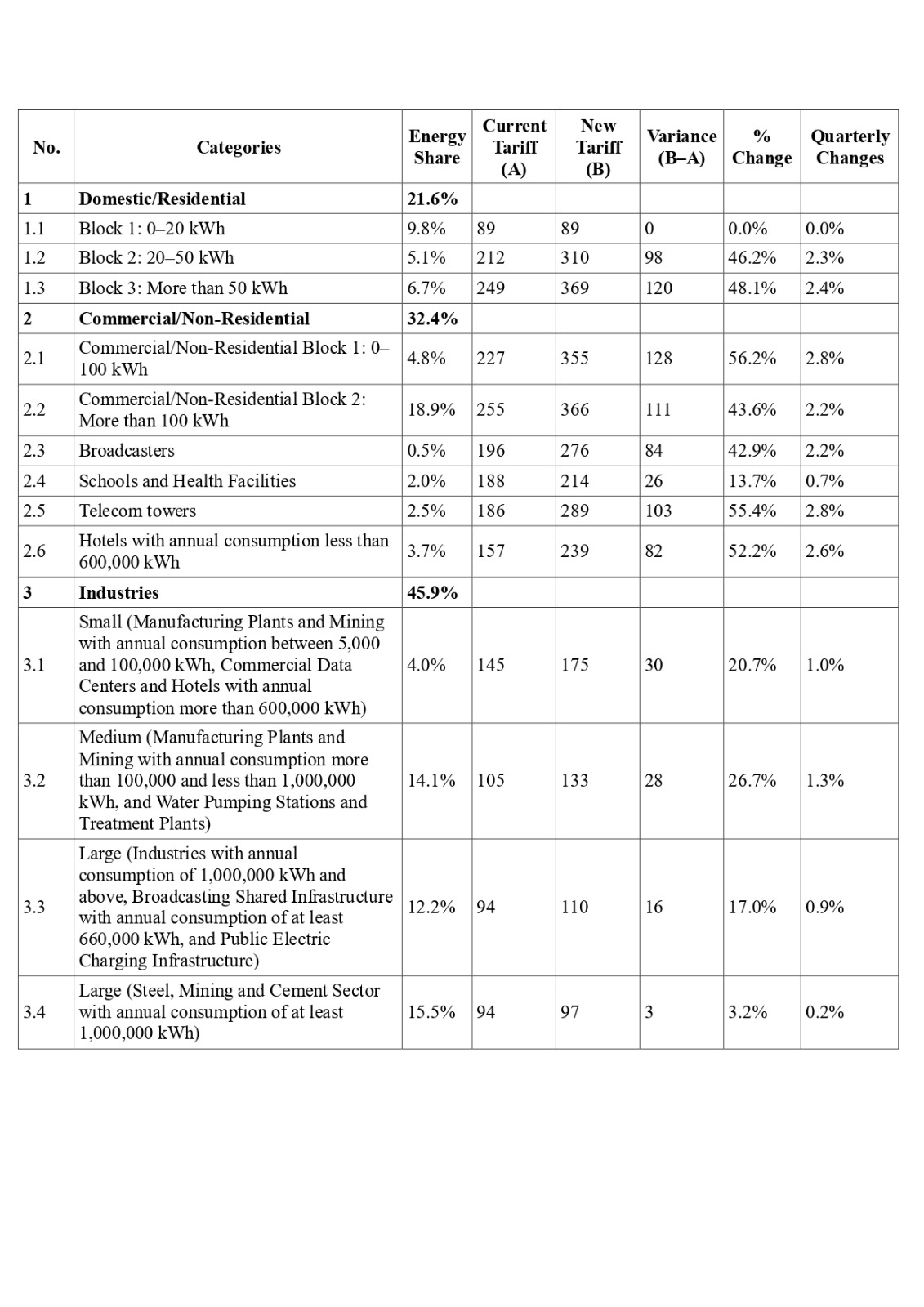
| No. | Categories | Energy Share | Current Tariff (A) | New Tariff (B) | Variance (B–A) | % Change | Quarterly Changes |
|---|---|---|---|---|---|---|---|
| 1 | Domestic/Residential | 21.6% | |||||
| 1.1 | Block 1: 0–20 kWh | 9.8% | 89 | 89 | 0 | 0.0% | 0.0% |
| 1.2 | Block 2: 20–50 kWh | 5.1% | 212 | 310 | 98 | 46.2% | 2.3% |
| 1.3 | Block 3: More than 50 kWh | 6.7% | 249 | 369 | 120 | 48.1% | 2.4% |
| 2 | Commercial/Non-Residential | 32.4% | |||||
| 2.1 | Commercial/Non-Residential Block 1: 0–100 kWh | 4.8% | 227 | 355 | 128 | 56.2% | 2.8% |
| 2.2 | Commercial/Non-Residential Block 2: More than 100 kWh | 18.9% | 255 | 366 | 111 | 43.6% | 2.2% |
| 2.3 | Broadcasters | 0.5% | 196 | 276 | 84 | 42.9% | 2.2% |
| 2.4 | Schools and Health Facilities | 2.0% | 188 | 214 | 26 | 13.7% | 0.7% |
| 2.5 | Telecom towers | 2.5% | 186 | 289 | 103 | 55.4% | 2.8% |
| 2.6 | Hotels with annual consumption less than 600,000 kWh | 3.7% | 157 | 239 | 82 | 52.2% | 2.6% |
| 3 | Industries | 45.9% | |||||
| 3.1 | Small (Manufacturing Plants and Mining with annual consumption between 5,000 and 100,000 kWh, Commercial Data Centers and Hotels with annual consumption more than 600,000 kWh) | 4.0% | 145 | 175 | 30 | 20.7% | 1.0% |
| 3.2 | Medium (Manufacturing Plants and Mining with annual consumption more than 100,000 and less than 1,000,000 kWh, and Water Pumping Stations and Treatment Plants) | 14.1% | 105 | 133 | 28 | 26.7% | 1.3% |
| 3.3 | Large (Industries with annual consumption of 1,000,000 kWh and above, Broadcasting Shared Infrastructure with annual consumption of at least 660,000 kWh, and Public Electric Charging Infrastructure) | 12.2% | 94 | 110 | 16 | 17.0% | 0.9% |
| 3.4 | Large (Steel, Mining and Cement Sector with annual consumption of at least 1,000,000 kWh) | 15.5% | 94 | 97 | 3 | 3.2% | 0.2% |
All tariffs are in Rwandan Francs per kilowatt-hour (FRw/kWh). The new average tariff is 214 FRw/kWh.
Analysis of Key Changes:
- Protected Group: The lowest-consuming domestic users (0-50 kWh) are shielded with a 0% increase
- Largest Increases: Commercial users and higher-consuming domestic households face the most significant hikes, between 43% and 56%.
- Strategic Reprieve: Large industries (Tier 2), which are crucial for economic growth and exports, receive the smallest increase of only 3.2%, enhancing Rwanda’s regional competitiveness. They will also be getting different other incentives
- Social Services: Even though schools and health facilities receive a below-average increase of 15.1%, aligning with social protection goals, they are all below the would-be real price of Rwf 214
Kigali, September 17 – In a move that recalibrates Rwanda’s social and economic contract with electricity, the government this Wednesday unveiled a sweeping new tariff structure that shields the nation’s poorest and its largest factories from the sharpest blows of a necessary price hike, while placing the heaviest new burden on the shoulders of the middle class and commercial businesses.
Approved by the cabinet on Monday and have been formally released by the Rwanda Utilities Regulatory Authority (RURA) this evening , the new tariffs mark the first review in over five years—a period the government itself describes as “unthinkable” in global energy economics.
The decision, a difficult but calculated bet on Rwanda’s future, is designed to rescue a struggling energy sector from the brink of a financial abyss and avert a systemic collapse reminiscent of other African nations.
The new average tariff will rise to 214 Rwandan Francs per kilowatt-hour (Rwf/kWh), a 15.1% increase from the previous 186 Rwf/kWh. This figure is the cornerstone of a new “Fiscal Sustainability Model” that prioritizes cost recovery and reduces the state’s subsidy burden.
The Perfect Storm: Forex, Frozen Tariffs, and a Looming Crisis
To understand the urgency of this decision, one must look back to early 2020. The previous tariff was set when the US dollar traded at about Rwf 1,000.
Crucially, regulations required quarterly adjustments to account for macroeconomic shifts in Forex and inflation, but these never happened. Over five years, the dollar soared to over Rwf 1,400, a devastating near 60% devaluation of the local currency.
This forex catastrophe ripped through the balance sheet of energy utility EUCL. A staggering 83% of its operational expenses, particularly payments to the private Independent Power Producers (IPPs) who own 60% of Rwanda’s generation capacity, are pegged in US dollars.
The government’s annual subsidy of roughly $10 million (Rwf 10billion in 2020) was rendered almost meaningless, unable to bridge the massive Forex gap.
The consequences were severe: mounting payment arrears to IPPs, deferred network maintenance, and increasingly frequent service disruptions. The country is on a path to a total system failure, say government officials.
The model is broken. Unlike regional neighbors Kenya, Uganda, and Tanzania, which benefit from massive natural advantages like large rivers for cheap hydropower and natural gas reserves, Rwanda’s production costs are inherently high. A full 87% of the final unit cost of power is attributed directly to production, leaving little room for error.
Independent studies and expert assessments point to a grim alternative: the path taken by South Africa and Nigeria, where decades of social subsidies and underinvestment led to bankrupt utilities and perpetual load-shedding. Rwanda must choose a different route: accept short-term pain with price hikes now to secure a reliable, self-sustaining energy sector for the next decade.
Winners and Losers
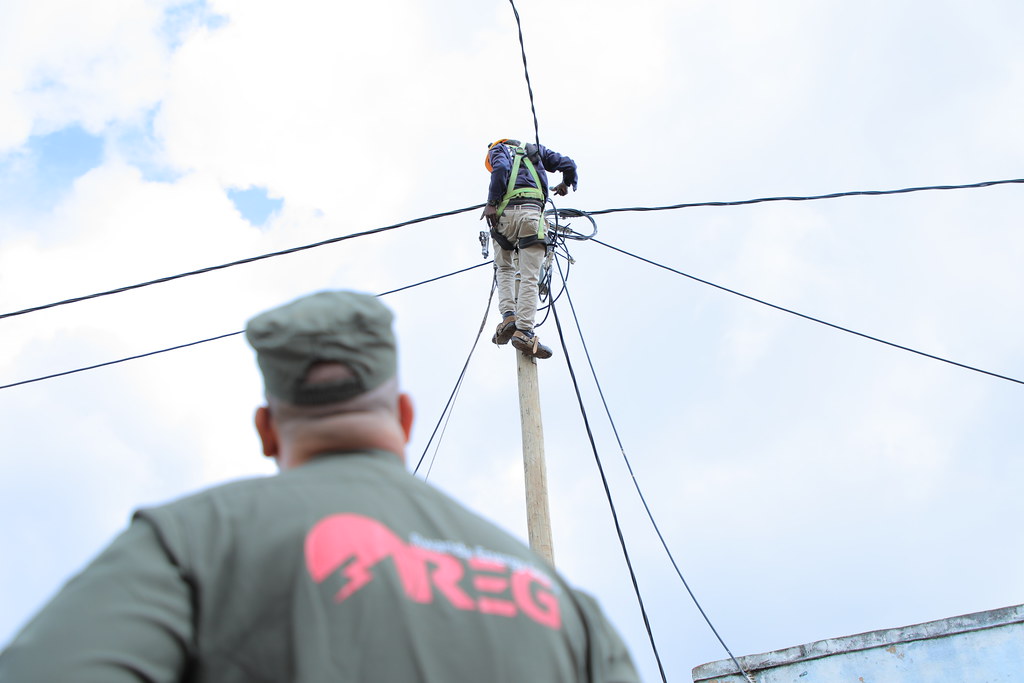
A technician with power provide REG watches as another undertakes a connection
The new tariff structure is a masterclass in targeted burden-sharing, designed to achieve multiple objectives at once.
The Protected Lifeline Consumers
The biggest winners from the new tariffs are Rwanda’s lowest-income citizens who make up about 10% of the total consumers. The government has held the line for the most vulnerable households. The tariff for the first lifeline block of consumption (0-50 kWh) remains completely unchanged at 89 FRw/kWh, a 0.0% increase. This ensures that the poorest families are insulated from the inflationary pressures of this policy shift.
The other clear winner is the industrial sector, which consumes 45.9% of the nation’s power and has long argued that high electricity costs cripple its regional competitiveness. In a strategic move to protect exports and attract investment, the government gave large industries a significant reprieve. Their energy charge sees a mere 3.2% increase, from 94 to 97 Rwf/kWh. Medium industries received a 26.7% hike, still modest compared to other categories.
It appears their campaign, including recent high-level meetings between the private sector with the finance minister Yusuf Muragwa, RURA and RDB, has paid off. For years, they have demanded for lower rates, arguing high tariffs were making cost of production high, thereby pushing away investors.
Furthermore, factories are being offered a powerful tool to manage their new costs: Time-of-Use (ToU) tariffs. For those with smart meters, a new demand charge structure incentivizes nighttime operation. From 11 PM to 8 AM, when a large segment of the national consumption pool is asleep, the demand charge for large industries falls to zero Rwf/kVA.
If they choose to operate during the high-demand evening peak (6 PM-11 PM), they will pay a steep premium of Rwf 7,184 /kVA. This clever demand-side management tool helps factories save money while flattening the national grid’s load curve, improving stability for everyone.
The Burden-Bearers
The cost of this rebalancing is being borne primarily by middle-to-upper-income households and the commercial sector. The government has identified these groups as having a higher capacity to pay.
Domestic users consuming more than 50 kWh will see their bills jump dramatically, with increases of 46% to 48%. This targets households with higher consumption habits—those leaving lights on, running multiple refrigerators, and using electric irons.
The commercial and service sector faces equally stark hikes. Hotels, broadcasters, and telecom tower operators saw increases between 44% and 56%.
This will undoubtedly raise the cost of doing business for these entities, a cost that may eventually be passed on to consumers. The only exception in this category was schools and health facilities, which received a below-average 15.1% increase, aligning with broader social goals.
The Road to 2030: Pain Today for a “Juicy” Tomorrow
The government is acutely aware of the pain this will cause. However, government says this not as a mere price hike, but as the essential first step in a long-term strategy. The core objective is to create a credible, bankable energy sector that signals to private investors that their capital is welcome and will see a reliable return.
This is paramount for funding Rwanda’s ambitious energy agenda. The current energy mix, revealed in supporting documents, shows a system heavily reliant on expensive sources and imports: Hydro (24%), Imports (23%), Peat (18%), Methane Gas (10%), Thermal (6%), and Solar (3%).
This dependency on costly peat, thermal, and volatile imports is the primary reason for the high production costs.
The new revenue will allow the government to stop funding operational deficits and focus on long-term investments. The goal is to expand domestic generation capacity, particularly from Lake Kivu’s methane gas and solar power, reducing reliance on imports and their associated Forex risk.
Key short-to-medium term solutions to stop recent abrupt power blackouts, include: the 43.5-megawatt dam Nyabarongo III is expected to be completed and fully operational by 2028. Construction begins in January next year on the big $800 Rusizi III dam for 206 MW shared with DR Congo and Burundi. Expected in next 3-4 years.
Another new source planned to be added on the grid is power imported from Ethiopia’s new mega Grand Renaissance Dam (GERD) via Uganda, as part of the regional interconnection project already operational.
The ambitious, long-term vision even includes nuclear energy by 2046.
The promise, though distant, is that by 2030, after this period of consolidation and investment, Rwanda could boast one of the lowest and most stable electricity tariffs in the region—a powerful engine for economic growth.
For now, the nation is being asked to power through the pain, with the hope of a more electrified, competitive, and prosperous future.
The winners in this new deal—the protected poor and the strategic industries—are the foundation upon which that future is meant to be built.
