




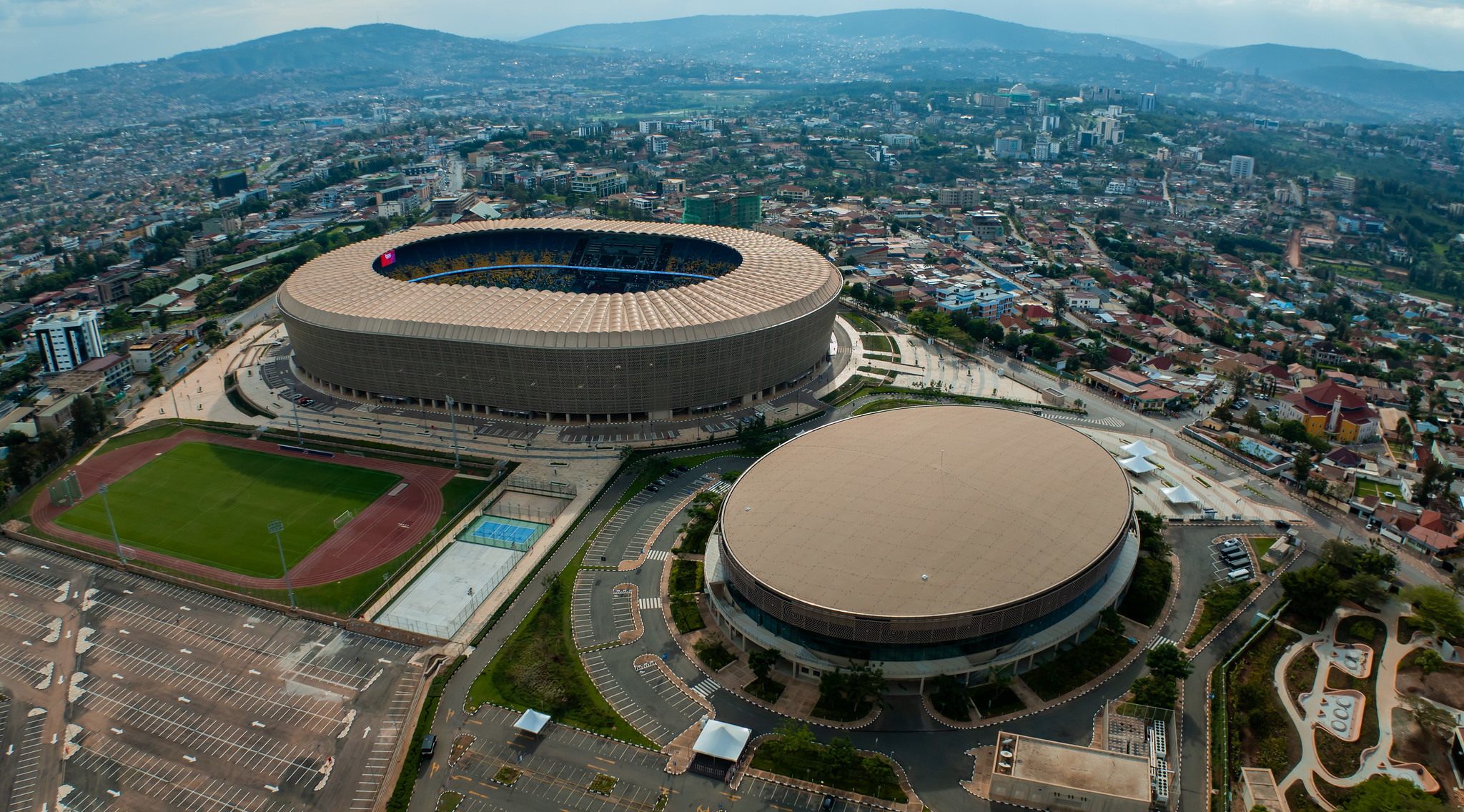
When the idea of putting up the Amahoro Stadium and BK Arena first started circulating, the outcry was; does a country like Rwanda need them? The story has shifted. Regional neighboring countries have seen the need, and all building similar facilities
A new data-based analysis from the International Monetary Fund (IMF) offers a view of Rwanda that sharply contrasts with what some of the government’s fiercest critics often claim.
For years, opposition voices outside the country have argued that public funds are spent without proper oversight, and that major investments—from landmark buildings to large sports facilities—reflect personal preferences at the top rather than national priorities.
They frequently point to various public institutions that hold taxpayers money and huge infrastructure, as evidence that money is used “anyhow,” with little regard for accountability or efficiency.
But the IMF’s latest Fiscal Monitor, released in October 2025, presents a very different picture—one built on detailed measurements of how countries manage public resources.
In this report, Rwanda stands out not as an example of reckless or prestige-driven spending, but as one of the few countries globally that has substantially improved the efficiency of its public expenditure, particularly in essential sectors that affect millions of ordinary citizens.
A Different Story
In analyzing global trends, the IMF selected only five countries to highlight for making strong progress in public spending reforms.
Rwanda appears on that short list, alongside Croatia, Bahrain, and the United Kingdom. It is the only country from East Africa included.
The Fund’s most detailed assessment focuses on the education sector, where Rwanda shows what the IMF describes as “significant efficiency gains.”
According to the report, Rwanda boosted its education spending efficiency by 8 percentage points between 2007 and 2011, and by another 3 percentage points between 2013 and 2016. Such improvements, rarely seen in low-income economies, indicate that the country began generating better results with the same level of public resources.
In practical terms, this means that as Rwanda expanded its education system—building more classrooms, hiring and training more teachers, and integrating digital learning tools—the money invested went further.
The IMF notes clear outcomes: near-universal primary school enrollment, rising transition rates to secondary school, and improved access for disadvantaged rural communities.
These results suggest structured spending, not wasteful use of public funds.
Public Needs, Not Prestige
The IMF traces Rwanda’s progress to a set of reforms introduced gradually over a decade: Nine-Year Basic Education in 2006, the One Laptop per Child initiative in 2008—through which more than 200,000 laptops were distributed—and Twelve-Year Basic Education in 2012.
These policies were designed to broaden access, reduce inequality and prepare young Rwandans for a digital economy.
Far from being symbolic or personal projects, the reforms were directed at national challenges: a youthful population, historical gaps in access to education, and the need to build a more skilled workforce. They required long-term planning, consistent investment, and systems capable of monitoring progress.
The IMF makes it clear that these reforms increased equity and efficiency across the system.
Nothing in this analysis supports the idea that spending decisions were made to satisfy individual tastes or preferences.
A Regional Context
The IMF report does not deeply profile other East African countries, but where comparisons appear, they underscore Rwanda’s distinct position.
One regional neighbor, for instance, is listed among countries whose public debt is expected to rise by more than 10 percentage points between 2024 and 2029, reflecting growing fiscal strain.
No neighboring country is mentioned for achieving major efficiency improvements in public spending.
This leaves Rwanda in a unique place. While the region grapples with budget deficits, rising debt and persistent inefficiencies, Rwanda is highlighted internationally for moving in the opposite direction: strengthening systems, using money more effectively and delivering tangible improvements.
The IMF also links Rwanda’s efforts to reduced inequality, noting that the biggest education gains were seen among rural and low-income families.
This widens the distance between the critics’ claims and the evidence presented by independent economists.
A More Complex Reality Than the Critics’ Narrative
Political critics may continue to raise questions about high-profile projects, as happens in any country.
But the IMF’s findings serve as a counterweight to claims that Rwanda operates without accountability.
The data shows a country whose public spending in key sectors is becoming more—not less—aligned with popular needs and national development goals.
The IMF does not portray a government driven by personal prestige.
Instead, it presents a picture of a state investing in long-term human development, measuring its progress and improving how it uses limited public resources.
In a region where fiscal stress is increasing, Rwanda’s trajectory, as described in the IMF’s own numbers, suggests a public finance system that is strengthening rather than weakening.
And for a government often accused of wasteful or self-serving spending, this independent assessment offers a sharply different verdict: efficiency, planning and measurable improvements—rather than excess or neglect—define Rwanda’s use of public funds in the areas studied.

11 comments
Congratulations congratulations congratulations to Rwanda’s authorities! Congratulations to all Rwandan every where you’re!, That means a strong Leadership! Our President has a strong Leadership spirit and Social Projects, that is Leadership African needs, every Country needs to grow like Rwandan do, let’s do more than my brothers and sisters and let our ennemies in down desolation.
The analysis done by Fred Rwasa on IMF findings and figures reflect what is seen by ordinary Rwandan. Let’s us applauds our leaders as they focus programs on citizens firstly.
This is great let’s continue building our country by using country’s resource efficiently
Sounds great. Let’s work together to strengthen our nation
Thanks to the good governance that is committed to serving it’s citizens for a better Rwanda, good utilization of country’s resources as well as managing international resources for the benefits of the community is our motion…
Construction our Rwanda we need
Good read
What can we do for Amavubi to go to the World Cup in 4years?
Woow, am proudly Rwandan🇷🇼
God bless Rwanda , God bless our visionary leaders 🙏
Imbere cyane Rwanda nziza 🥰
We need a roundabout here at Kibagabaga/Kumavaze. Many people are losing life,the space is too small for traffics,help us please.
The Rwanda’s reality speaks itself
Rwanda’s reality speaks itself
Comments are closed.