



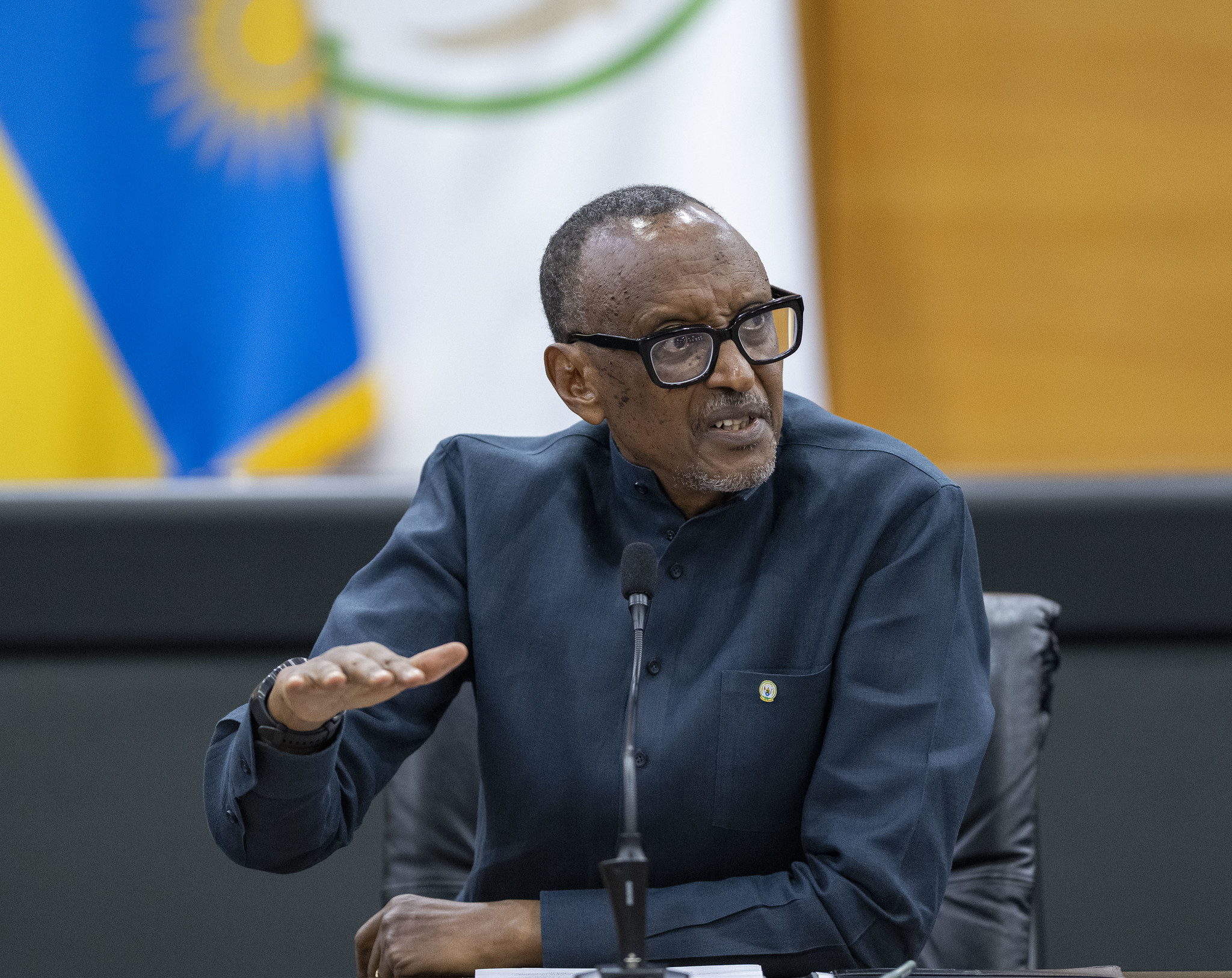
President Paul Kagame speaking during the press conference
President Paul Kagame on Thursday delivered one of his most direct and philosophical analyses of Africa’s political instability—addressing the surge of coups, the rise of Gen-Z protest movements, and the failures of governance he believes lie at the heart of both trends.
Drawing from events across the continent, Kagame painted a picture of a political environment where leaders ignore warning signs, international actors apply double standards, and young people lash out when they feel excluded from their country’s future.
The President repeatedly insisted that recent events in West Africa—military mutinies, popular uprisings, and contested elections—validate points he has made for years about the dangers of pretending that constitutional rule automatically equals good governance.
Gen-Z Protests as a Warning to Leaders
Kagame said the growing wave of youth protests on the continent—popularly framed as “Gen-Z uprisings”—should not surprise anyone. These eruptions, he argued, are the consequence of deeper structural failures, especially dishonesty in leadership, mismanagement of resources, and a failure to engage young people meaningfully in national processes.
The President explained that youth anger rarely occurs without warning. It builds over time, he said, in societies where leaders “fail to communicate honestly” about limited national resources, strained budgets, or the reduction of development assistance.
When leaders explain reality transparently, he said, people will often be patient: “If somebody has a problem and they understand, they won’t be violent.”
But Kagame warned that youth become hostile when they suspect corruption or manipulation. Young people may applaud a leader in public, he said, “but in their hearts, they are keeping a grudge.”
Once citizens believe that leaders are enriching themselves—“building castles in Paris or Brussels”—frustration becomes combustible.
“Why would anybody get angry with me if I have explained?” he asked. “But if they suspect you are taking money for yourself, they will not be sympathetic.”
Kagame argued that leaders have an obligation to engage young people before their frustrations reach a breaking point.
Youth activism, he said, should be understood as a message, not a threat: “We may need to find a way of making these young people responsible also, so that they feel they are part of the country—and therefore no need to overthrow.”
He noted that once young people feel excluded or deceived, momentum can swing quickly, and leaders must act early to address this reality.
‘Good Coups and Bad Coups’
Kagame also revisited his earlier remarks about coups—comments that generated considerable discussion across Africa. He stood by his view that not all coups are morally or politically equivalent, noting that some emerge out of sheer opportunism, while others arise from genuine public outrage against abusive or corrupt regimes.
“For me, there are good coups and bad coups,” he said. He described “bad coups” as those driven by reckless officers who take power simply because they command guns. “Good coups,” as he described them, emerge in situations where citizens and soldiers alike conclude that their leaders have gone too far—lying, stealing, repressing, and manipulating elections.
“If somebody says, ‘These guys have been telling us lies, enriching themselves, cheating us… we can’t have it anymore,’ and they act—it’s stinky but I’m okay with it,” he said.
Kagame insisted, however, that even such coups are only justifiable if they lead to improvement. “If you come and do the very things you overthrew people for—or do worse—then why did you carry out the coup? That one deserves another coup, or should go to jail.”
Coups as Indicators of Deep Problems
Mentioning recent examples in Guinea-Bissau and Madagascar, Kagame said these recent military takeovers reinforced what he has warned for years: that coups rarely erupt in places where governance is healthy.
“When I heard about the coup in Guinea-Bissau, I thought somebody was guiding a coup against himself,” he said. “But assuming it happened… and that in Madagascar it happened, it means I have been vindicated.”
According to Kagame, coups almost always reveal long-ignored problems—corruption, election fraud, or political repression—often hidden behind official narratives of stability.
“Once there is a coup, maybe 90 percent plus, it means in that place there has been a problem,” he said. “People have been covering it up.”
He added that some of the governments toppled by recent coups were the same ones repeatedly praised by Western actors, who “tell lies” about their governance records while ignoring abuses on the ground.
Congo’s Elections: ‘A Smokescreen… Elections Did Not Happen’
Kagame also issued one of his strongest critiques yet of political developments in the Democratic Republic of Congo, sharply questioning the legitimacy of the country’s electoral process.
He referred to “a man in our neighbourhood who raises the whole world and causes all kinds of troubles,” before turning to the manner in which he came to power—and stayed there. Kagame said Congo’s recent elections were “a smokescreen,” adding bluntly: “Elections did not happen.”
He suggested that even the first transfer of power in Kinshasa was not the democratic breakthrough it was portrayed to be internationally.
“The first time, he was just handed over his fraud,” Kagame said, adding that the pattern was repeated in the subsequent election.
Without naming President Félix Tshisekedi directly, he warned that Congo was heading for yet another manipulated electoral cycle: “You are likely to have a third one… coming back under the same fraud.”
Kagame criticised what he described as the hypocrisy of international actors who were fully aware of these realities but rushed to congratulate Congo’s leadership after each electoral cycle.
He said the same governments that preach democracy are often the first to send congratulatory messages “even when they are briefed” about electoral irregularities.
This, he argued, not only entrenches authoritarianism but emboldens leaders to continue abusing their populations while enjoying external legitimacy.
Challenging Civilian Exceptionalism
Kagame argued that Africa must stop pretending that civilian rule is automatically legitimate, especially when those in power manipulate constitutional frameworks to entrench themselves.
He questioned why the international community condemns coups unequivocally while turning a blind eye to civilian leaders who steal elections, enrich themselves, or brutalize their populations.
“The Constitution does not provide for you to cheat elections. Does it?” he asked. “There should be a mechanism at the African Union to hold civilians who are messing up their countries.”
He pointed to neighboring examples—again referring to Congo—where elections “did not happen,” yet foreign governments rushed to congratulate the result. Such contradictions, he said, fuel the very instability the world claims to oppose.
A Critique of International Double Standards
Kagame reserved some of his sharpest criticism for Western governments, accusing them of hypocrisy for praising leaders who rig elections or violate human rights—often because of strategic or economic interests.
He referenced instances in which powerful nations, fully aware of electoral fraud, still issued congratulatory messages and pushed for business concessions, including “deals for cobalt” and other minerals. Foreign actors, he argued, often prioritize commercial advantage over democratic principles.
“These are the same people who talk about democracy,” Kagame said, “but they are the first to send messages—‘thank you very much, congratulations’—even when they know the truth.”
Such behavior, he argued, undermines African efforts to build accountability and allows abusive regimes to survive far longer than they should.
Accountability Across the Board
Throughout his remarks, President Kagame returned to a central conclusion: the political instability seen across Africa—from Gen-Z uprisings, to coups, to questionable electoral processes in countries like Congo—is rooted in governance failures and compounded by international inconsistency.
He said African leaders must be transparent, confront corruption, address grievances early, and communicate honestly with their populations. At the same time, international actors must stop shielding leaders who “cheat elections” or mistreat their citizens.
True stability, Kagame argued, requires accountability for civilians, soldiers, youth movements, regional actors, and foreign governments alike.
Only by addressing these interconnected failures, he said, can African nations escape the cycles of anger, revolt, diplomatic crises, and coups now reshaping the continent.
