




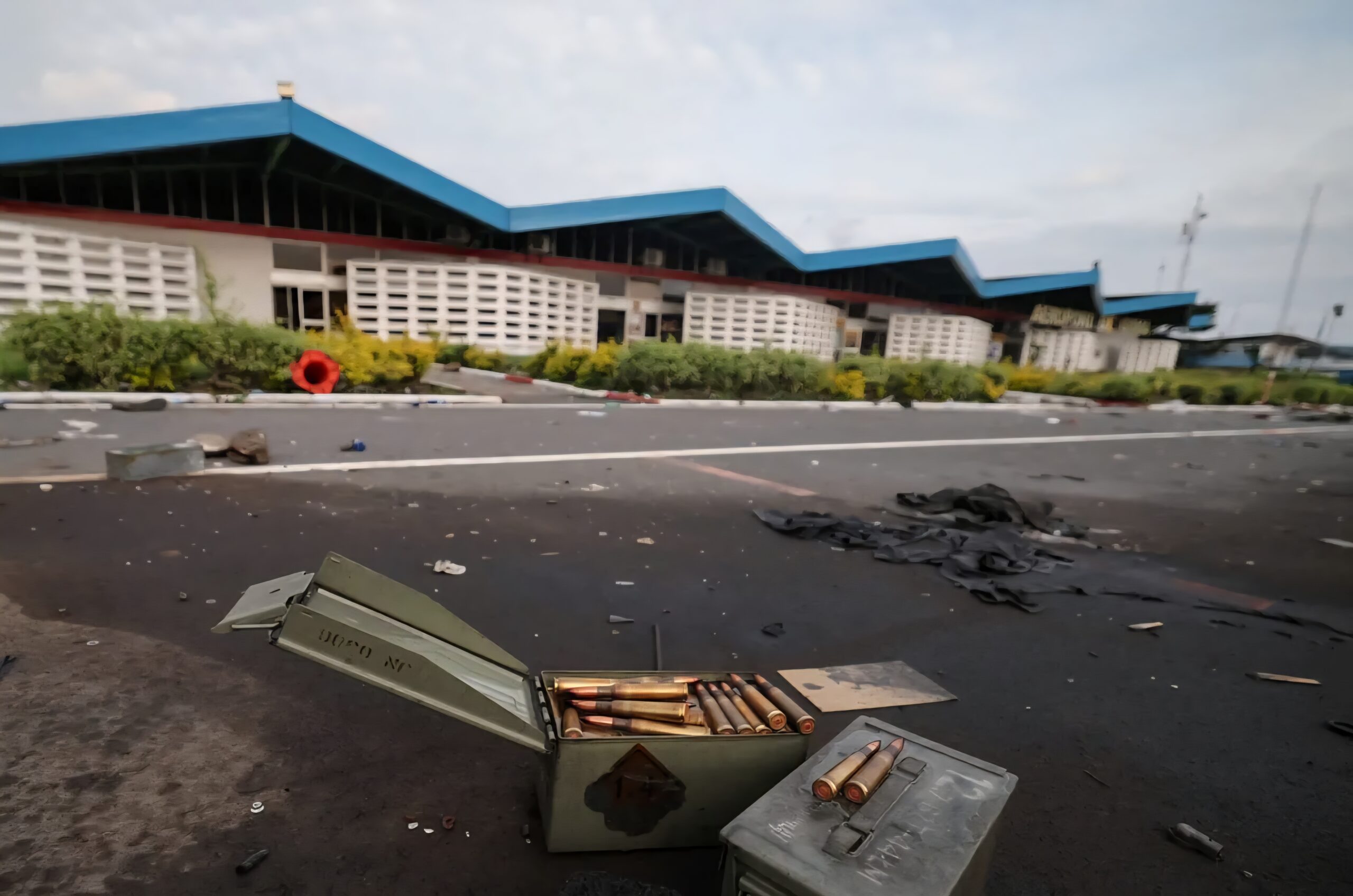
With ammunition scattered everywhere, booby traps and communication systems completely destroyed, that’s how the AFC-M23 rebels found the airport when they took over the region earlier this year
Rwanda has sharply pushed back against comments by French President Emmanuel Macron suggesting that the AFC–M23 rebel movement is responsible for delaying the reopening of Goma International Airport.
In an extensive statement, Rwanda’s Minister of Foreign Affairs, Olivier Nduhungirehe, said Macron’s remarks misrepresented what was agreed at last month’s humanitarian conference in Paris and overlooked the realities on the ground in eastern Congo.
Nduhungirehe, who represented Rwanda at the Humanitarian Conference on the Great Lakes Region on 30 October, said participants did not reach any consensus on reopening the airport immediately, nor was such a decision expected from the gathering.
Instead, he said, the conference ended with a clear understanding—expressed publicly by President Macron—that the conditions surrounding the airport’s reopening would be negotiated as part of the ongoing Doha peace process between Kinshasa and the AFC–M23.
“President Macron himself stated in his closing remarks that the ‘conditions’ for reopening Goma airport would be negotiated in Doha,” Nduhungirehe noted. “His own foreign minister repeated the same point during the final press conference. Rwanda said nothing different. Any claim that the Paris conference ordered the immediate reopening of the airport is simply inaccurate.”
The minister emphasized that the airport is physically controlled by the AFC–M23, meaning that Kinshasa cannot unilaterally dictate administrative or operational conditions for reopening it.
For reasons of “realism and effectiveness,” he said, any meaningful discussion must involve those who hold the facility on the ground.
He further pointed out that Kinshasa’s demands—that the airport be placed under full authority of the Régie des Voies Aériennes (RVA), the Congolese civil aviation agency—are entirely different from the position expressed by France, which proposed a dual-perimeter control system involving MONUSCO and the AFC–M23.
“These are fundamentally different visions,” he said. “Kinshasa speaks of exclusive control by RVA. Paris speaks of MONUSCO and AFC–M23 managing different layers of security. It is therefore incorrect to pretend that there is a unified or agreed administrative plan for the airport’s reopening.”
Nduhungirehe said that, in the context of a conflict where a Doha Framework Agreement has already been signed and where both sides have committed themselves to a cessation of hostilities, the opening of humanitarian corridors depends first on respect for the ceasefire—not on what he called “artificial administrative conditions” being advanced by Kinshasa.
He stressed that daily bombardments by Congolese fighter jets and attack drones continue to target not only M23 positions around the airport but also villages inhabited by Banyamulenge civilians, making any discussion of reopening the airport impossible until the Congolese government stops its attacks.
“Humanitarian access cannot be achieved under bombardment,” he said. “It is not paperwork that is blocking the reopening of Goma airport. It is the fact that Kinshasa continues daily attacks in violation of the ceasefire.”
The minister noted that under the Doha agreement signed on 15 November, the first protocol to be negotiated between Kinshasa and the AFC–M23 is dedicated entirely to humanitarian access, which must be “unimpeded, safe and durable”—three terms he said were deliberately chosen and equally important.
Goma airport falls within this protocol and will be addressed in that framework, under the guidance of Qatar as mediator.
As diplomatic tensions rose, the AFC–M23 leadership also responded directly to Macron’s comments.
Bertrand Bisimwa, the movement’s deputy leader, issued a sharp statement dismissing claims of a humanitarian emergency in areas under M23 control.
He insisted that those zones are secure, civilians have returned to their homes, markets are functioning, and there are no famine conditions or displacement camps.
“The Kivu region secured by AFC/M23 has neither displaced persons’ camps nor famine,” Bisimwa said. “Citizens have regained security and returned to their villages. So what humanitarian urgency are we talking about?”
Bisimwa went further, drawing a parallel with Operation Turquoise, the French military intervention in Rwanda in 1994. That operation, which France described as humanitarian, has been widely criticized for creating a safe corridor through which genocidal forces escaped into eastern Congo.
Bisimwa accused France of reviving the same humanitarian rhetoric today to justify political pressure or possible intervention in Kivu.
“A new version of ‘Turquoise’, with the same actors, has no place in Kivu,” he said.
Nduhungirehe did not reference Operation Turquoise directly in his statement, but he concluded by stressing that the path forward is already firmly established under the Doha agreement.
He expressed confidence in Qatar’s mediating role and said Rwanda fully trusts Doha to guide discussions toward a rapid and realistic solution.
“With the humanitarian access protocol already defined, the way forward is clear,” the minister said. “We trust the Qatari mediator to lead these discussions to a swift conclusion.”
