



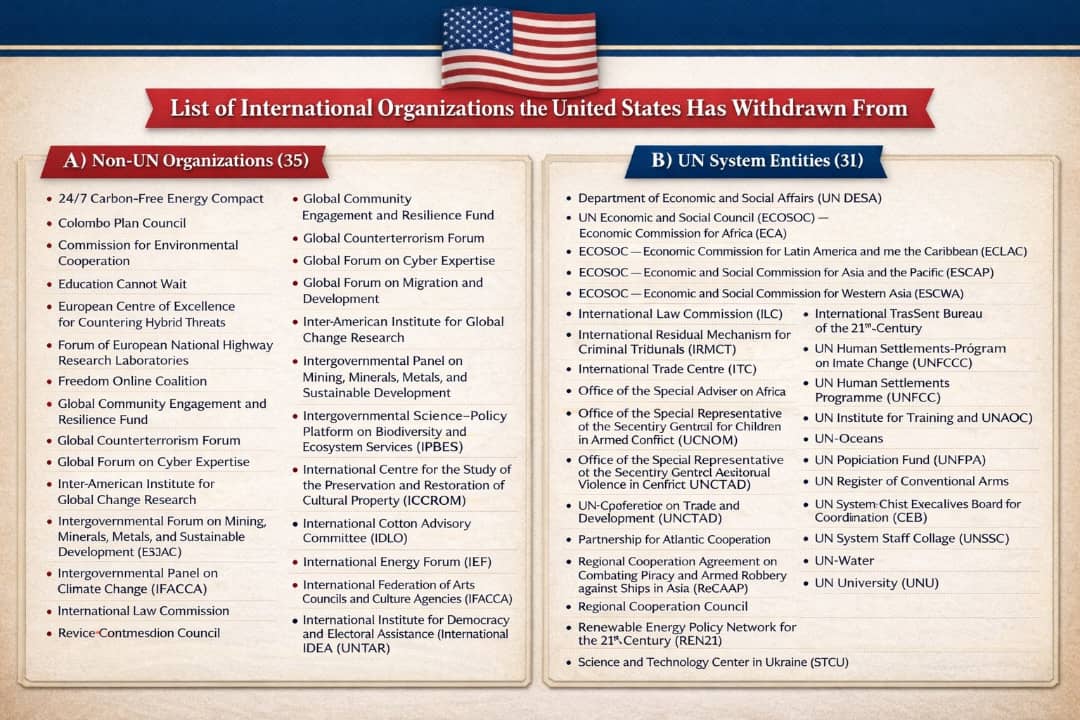
The United States, under President Donald Trump, has announced its withdrawal from or suspension of participation in 66 international organizations, a decision that is reshaping global multilateral engagement.
Washington cited concerns over efficiency, sovereignty, and alignment with U.S. interests.
“These institutions have often been redundant, poorly managed, or a threat to our nation’s sovereignty,” Secretary of State Marco Rubio said.
However, for decades, the U.S. has been a major funder of multilateral agencies, supporting humanitarian response, health systems, climate initiatives, governance programs, and development planning.
Its withdrawal introduces operational adjustments that could affect Rwanda, where organizations such as the Global Fund, UNFPA, UNICEF, UNHCR, WFP, and WHO play critical roles in national development.
Rwanda’s post-genocide recovery has relied on strategic engagement with these institutions. While the country has prioritized resilience and domestic capacity, key sectors—including health, population services, social protection, and climate adaptation—remain most exposed.
Progress against HIV/AIDS, tuberculosis, and malaria depends heavily on the Global Fund, historically funded largely by the United States.
While the Fund continues to operate, U.S. disengagement from related health frameworks risks destabilizing long-term financing, technical coordination, and cross-border disease responses critical in Rwanda’s densely populated and regionally mobile communities.
The World Health Organization (WHO) provides essential support for disease surveillance, immunization strategies, epidemic preparedness, and health policy planning. Reduced U.S. engagement could weaken these systems, which proved vital during COVID-19 and Ebola preparedness.
Programs supported by UNFPA, including family planning, adolescent health, and gender-based violence prevention, also face uncertainty.
Funding volatility disproportionately affects women and youth, threatening demographic and social policy gains made over the past two decades. Rwanda’s role as a host for refugees from the Democratic Republic of Congo and Burundi adds further complexity.
Services provided through UNHCR and WFP, including food, health care, education, and livelihoods, could face strain as U.S. withdrawal diminishes coordination and resources.
Child protection and education initiatives supported by UNICEF are similarly vulnerable. While core services may continue, uncertainty could slow program expansion, innovation, and emergency response.
Environmental and urban development are equally critical. Rwanda faces floods, droughts, and landslides, while urbanization—particularly in Kigali—has benefited from technical guidance from UN-Habitat and other agencies.
Although U.S. withdrawal may slow financing and knowledge exchange, domestic planning, public-private investment, and regional collaboration provide partial buffers against disruption.
Local perspectives illustrate the range of reactions. Albert Baudouin Twizeyimana, a political analyst and PAX PRESS Coordinator, welcomed the decision:
“Governments must take responsibility for their own citizens. These organizations were often inefficient and corrupt. Much of the aid money circulates back to donor countries through salaries, equipment, and contracts. Africa will be better off relying on its own resources.”
Journalist and analyst Ildephonse Sinaburiraga warned of short-term disruptions. To him, a lot of people are going to lose jobs, and business people partnering with these organizations will also be heavily affected.
“Families may need to adjust their living standards. Children who could attend private schools may now have to enroll in public or more affordable schools. Governments may lose tax revenue from salaries, and landlords lose income from properties previously leased to international agencies.”
While U.S. withdrawal will not immediately close clinics or halt refugee services, it introduces long-term structural risks: reduced funding predictability, potential weakening of technical support, and increased competition for global resources.
Rwanda’s challenge is to maintain gains in health, social protection, governance, climate adaptation, and urban development while diversifying international partners, mobilizing domestic resources, and strengthening regional cooperation.
The AP News report confirming the withdrawal from 66 organizations underscores that this is not symbolic rhetoric but a structural shift. For Rwanda, the risk is gradual erosion: delayed disbursements, reduced program scale, and tighter competition for dwindling global funds.
In a world where multilateralism is under political and financial pressure, Rwanda’s experience highlights the importance of national ownership, strategic planning, and self-reliance in protecting development achievements and sustaining progress.
