



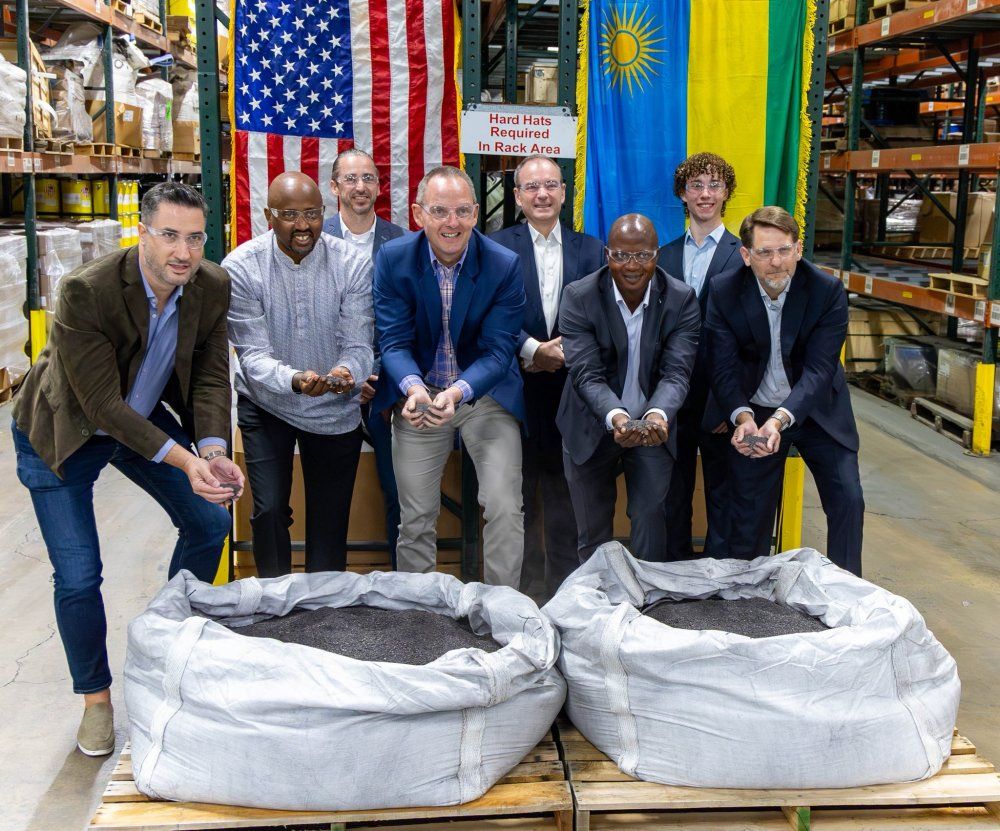
“The first containers of tungsten from Nyakabingo Mine arriving at Global Tungsten & Powders (GTP) in Towanda, Pennsylvania in September last year. Courtesy photo
Tungsten, one of the world’s most strategic industrial minerals and a critical input for defence systems and aerospace technology, has for the first time entered the United States defence supply chain from Africa’s Great Lakes region through Rwanda’s Nyakabingo Mine. The development positions Rwanda as a credible new supplier in a highly sensitive and tightly regulated global market. Tungsten is also a key material in the manufacture of electronics, including semiconductors, integrated circuits and electrical contacts.
The breakthrough follows a supply agreement with Global Tungsten & Powders (GTP), the largest tungsten manufacturer in the United States, under which between four and seven containers of tungsten concentrate will be shipped every quarter for two years. Traxys will manage the offtake and delivery to the U.S. market. The deal places Rwanda in a supply chain that serves highly regulated industrial and defence clients at a time of tightening global supply.
China controls an estimated 80% of global tungsten production, but recent export restrictions and tariff tensions have constrained supply and pushed prices up by roughly 80% over the past year, driven largely by trade disruptions and growing geopolitical risk.
In this context of rising global demand and constrained supply, Rwanda is establishing itself as a reliable alternative source of high-quality tungsten for industrial and defence markets. Global mining data rank the country among the world’s top six tungsten producers and fourth in quality and export volumes, after China, Russia and North Korea. Nyakabingo is Africa’s largest tungsten producer, giving Rwanda increasing strategic leverage in a mineral closely linked to aerospace, defence and high-performance manufacturing.
Peter Geleta, Chief Executive Officer of Trinity Metals, described the U.S. supply agreement as historic.
“This marks the first time that tungsten flows from the Great Lakes region into the United States. The partnership opens the door for further U.S. investment into our operations,” he said.
Since taking over operations in May 2022, Trinity has modernised its three Rwandan mines — Nyakabingo (tungsten), Rutongo (tin) and Musha (tin and tantalum). Updated Environmental and Social Impact Assessments have been completed, while closure and rehabilitation plans are under implementation. In late 2024, the Government approved new 25-year mining licences for the sites, strengthening long-term investor confidence. The company also provides stable employment for more than 6,500 workers, 99% of whom are Rwandan nationals.
In 2025, Trinity recorded a Lost Time Injury Frequency Rate of 0.16, in line with international industry benchmarks. It also secured US$3.85 million in technical assistance from the U.S. International Development Finance Corporation to support workforce development and environmental, social and governance initiatives.
Despite persistent allegations that Rwanda serves as a conduit for conflict minerals from eastern Democratic Republic of Congo, where armed groups have seized some mining areas, authorities and industry leaders insist Rwanda’s supply chains meet international standards.
Alice Uwase, Chief Executive Officer of the Rwanda Mines, Petroleum and Gas Board, said such claims “undermine our efforts as a government,” noting that Rwanda has invested heavily in strengthening regulation, traceability and oversight.
Trinity says it tracks every bag of ore from the pit to the end user through independent third-party systems aligned with OECD due-diligence guidance and Responsible Minerals Initiative standards. The company does not purchase minerals from illegal operators and subjects its operations to regular independent audits.
From a regulatory perspective, entry into U.S. defence-linked supply chains is widely viewed as strong validation of origin and compliance. The United States applies some of the world’s strictest due-diligence requirements, making acceptance into its procurement ecosystem both commercially and reputationally significant.
Looking ahead, Trinity is seeking about US$60 million to build a tungsten processing plant at Nyakabingo. The facility would improve recovery rates and support Rwanda’s ambition to move beyond raw mineral exports into value addition.
The project aligns with broader U.S.-backed initiatives aimed at formalising cross-border mineral trade and promoting economic stability in the Great Lakes region.
While Rwanda’s tungsten story is gaining momentum, the sector’s long-term success will depend on its ability to match expanding export performance with sustained transparency and regulatory credibility in a global market where strategic minerals increasingly carry geopolitical weight.
The U.S. government is taking a robust step to secure its critical mineral supply chains. On February 4, Secretary Rubio hosted the Critical Minerals Ministerial, convening 55 delegations to strengthen global supply chains for key minerals, including lithium, copper, and rare earths. The event focused on diversifying sources in the Western Hemisphere and attracting U.S. investment in mining, processing, refining, and recycling. During the ministerial, the United States signed new bilateral framework agreements with Argentina, Ecuador, Paraguay, and Peru, launched the FORGE initiative, and announced joint projects worth over $30 billion to secure supply chains, create jobs, and expand responsible investment across the Americas.