




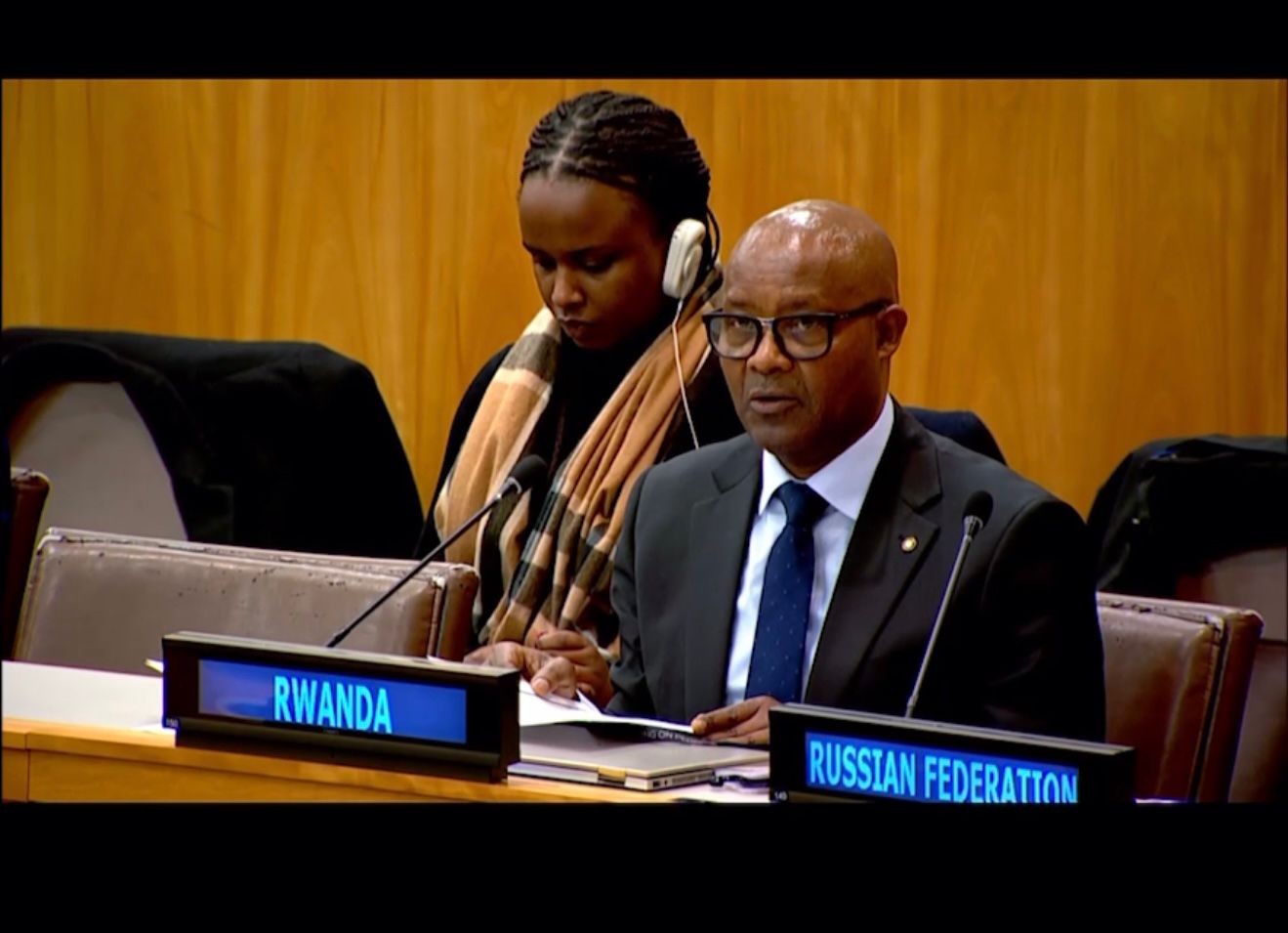
Col Deo Mutabazi, the Defence and Military Adviser to Rwanda Mission to the UN in New York
At United Nations headquarters this week, as diplomats debated the future of global peacekeeping, Rwanda delivered a message shaped by both history and contemporary conflict: silence in the face of hate speech can weaken — and even endanger — U.N. missions tasked with protecting civilians.
Speaking during the annual session of the Special Committee on Peacekeeping Operations (C-34), Col. Deo Mutabazi, Rwanda’s defense and military adviser to the U.N. Mission, argued that inflammatory rhetoric and disinformation are not peripheral concerns.
Left unchecked, he suggested, they can accelerate violence beyond the capacity of blue helmets to contain it.
For Rwanda, the warning carries historical gravity. The 1994 genocide against the Tutsi was preceded by systematic campaigns of dehumanizing propaganda.
Kigali, which is one of the biggest contributors for UN forces, has long argued that international hesitation to confront such rhetoric early contributed to catastrophic consequences.
That experience continues to inform Rwanda’s diplomatic posture in multilateral forums.
Today, Rwandan officials point to eastern Democratic Republic of Congo as a region where ethnic incitement, online disinformation and militia propaganda risk inflaming already volatile tensions.
Armed groups in North Kivu and Ituri have used narratives rooted in identity and historical grievance to mobilize support and justify attacks.
Kigali has repeatedly warned that anti-Tutsi rhetoric circulating in parts of the region carries dangerous echoes of the past.
The U.N. peacekeeping mission in Congo, MONUSCO, has itself faced waves of hostile messaging, including protests fueled by allegations of inaction or bias.
Analysts note that such narratives can erode public trust in missions, complicate civilian protection efforts and increase risks to peacekeepers on the ground.
Rwanda was not alone in linking information warfare to operational challenges. Several delegations, particularly from African and Asian troop-contributing countries, underscored the destabilizing effects of disinformation and hate speech on fragile societies.
India, one of the largest troop contributors, reiterated calls for realistic mandates and improved safety provisions, noting that peacekeepers increasingly operate in environments shaped by asymmetric threats — including propaganda that targets missions directly.
China emphasized respect for sovereignty and cautioned against politicization, but also acknowledged that misinformation can undermine stability and development efforts.
European delegations, including France and the United Kingdom, highlighted the importance of robust civilian protection strategies, with some pointing to the need for better community engagement and strategic communications to counter false narratives.
The United States and several major financial contributors framed the issue somewhat differently. While not centering hate speech explicitly, they stressed accountability, measurable performance and technological modernization — including surveillance tools and improved situational awareness — as ways to enhance mission effectiveness in complex information environments.
Regional blocs also weighed in. Representatives aligned with the Non-Aligned Movement and ASEAN stressed impartiality and the consent of host nations, while recognizing that societal polarization and incitement can threaten peace processes.
Though language varied, there was broad acknowledgment that modern peacekeeping missions operate in an era where narratives travel as quickly as armed groups.
Still, differences remain over how far U.N. mandates should go in confronting hate speech directly. Some member states are wary of blurring lines between civilian protection and perceived interference in domestic political discourse.
Others argue that failure to address incitement early leaves peacekeepers managing the aftermath of preventable violence.
With roughly 70,000 personnel deployed in missions from the Democratic Republic of Congo and South Sudan to Lebanon, the stakes of that debate are far from theoretical.
Rwanda’s intervention sharpened a central tension confronting the C-34: whether peacekeeping will evolve to treat disinformation and hate speech as core security threats, or continue to view them as secondary political issues.
For Kigali, shaped by a history in which words preceded mass violence, the answer carries urgency. In the marble halls of the United Nations, Rwanda is pressing fellow member states to see that in today’s conflicts, the battle for peace may begin long before the first shot is fired — in the language that prepares the ground.
