




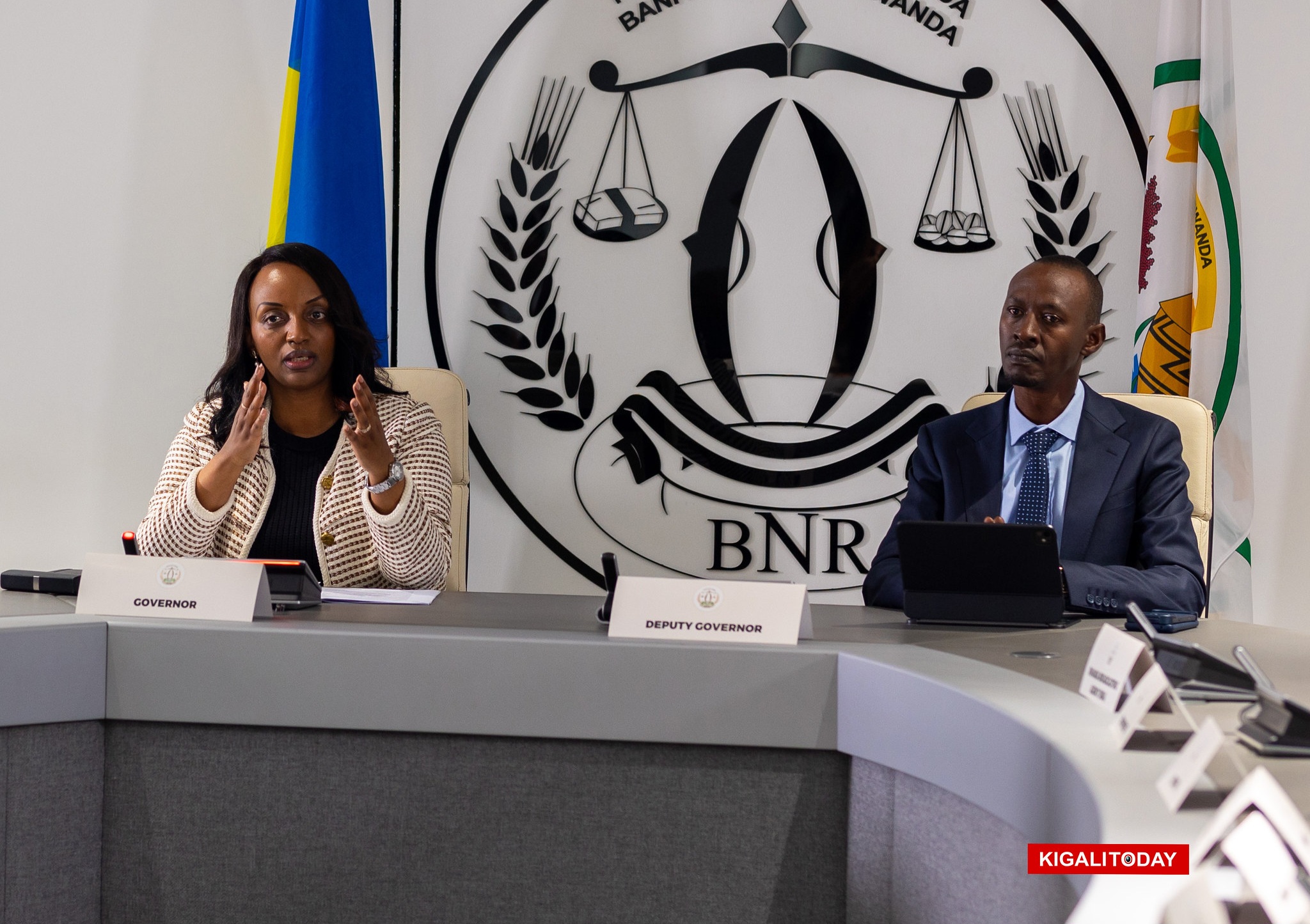
BNR Governor Soraya Hakuziyaremye (L) alongside the Central bank’s deputy Governor Nick Barigye, during the Monetary Policy Committee and Financial Stability Committee Press Conference held February 19, 2026
Rwanda’s financial authorities are celebrating a milestone year after the National Bank of Rwanda delivered its strongest performance since its establishment.
The achievement reflects years of steady growth and stronger returns on the country’s foreign reserves.
For the financial year ending June 2025, the central bank recorded a surplus of Rwf 150 billion — the highest in its history, according to its annual performance report for 2025.
Understanding the Surplus
Think of the central bank as the country’s chief financial manager. It does not sell goods like a company, nor does it collect taxes like the Rwanda Revenue Authority (RRA).
Its main responsibilities are to keep inflation under control, supervise banks, and manage Rwanda’s foreign currency savings.
While performing these duties, the bank earns income. That income, after covering its operating costs, is what forms the surplus.
Sources of Income
Rwanda keeps billions of dollars in foreign reserves, money used to pay for imports like fuel, medicine, and machinery.
Instead of leaving this money idle, the central bank invests it in safe international assets such as government bonds. These investments generate interest.
In simple terms, it’s like putting money in a savings account. The difference is that Rwanda’s reserves are on a much larger scale, so the interest earned is significant.
Recent years of high global interest rates have helped boost these earnings.
The central bank also generates income through lending and transactions with commercial banks. These financial operations add to the total surplus.
Not Taxpayers’ Money
It is important to note that the surplus is not derived from new taxes, money printed out of thin air, or loans.
It is simply the income earned by the central bank minus its expenses.
After paying for salaries, technology systems, currency printing, and other operational costs, the remaining amount becomes the surplus.
Growth Over Time
The rise in the central bank’s surplus has been steady over the years. In 2016/17, that is 10 years ago, the surplus was just under FRW 22 billion.
By 2021/22, it had grown to FRW 56 billion. In 2022/23, it reached nearly FRW 122 billion.
Now, at FRW 150 billion (about $110m), it is the highest ever recorded.
This growth reflects Rwanda’s expanding financial system and the increasing size of its foreign reserves.
What Happens to the Surplus?
The central bank does not simply spend the money. Part of it is kept as a safety cushion, helping the bank remain resilient if global markets become unstable.
Another portion can be transferred to the government as non-tax revenue, supporting public services without increasing taxes or borrowing.
Why This Matters
A financially strong central bank builds confidence among investors, strengthens the local currency, supports economic stability, and reduces pressure on government borrowing.
In short, it shows that the institution responsible for protecting Rwanda’s money is itself financially healthy.
Will the Surplus Always Stay This High?
Not necessarily. Central bank earnings are heavily influenced by global interest rates and financial markets.
If international rates fall, investment returns may decline.
This year’s record surplus is an achievement, but future results will depend on global economic conditions.
