




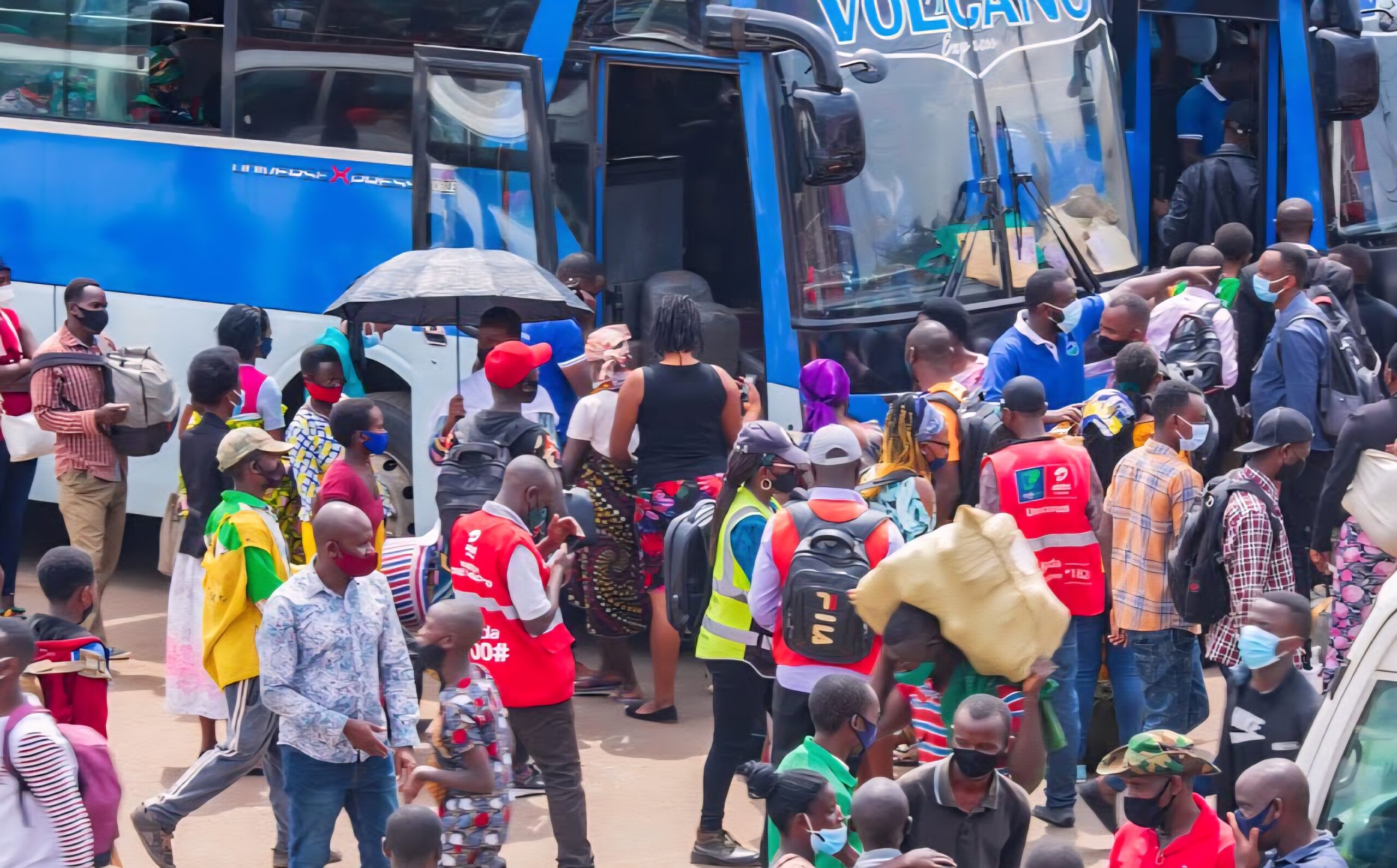
In the Nyabarongo bus park, travelers have been at mercy of the power bus companies. Now, it appears, Government has decided enough is enough, and wants good service for the future, not a few profiteering
KIGALI, Rwanda — On a rain-slicked morning in Nyabarongo main bus park, Kigali, passengers clutching plastic bags and small suitcases face a familiar chaos: dozens of buses from competing companies idle at the terminal, drivers shout destinations, and vehicles depart only when full — sometimes after hours of waiting.
That free-for-all system, while profitable for operators, produces unreliable schedules, overcrowded terminals, and what regulators call “unhealthy competition” that threatens safety.
Now the Rwanda Utilities Regulatory Authority (RURA) wants to change that.
A one-month pilot program, officially called the “Transport Service Enhancement on North-West Corridor through Joint Scheduling” — or the Joint Fleet Transport System by operators — would impose coordinated timetables, designated parking zones, and centralized ticket sales on the busy Kigali-Musanze-Rubavu route.
Thirteen companies would participate, including market leaders RITCO Ltd., Different Express, and Virunga Express.
The Kigali-Musanze-Rubavu route is one of Rwanda’s most lucrative and heavily traveled intercity corridors. Tens of thousands of passengers use it every day.
Beyond connecting key Rwandan towns, the route links to Goma and other parts of eastern Democratic Republic of Congo. Its high volume and cross-border significance likely explain why RURA chose it: the pilot can provide real-world results for potential nationwide implementation of joint scheduling and fleet coordination.
How the Pilot Would Work
Under the proposed system, buses would no longer compete in a scramble for passengers. Instead:
- Departures would follow a fixed, shared timetable.
- Ticket sales and boarding would be centralized at designated points (“aho gukatira amatike”).
- Parking would be organized (“parikingi”) so that buses wait in assigned zones.
Operators have been told, according to themselves, that the system would operate on a rotational “one-ticket” principle.
Passengers buy a single ticket for the route, not for a specific company. Buses from one operator load until full, then the next company’s bus in the rotation boards the following passengers. The sequence repeats throughout the day.
Imagine a typical afternoon at the Nyabarongo terminal under the pilot. A Ritco bus pulls into Slot 1 and fills all 60 seats. Only then does a Different Express bus take its turn at the boarding point. A Virunga Express coach waits behind.
No more drivers racing to poach customers or idling for hours. Departures leave on schedule, whether buses are full or not, though the rotation is designed to balance loads.
RURA stresses that this is not a merger and does not eliminate competition. It as a temporary test to deliver “the expected results” for passengers: predictable times, less congestion, and safer journeys.
In a Feb. 20 thread on X, the regulator wrote that a joint team had been formed “to study carefully and prepare how this pilot can be implemented effectively.”
Why Operators See It as a Threat
For larger fleets, the changes threaten core business models. In the current system, a big operator with 20 buses can run as many trips as demand allows, capturing market share through aggressive driving and flexible scheduling.
Joint scheduling removes that flexibility. Revenue would be shared evenly across all 13 operators, regardless of fleet size.
Executives from Ritco, Different Express, and Virunga Express privately fear “forced passenger sharing” could lead to heavy losses.
Smaller operators might benefit, while well-capitalized companies that have invested billions in branding, fleet maintenance, and driver networks stand to lose the most.
This backlash reflects broader tensions in Rwanda’s transport sector. Since November 2025, the Association of Transporters in Rwanda (ATPR) has campaigned for reform, admitting the system delivers poor service.
President Paul Kagame has publicly criticized the industry, saying substandard transport “should not be tolerated.” Yet when regulators propose concrete fixes, major operators push back.
A Test Case for National Modernization
The North-West Corridor pilot is part of a larger push to modernize Rwanda’s public transport.
Initiatives include the new “airline-style” fixed-schedule system in Kigali, with real-time tracking and plans for electric buses, and electronic ticketing on select intercity routes.
RURA aims to move the sector away from the old “fill-and-go” model toward reliability and safety — the same philosophy behind dedicated bus lanes and smart fare systems being tested nationwide.
Passengers appear largely supportive. Interviews and social-media comments show that travelers on the Kigali-Musanze-Rubavu route most complain about not knowing when the next bus leaves and enduring chaotic boarding.
A coordinated system, many say, would finally bring the predictability they see in Kigali’s newer urban buses.
Delays, Negotiations
The operators’ opposition has forced repeated delays. The original Feb. 15 launch was postponed. After meetings, technical committees, and ongoing negotiations, the start date has now been pushed to late March.
The delays allow RURA and stakeholders to refine the pilot, while ensuring all 13 companies are involved in shaping final rules.
Whether the pilot launches successfully or is watered down will be watched closely across Rwanda.
If it succeeds, similar joint-scheduling systems could spread to other busy inter-provincial routes. If operators prevail, the chaotic status quo may persist — at least until the next regulatory push.
For now, buses on the road to Rubavu continue to race for passengers, horns blaring, while regulators and industry leaders meet in Kigali to determine whether Rwanda’s roads can finally run on schedule.
