



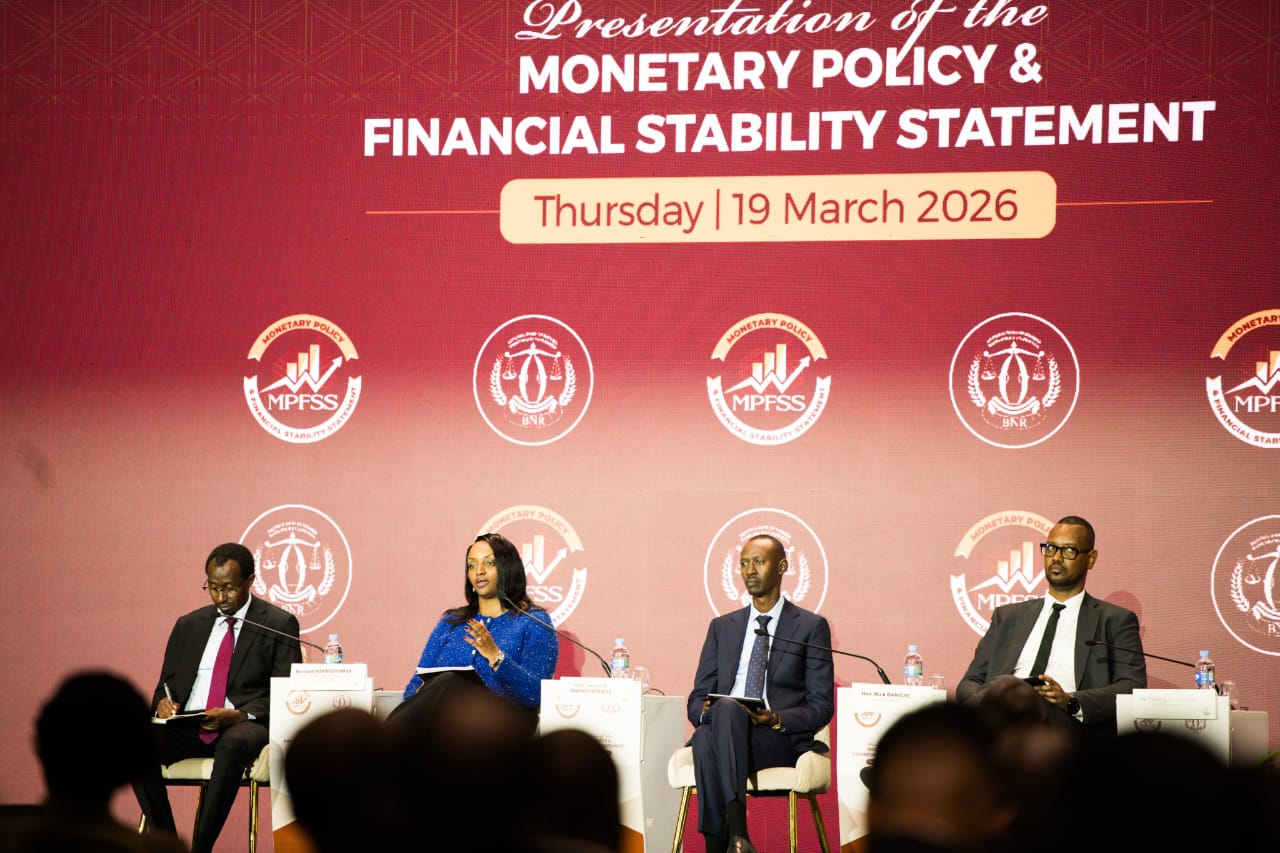
The Central Bank presented the March 2026 Monetary Policy and Financial Stability Statement.
The Central Bank has warned that a sharp surge in global energy prices, driven by escalating tensions in the Middle East, is emerging as the main risk to Rwanda’s economic outlook, even as the economy posts strong growth of 9.4%.
Presenting the March 2026 Monetary Policy and Financial Stability Statement, National Bank of Rwanda (BNR) Governor Soraya Hakuziyaremye said the central bank is now operating in a far more volatile global environment than anticipated just months ago.
She pointed to rapid disruptions in global energy markets, noting that oil prices have risen from about $72 to above $100 per barrel within weeks, while natural gas prices have climbed by more than 60%.
“This is not a gradual adjustment; it is a shock,” she said. “The volatility in global commodity markets introduces significant upside risks to inflation and, if sustained, could weigh on economic activity.”
Inflation Fight Intensifies Amid External Shocks
The central bank raised its key policy rate to 7.35% after inflation increased to 9.2% in February, breaching the upper limit of the 2–8% target range.
BNR said the current inflation cycle is largely driven by external shocks, unlike previous episodes influenced mainly by domestic factors.
“You cannot anchor sustainable growth in an environment where inflation is drifting beyond control,” Hakuziyaremye said. “Our role is to act decisively when price pressures threaten macroeconomic stability, even when those pressures originate beyond our borders.”
She warned that inflation is likely to remain elevated in the near term, with rising energy costs expected to feed into transport, food, and production prices.
Growth remains strong, but risks build

BNR Governor Soraya Hakuziyaremye has said that the central bank is now navigating a far more volatile global landscape than anticipated just months ago.
Despite external pressures, Rwanda’s economy remained broadly resilient in 2025, with industry growing by 11%, services by 8.5%, and agriculture by 7.4%, supported by infrastructure investment and gains in exports, particularly minerals and coffee.
However, policymakers say rising import costs, especially for fuel and essential goods, are narrowing the country’s external buffers.
Deputy Governor Nick Barigye said maintaining stability will require tighter coordination between monetary and fiscal policy.
“This is a moment where monetary policy alone is not sufficient. The alignment with fiscal measures is critical to ensure inflation is contained without undermining growth,” he said.
The financial sector continued to grow, with total assets rising by nearly 24% to Rwf 15.9 trillion. Credit to the private sector increased by 25%, while non-performing loans fell to 2.5%, and capital buffers remained strong.
However, lending remains heavily concentrated in trade, construction, and personal loans, with agriculture still receiving limited financing despite its economic importance.
Officials said this imbalance could limit the long-term impact of credit growth on structural transformation.
Push for inclusion and institutional reform
BNR also highlighted ongoing efforts to deepen financial inclusion, noting that while access to accounts has expanded, usage of credit and insurance remains uneven, particularly among women and youth.
Governor Hakuziyaremye said collateral constraints and low financial literacy remain key barriers.
“Access to finance is no longer just about opening accounts, it is about enabling meaningful participation in the financial system,” she said.
A major reform underway is the integration of the Business Development Fund into the Development Bank of Rwanda, aimed at consolidating guarantee schemes and improving financing efficiency.
“This is about scale and efficiency. By integrating these functions, we are creating a stronger institution capable of delivering more impactful financing solutions,” she said.
Policymakers say the economy remains fundamentally sound but is increasingly exposed to external shocks driven by a more volatile global environment. Officials note that while the country’s resilience remains intact, it now requires active management amid rising uncertainty in global economic and geopolitical conditions.