



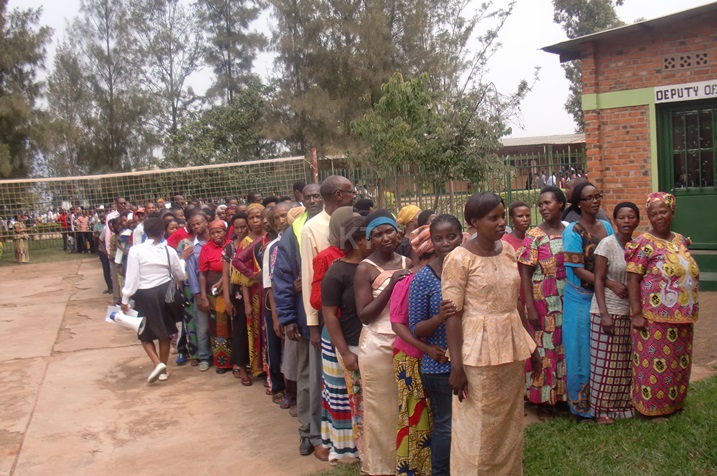
At village and cell level, elections will continue to be direct, as everyone adult can take part
KIGALI — A sweeping draft amendment to Rwanda’s organic law governing elections proposes to abolish direct voting for District Councillors, replacing it with an indirect system that fundamentally reshapes how citizens participate in local governance.
Under the proposed changes, District Councillors will no longer be elected directly by the population. Instead, they will be chosen through an electoral college made up of delegates who vote on behalf of citizens.
The exact composition of this electoral college will not be fixed in the law itself but will be determined through a presidential order, a move designed to provide flexibility and avoid frequent legal revisions.
The reform marks a major departure from Rwanda’s previous approach to local elections, where citizens were more directly involved in choosing their representatives, particularly at the sector level.
From sector-based representation
For years, District Councils were built on a sector-based model, where each sector elected its own representative through direct voting. This ensured that every part of a district had a clearly identifiable voice in the council.
For context; Rwanda is divided into 30 districts, which are in turn each subdivided into sectors, which are also broken down to cells, and finally villages.
However, reforms introduced in 2021 changed the structure of District Councils, reducing them to eight councillors elected at the district level rather than from individual sectors.
While the law maintained direct elections in principle, the COVID-19 pandemic forced authorities to organize those elections indirectly, using delegates instead of the general population.
According to the explanatory note in the draft law, this indirect approach was later evaluated and found to be effective, particularly in reducing the logistical burden of organizing elections and limiting disruptions to citizens.
The new amendment formalizes that experience by making indirect elections the standard method going forward.
The Nnew system
If adopted by Parliament eventually signed by the President, the system will operate through a multi-layered structure of representation.
Ordinary citizens will no longer vote directly for District Councillors. Instead, they will participate primarily at the grassroots level—such as in the election of village leaders and other lower administrative structures.
From there, representatives or delegates emerging from these lower levels will form an electoral college tasked with electing District Councillors.
Voting within this college will be conducted by secret ballot, and the candidates receiving the highest number of votes will fill the eight available council seats in each district.
Although the law does not spell out the exact composition of the electoral college, the decision to leave this to a presidential order suggests that it may include local leaders or other designated representatives from across the district.
The result is a new chain of representation: citizens elect grassroots leaders, those leaders or their delegates elect District Councillors, and the councillors in turn elect the district’s executive leadership.
Implications for mayoral selection
The changes to councillor elections have direct implications for the selection of District Mayors.
Under Rwanda’s governance system, mayors are not elected by the general population. Instead, they are chosen by members of the District Council. Importantly, a mayor does not have to be a sitting councillor; the council can elect any eligible candidate.
With councillors now set to be chosen indirectly, the entire process of selecting district leadership becomes one step further removed from direct public voting.
In practice, this means that the chain of selection will follow a fully indirect path: citizens influence grassroots leadership, grassroots structures influence councillor selection, and councillors elect the mayor and vice mayors.
Fewer elections, longer stability
Another key change in the draft law concerns the timing of by-elections.
Currently, replacement elections are organized when a local leader leaves office and more than six months remain in their term. The draft extends this threshold to one year, meaning that by-elections will only be held if a significant portion of the term is still left.
In the Lower Chamber of Parliament yesterday, Local Government Minister Dominique Habimana argued that the previous six-month threshold was too short to justify the cost and effort of organizing elections, especially when broader electoral cycles were already underway.
However, the draft maintains an exception: if vacancies prevent decision-making due to lack of quorum, elections can still be organized regardless of the remaining term.
The government frames the reform as a response to both practical challenges and lessons learned from recent elections.
Rwanda conducts frequent elections at multiple administrative levels, which officials say can disrupt daily life and require repeated mobilization of citizens.
By shifting district-level elections to an indirect system, the draft law aims to reduce what it describes as “election fatigue” while maintaining representation through delegated structures, according to the Minister.
The reform also seeks to streamline the legal framework governing elections by consolidating multiple amendments made since 2019 into a single, unified law.
It further aligns electoral provisions with other laws, including those governing the functioning of Parliament and the Senate, to eliminate inconsistencies.
A shift in citizen participation
While the proposed system preserves direct voting at the grassroots level, it significantly reduces direct public involvement in higher levels of local governance.
Citizens will continue to vote for village leaders and participate in national elections, but their role in selecting district-level leadership will become indirect.
Supporters argue that this layered representation model improves efficiency and governance.
However, the shift also raises questions about how it may affect perceptions of accountability and the connection between voters and their district leaders.
The draft organic law, which contains 164 articles covering all aspects of elections—from voter registration to campaign rules and penalties—is part of a broader effort to modernize Rwanda’s electoral framework.
If adopted, it will formally institutionalize indirect elections at the district level and redefine how local representation is structured across the country.
At its core, the reform signals a transition toward a system where citizens participate most directly at the grassroots, while higher levels of leadership are shaped through successive layers of representation.
