



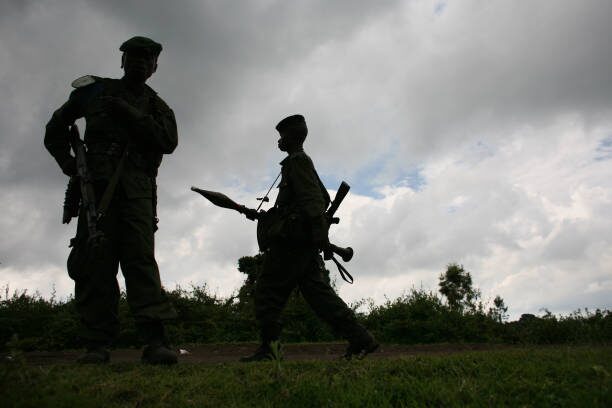
CNDP fighters, 2008:The 2008 CNDP movement’s demands directly culminated in the March 23, 2009, peace agreement that gives today’s M23 its name.
For most of the world, March 23rd is just another day. However, for a rebel movement in the Democratic Republic of the Congo (DRC), this date marks an anniversary seventeen years in the making—one that continues to reshape the politics of the entire Great Lakes region.
Anyone with a passing interest in global affairs has likely heard of M23. Yet, few can explain the significance of the name itself. This is a critical oversight, as the name “M23” reveals not only what the organization is, but the very reason for its existence.
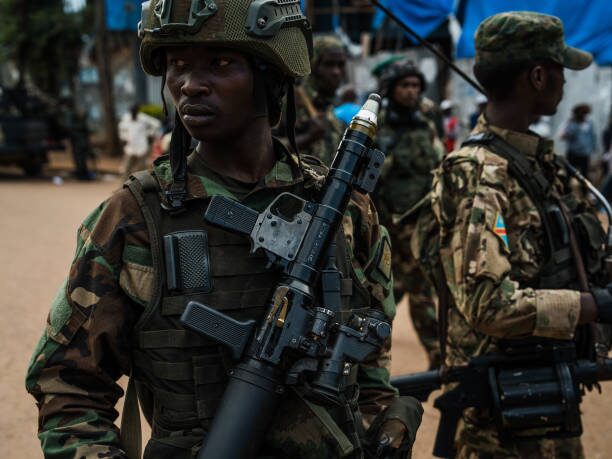
AFC/M23 fighters today. For this movement, this date isn’t just an anniversary—it is the very reason for their existence.
The March 23rd Movement to give its proper appellation has gone on to become AFC/M23, the AFC being the Congo River Alliance. Like M23, the letters AFC also point to the why as well as the what. Unlike M23 however, the why of AFC, demands an explanation all of its own, and will be a story for a later date.
The M23 Movement can boast the same amount of detail, but could not be more straightforward. Today, news organisations ostentatiously precede any mention of the rebel group, with the words, “Rwanda backed,” as in “Rwanda-backed M23.” This is in itself instructive.
None of the news organisations which parrot the words, base them on any research or logic of their own finding. They lift it wholesale from a politically driven narrative, began by the French in the United Nations Security Council (UNSC), to divert consideration of the conflict in the DRC from its causes, the better it seems, to maintain Western control of the DRC.
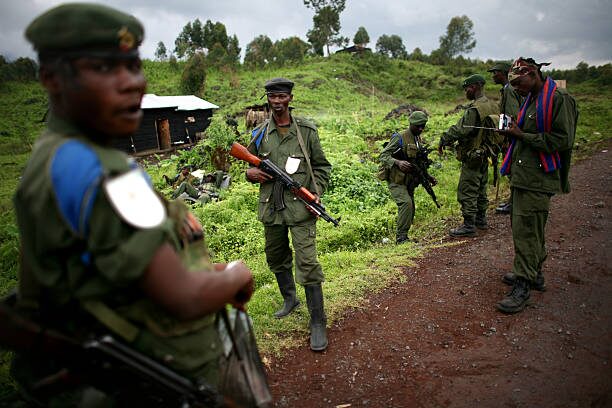
CNDP forces after signing of ceasefire 2008
The M23 Movement was born in 2012, in response to what with amply verifiable justification, it argues has been successive Congolese governments habitual reneging on agreements signed in 2008-9.
The agreements were signed between the government of the DRC, headed by then President Joseph Kabila, and the rebels of the National Congress for the Protection of the People (CNDP), an earlier of iteration of M23.
Unlike CNDP, M23 has broadened its demands, but at source these demands remain what they were when CNDP was formed. As CNDP, the rebel movement was made up mainly of Kinyarwanda-Speaking Congolese, Congolese Tutsi, in particular.
For generations, this community was persecuted by the Congolese state, including being denied the rights of citizenship, to the extent that a community which had been in what is now the DRC since the nineteenth Century, was regarded as foreign on its ancestral lands.
In 1994 the defeated planners and perpetrators of the Genocide Against Tutsi in Rwanda, were escorted by their French collaborators into the DRC, or Zaire as it was then, during the presidency of Mobutu Sese Seko.
With the continued support of the French and the Congolese state, the genocidal establishment, which had entered Zaire with its well equipped army, began to introduce its genocide ideology into what is now eastern DRC, turning persecution of Kinyarwanda-Speaking Congolese from zenophobia to genocidal.
The Kinyarwanda-Speaking Congolese took arms to defend their communities. Their success against the ever ill disciplined, corrupt Congolese army that preys on its own population, was immediate and dramatic.
In a relatively short period of time, they were threatening to take Goma, the capital of Eastern DRC, and seat of the International Community, in reality, the Western presence in the DRC, or Zaire. Western powers heaped pressure upon Rwanda, which had influence with CNDP, demanding that the rebel group halt its advance.
Rwanda agreed to intervene, on the proviso that the grievances, which all, including the Congolese state, agreed were just, be fully acknowledged and acted upon by both the International Community and the Congolese state.
That agreement was signed on March 23rd 2009.
Three years later, in 2012, members of CNDP took up arms again, pointing to the Congolese government’s failure to honour the agreement it had signed.
Today, the much changed M23 to become AFC/M23, still technically declares a unilateral ceasefire, insisting it ever advances against government forces only when attacked, and still calls upon the government to honour agreements it signs. Many others have since been signed between the government and M23.
Meanwhile, those government forces, now under President Felix Tshisekedi, are made up of a motley crew of armed groups under the umbrella name of Wazalendo, the defeated genocidal forces from Rwanda, now under the acronym FDLR (Democratic Forces for the Liberation of Rwanda), Burundi forces, mercenaries from around the world, including Europe, Israel and the United Sates of America, notably, Eric Prince’s Black Water group.
Two constants remain, eradication of the genocidal FDLR, and ending the persecution of Kinyarwanda-Speaking Congolese.
