



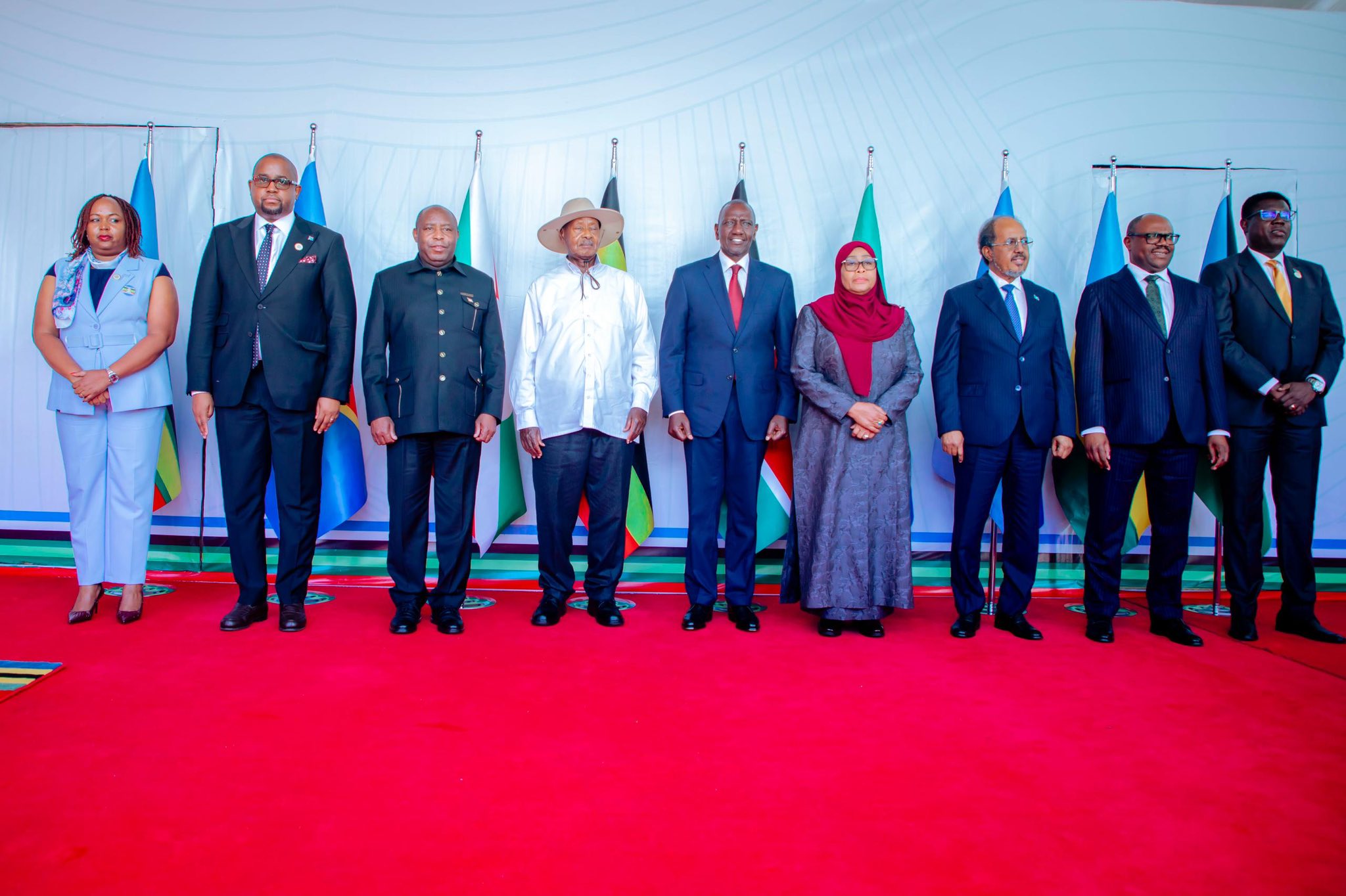
The 25th Ordinary Summit held Saturday March 7, 2026
Leaders of the East African Community agreed on Saturday to change how the regional bloc is financed, adopting a new formula that ties member contributions more closely to their economic strength.
The decision was made during the 25th Ordinary Summit of EAC Heads of State in Arusha, Tanzania, on March 7. The move is aimed at addressing a persistent problem that has troubled the bloc for years: unpaid contributions from member states.
The 25th Ordinary Summit was attended by Ugandan President Yoweri Museveni, Kenyan President William Ruto, Tanzanian President Samia Suluhu Hassan, Burundian President Évariste Ndayishimiye, and Somali President Hassan Sheikh Mohamud.
Rwanda was represented by Prime Minister Dr Justin Nsengiyumva, and DR Congo (DRC) was represented by its minister, as well as South Sudan.
As of early 2026, the community’s unpaid dues had reached more than $89 million, with some countries owing tens of millions of dollars. The arrears have slowed programs and strained the operations of regional institutions.
The EAC brings together eight countries — Burundi, Democratic Republic of the Congo, Kenya, Rwanda, Somalia, South Sudan, Tanzania and Uganda — and is often described as one of Africa’s most ambitious regional integration projects.
Members and Donors
The EAC’s current budget for the 2025–2026 financial year is about $109.3 million. Member states finance roughly 62 percent of that amount — about $67.7 million — while development partners cover the remaining 38 percent, or roughly $41.6 million.
The reform adopted in Arusha does not change the overall size of the budget or the share covered by donors. Instead, it changes how the member states divide their portion of the bill.
Under a funding formula adopted in 2023, the member states’ share was divided into two parts.
About 65 percent of the $67.7 million — roughly $44 million — was paid equally by the eight countries. The remaining 35 percent, about $23.7 million, was calculated based on each country’s economic strength.
But the system did little to solve the problem of unpaid contributions. Arrears continued to grow, led by the DR Congo, which owed about $27 million, followed by Burundi, South Sudan and Somalia.
How the New 50–50 System Will Work
Under the new formula adopted in Arusha, which will take effect on July 1, 2026, the member states’ contribution will be divided equally in two halves.
Half of the $67.7 million — about $33.9 million — will be shared equally among the eight countries. If the budget remains similar, each country would pay about $4.2 million for this portion.
The other half — also about $33.9 million — will be distributed according to each country’s economic capacity, calculated using the average nominal GDP per capita over the previous five years. Data will be drawn from sources such as the World Bank and the International Monetary Fund.
This means wealthier economies will contribute a larger share of that half, while poorer or more fragile economies will pay less. The more prosperous countries have surely benefited more from the union, and the new formula seeks to have them pay more to maintain it.
In simple terms, half of the member-funded budget will be split equally, while the other half will be divided according to economic strength.
If the EAC budget grows or shrinks in future years, the exact dollar amounts will change, but the 50–50 structure will remain the same.
Bigger Economies to Pay More
The change means that countries with stronger economies will shoulder a larger share of the budget.
Estimates based on recent economic data suggest that within the assessed half of the budget, Kenya could contribute around 30 percent, followed by Uganda and Tanzania at about 15 percent each, Rwanda at roughly 12 percent, with smaller shares coming from the Democratic Republic of Congo, Somalia, Burundi and South Sudan.
Final figures will be calculated by the EAC Secretariat.
Push for Financial Stability
Supporters say the reform is intended to make the community more financially sustainable and less dependent on donors.
The EAC finances key institutions including its Secretariat, the East African Legislative Assembly (EALA) and the East African Court of Justice (EACJ), which oversee regional laws, policies and dispute resolution.
Still, the new formula could create tensions among members with weaker economies, many of which already face financial and security challenges.
For now, EAC leaders are betting that a clearer, capacity-based system will reduce unpaid dues and strengthen the bloc’s finances — an important step for a community that hopes to deepen economic integration across East and Central Africa.
Uganda’s Museveni, as EAC Chair for this year, will be expected to steer the bloc into the new system.
