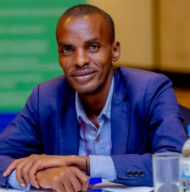




TV screenshot of President Paul Kagame delivering remarks earlier today, addressing current national and regional developments.
“We cannot waste these opportunities and end up dying of hunger,” Kagame said. “We need to do more to be food secure and even supply some food to others.”
The President linked the slow progress in agriculture and livestock to weak coordination among institutions and a disconnect between leaders and citizens. He noted that, despite significant investments to empower farmers through various government programmes, implementation gaps continue to hinder productivity.
“There is a need to act fast, but also to coordinate closely between institutions,” he said, emphasising that empowered citizens must be supported by efficient systems that translate policy into results on the ground.
He added: “We have to move away from words and promises to action. You have to work together to deliver, because we have the land, the weather is on our side, and we have the people.”
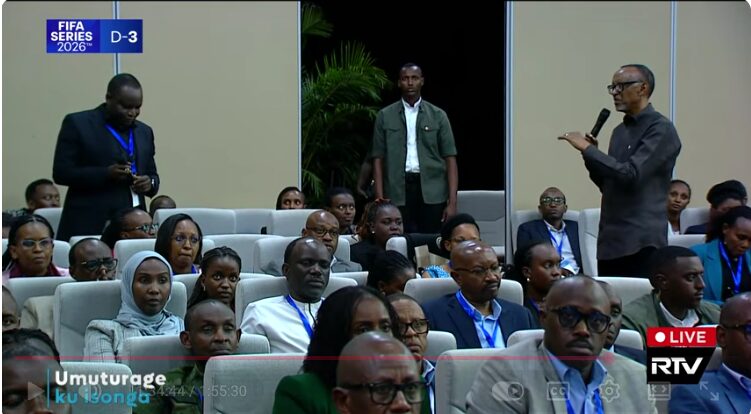
TV screenshot of President Paul Kagame addressing local leaders during today’s engagement on national priorities and community development.
His remarks come at a time when Rwanda is implementing its Second National Strategy for Transformation (NST2), a five-year development framework running from 2024 to 2029. The strategy places strong emphasis on modernizing agriculture and increasing livestock productivity as key drivers of economic growth, food security, and export expansion.
Under NST2, Rwanda aims to significantly increase agricultural output through expanded irrigation, improved use of fertilizers and seeds, and greater mechanization. The government targets irrigation coverage to reach tens of thousands of additional hectares, reducing reliance on rain-fed agriculture and mitigating the impact of climate variability.
In the livestock sector, NST2 prioritizes improved breeds, enhanced veterinary services, and better feed systems to increase meat and dairy production. The strategy also seeks to strengthen value chains by investing in processing, storage, and market access, enabling farmers to earn more from their produce.
Agriculture remains a central pillar of Rwanda’s economy, employing more than 60% of the population while earning the country about 25% of its GDP.
NST2 sets ambitious goals to boost productivity and transition from subsistence farming to a more market-oriented and resilient system, contributing to poverty reduction and improved nutrition.
Kagame’s message to leaders underscored the urgency of aligning these national ambitions with practical action at all levels of government. While local leaders at the meeting pledged to take responsibility, the President insisted that measurable progress—not promises—would define success.
Christian Irakoze, the Chairperson of the Private Sector Federation (PSF) Agriculture and Livestock Cluster told the president that the sector mainly faces a post-harvest and packing challenges, an aspect that was also raised by the minister of trade and industry who stated that post production continues to affect the value chain.
Tasked to respond to the issue, Prime Minister Dr. Justin Nsengiyumva said that the issue remains a long term challenge but effective action will be taken following the national dialogue (Umushyikirano 2026).
“The problem is known and it is because of lack of ownership and not taking action,” PM Nsengiyumva said despite investments in infrastructure such as cold-chains.
While some officials argued they face multiple priorities, Kagame dismissed this as a weak excuse for inaction, saying many hide behind it even as the country has numerous priorities to address.
Newly elected PSF Chairperson, François Twagirumukiza told the president that the organisation is ready to take the challenge to act but Kagame urged them to not act like government officials but lead by example considering the history of the problem at hand.
The retreat concluded with a renewed call for accountability and coordination, as Rwanda seeks to unlock the full potential of its agriculture and livestock sectors in line with its broader development goals.