



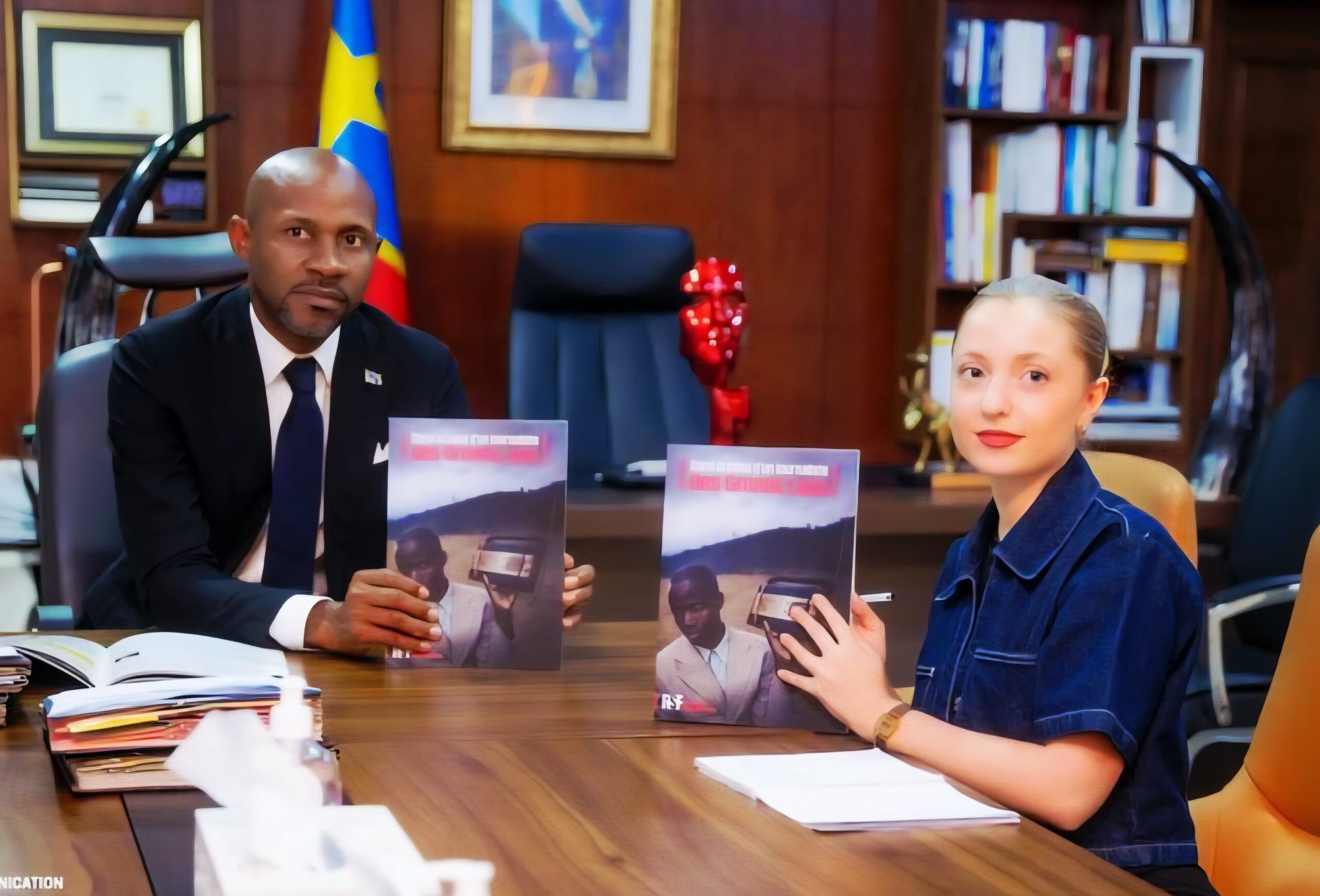
Jeanne Lagarde, RSF advocacy officer for Sub-Saharan Africa, met with DR Congo Information Minister Patrick Muyaya in Kinshasa
KIGALI — When Reporters Without Borders met Congolese officials in Kinshasa this Tuesday, the visit followed a familiar script: publish a critical report, present findings to government, and press for reforms.
But in the politically charged landscape of eastern Democratic Republic of Congo, the encounter has drawn a more complex reaction — not so much about what was said, but about what the engagement might signal.
Days earlier, RSF had released findings highlighting worsening conditions for journalists in the Great Lakes region, including abuses in conflict-affected areas of eastern Congo.
The report noted pressure from multiple actors, from armed groups – naming AFC-M23 rebels particularly, to state institutions, though much of the immediate attention focused on violence in rebel-held zones.
Then came the meeting.
Led by its Sub-Saharan Africa advocacy team, RSF presented its recommendations to Communications Minister Patrick Muyaya, urging stronger protections for journalists, faster responses to attacks, and action against impunity.
Muyaya, in turn, publicly welcomed the engagement — but framed the issue largely through the lens of external aggression, pointing to attacks in “occupied areas” and linking them to Rwanda-backed rebels.
That response was predictable. What is less straightforward is how such exchanges are interpreted beyond official statements.
Engagement or Endorsement?
For advocacy organizations, direct engagement with governments is part of the job. Reports alone rarely produce change; dialogue and pressure are meant to follow.
But in highly polarized conflicts, engagement can carry unintended meaning.
By appearing alongside government officials — even in a critical capacity — watchdog groups risk being seen as reinforcing official narratives, particularly when those governments are themselves accused of violations.
In Congo’s case, that tension is acute.
Kinshasa has faced criticism over its own conduct in the east, including military operations, bombardments, and uneven implementation of regional peace commitments.
Yet in public messaging, the government has consistently emphasized external actors as the primary source of instability.
Against that backdrop, any high-level engagement with an international organization can be read politically.
Selective Framing
RSF’s reporting does not absolve the Congolese state. Its broader findings point to a pattern of pressure on journalists that extends beyond rebel groups.
But in practice, governments often highlight the parts of international reports that align with their positions — and downplay the rest.
That creates a familiar dynamic: a complex report becomes a simplified narrative.
For critics, the concern is not necessarily about RSF’s conclusions, but about how they are used. Does such engagement allow Kinshasa to project cooperation while deflecting scrutiny? Does it risk creating the impression of international backing at a moment when accountability questions remain unresolved?
A Dilemma
For RSF and similar organizations, this is not a new problem.
To be effective, they must engage governments. To remain credible, they must be seen as independent from them.
In stable environments, that balance is easier to maintain. In conflict zones — especially ones as politically sensitive as eastern Congo — it becomes far more difficult.
Every meeting, every statement, every photograph carries weight.
There is no indication that RSF has altered its findings or softened its stance. Its call for stronger protections and accountability remains consistent.
But in a region where narratives are contested and alliances scrutinized, perception can be as important as substance.
The Kinshasa meeting, routine on paper, has become a small test of that balance.
Not because of what was said inside the room — but because of how it is heard outside it.
In conflicts like this, even neutrality must constantly be demonstrated.
And for international watchdogs, credibility depends not only on what they report, but on how their actions are interpreted.
