



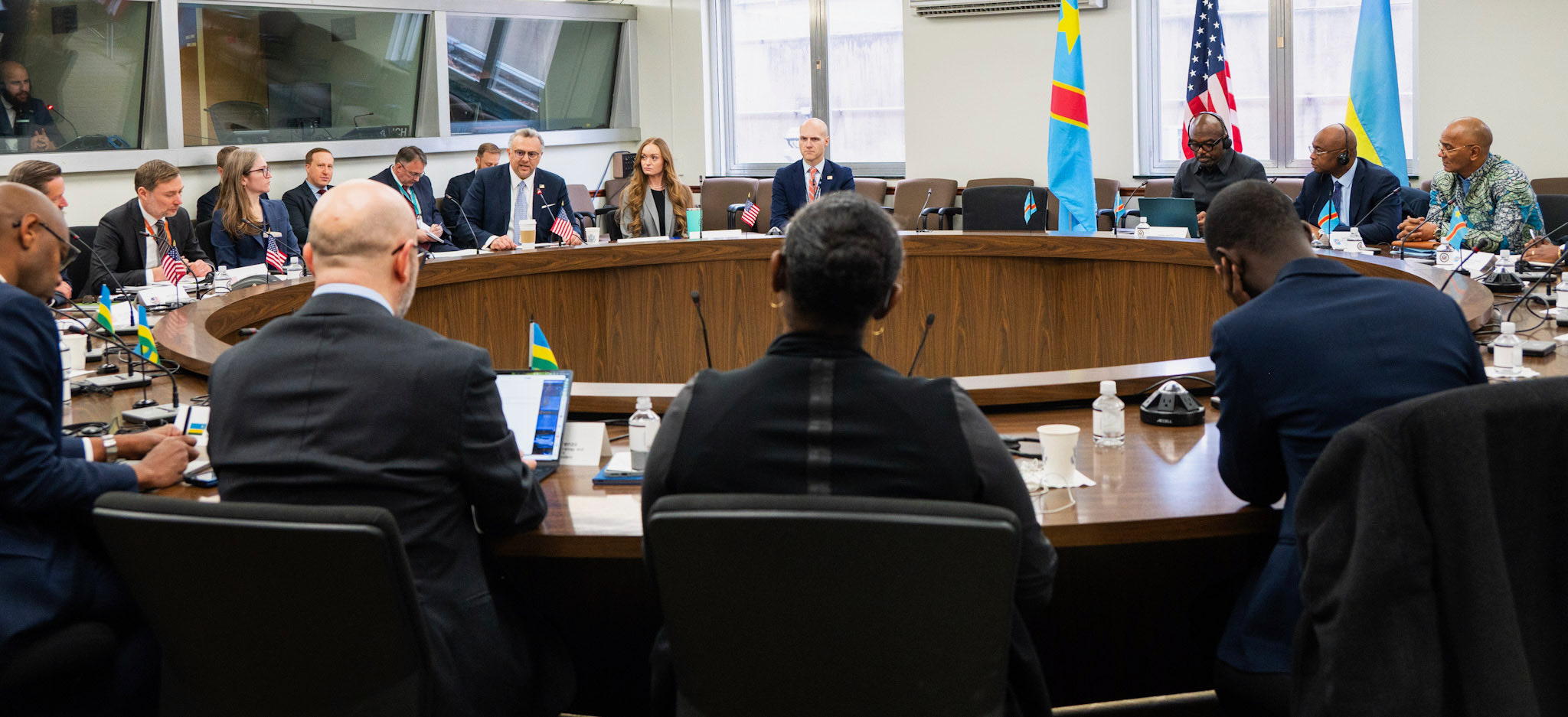
Rwanda and the Democratic Republic of the Congo (DRC), with facilitation from the United States, have agreed on a new set of coordinated measures aimed at de-escalating tensions and advancing implementation of the Washington Accords for Peace and Prosperity.
According to a joint statement released on March 18 by the three governments, representatives from Kigali and Kinshasa met in Washington, D.C. on March 17–18 and committed to “concrete steps” designed to stabilise the situation on the ground and reinforce mutual trust.
The agreement outlines a series of reciprocal actions, including commitments to respect each other’s sovereignty and territorial integrity — a central point of contention in the long-running crisis in eastern DRC.
Among the key measures is a planned disengagement of forces, alongside what the statement describes as the “lifting of defensive measures” by Rwanda in specified areas of eastern Congo. In parallel, the DRC committed to time-bound and intensified operations to neutralise the Democratic Forces for the Liberation of Rwanda (FDLR), an armed group Kigali has consistently identified as a major security threat.
Both sides also pledged to prioritise the protection of civilians, as part of broader efforts to reduce violence in conflict-affected communities.
The latest commitments build on the Washington Accords, a US-backed framework aimed at addressing the root causes of instability in eastern DRC while fostering regional cooperation on security and economic development.
A fragile but significant step
The renewed diplomatic push comes as violence persists in eastern DRC, where civilians continue to bear the brunt of clashes involving armed groups, the Congolese army (FARDC), and other actors.
In recent months, human rights organisations and UN agencies have raised concerns over civilian casualties, displacement, and alleged violations by multiple parties to the conflict. The situation has been further complicated by the use of heavy weaponry in populated areas and the continued presence of numerous non-state armed groups.
The United Nations peacekeeping mission in the DRC (MONUSCO) is also operating under heightened risk, as it seeks to protect civilians and support stabilisation efforts in an increasingly volatile environment.
The latest commitments by Rwanda and the DRC — particularly on civilian protection and de-escalation — are likely to face close international scrutiny.
The Path Toward Implementation
While the statement stops short of publishing a granular calendar, the emphasis on a “time-bound” approach suggests that the international community expects to see movement in the immediate term. The true test of this agreement will not be found in the corridors of D.C., but in the dense forests and borderlands of eastern Congo, where the integrity of verification mechanisms will be put to the test.
The success of these measures ultimately hinges on the political will to dismantle long-standing military postures. By reaffirming the Washington Accords, all three nations have signaled that a multilateral framework remains the only viable path forward. For the people who have suffered years of conflict, the coming weeks will reveal if these commitments are a genuine turning point or merely a temporary pause in a decades-long cycle of instability.