



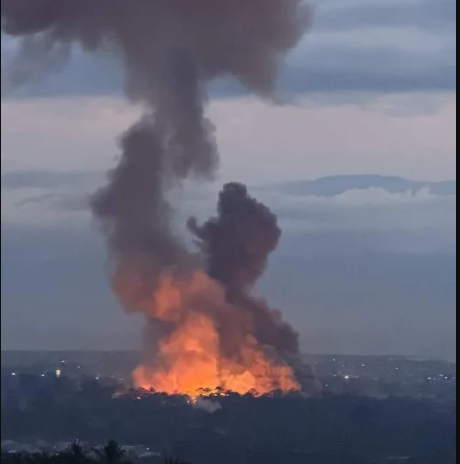
Last Month, Burundi was rocked by a deadly explosion after a fire broke out at a military installation in the Musaga zone, triggering a series of blasts at an ammunition depot.
A spokesperson for the Burundi National Defence Force said at least 13 people were killed and 57 others injured. Authorities attributed the initial fire to an electrical fault that ignited stored munitions, causing secondary explosions.
However, military analysts say the scale of destruction suggests deeper failures in ammunition storage and safety protocols.
Improper Storage Concerns
Military expert Egide Ruhashya told local media that while military installations in urban areas are not unusual, storing high-explosive ordnance in densely populated zones poses significant risks.
He said such depots—especially those holding artillery shells, grenades and aerial bombs—should be built as hardened underground facilities to contain accidental blasts and prevent chain reactions.
“Standard military doctrine requires ammunition storage facilities to be underground, using reinforced concrete, steel and blast-resistant materials,” Ruhashya said. “This protects the munitions and limits damage in case of an accidental detonation.”
Experts warn that poorly managed depots are vulnerable to “sympathetic detonation,” where one explosion triggers others nearby.
Proper storage protocols include separating munitions by type and explosive yield, using compartmentalized storage, maintaining controlled temperatures, and enforcing strict handling procedures.
“In tropical climates like Burundi, high temperatures can destabilize explosives if they are not properly stored,” Ruhashya added.
The incident also highlights risks linked to rapid urban expansion, as civilian settlements in Bujumbura have grown closer to military sites, increasing vulnerability.
Witnesses said the blast sent shockwaves through nearby neighborhoods, damaging homes, shattering windows and causing structural collapses—effects consistent with high-order explosions.
Accountability and Systems Gaps
Ruhashya also pointed to weaknesses in military logistics and inventory management, noting that modern armed forces rely on digital tracking systems rather than manual records.
“Each munition should have a unique identification code to track its origin, movement and allocation,” he said, adding that this improves accountability and reduces mismanagement.
He called for a multi-layered verification system covering the entire chain—from entry points such as airports to storage and distribution.
While authorities maintain the explosion was accidental, alternative theories have circulated, including a possible external attack, unconfirmed drone involvement, internal sabotage and risks linked to recently imported weapons.
These claims remain unverified, and officials have not presented evidence to support them.
Broader Implications
The March 2026 explosion in Bujumbura underscores broader concerns about military safety standards in rapidly urbanizing cities.
Analysts say it should prompt stricter enforcement of storage regulations, modernization of logistics systems, and the relocation or reinforcement of high-risk military infrastructure away from civilian areas.