


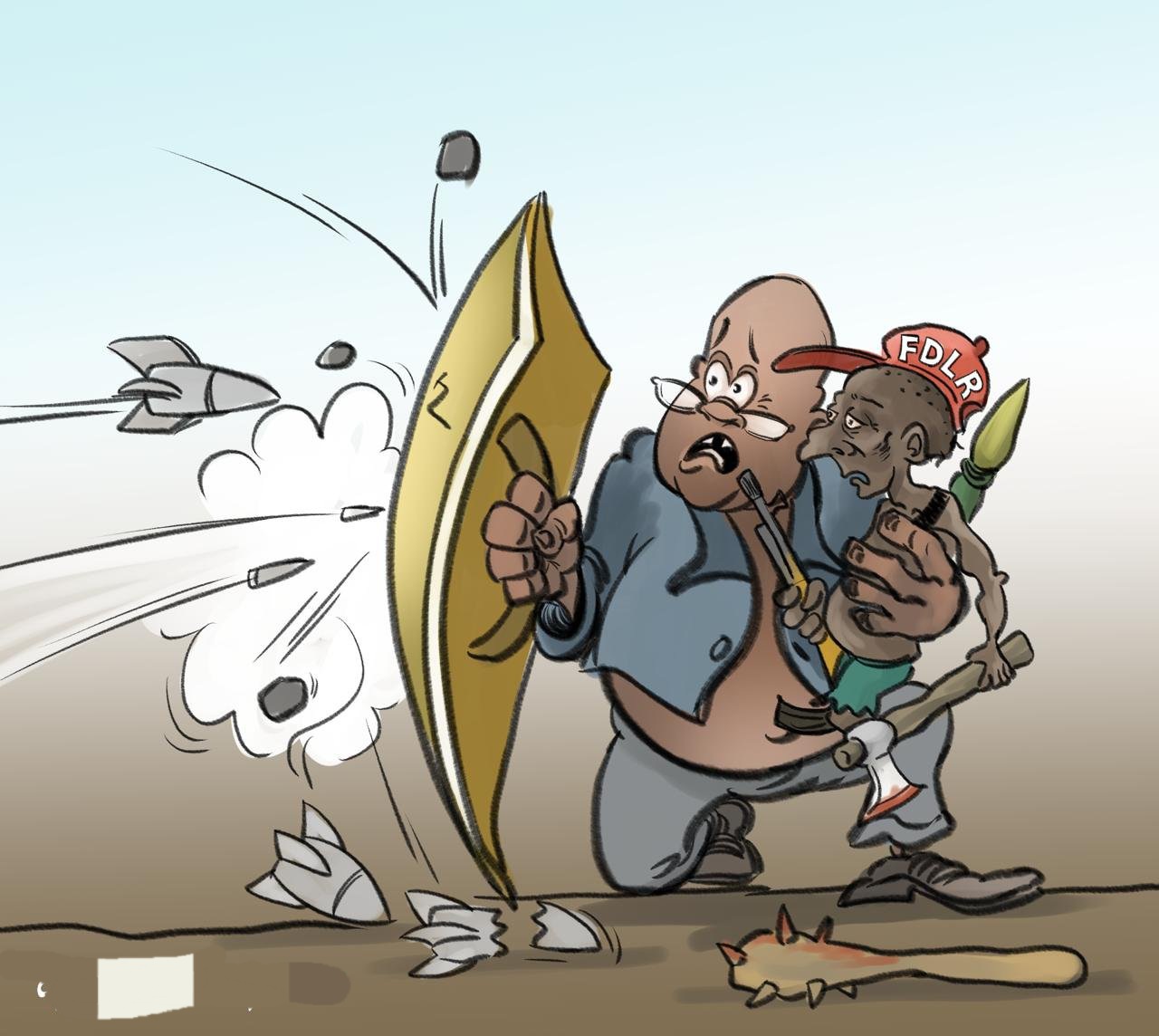
DRC leader Félix Tshisekedi has moved the notch even higher, not only providing protection to FDLR genocidal forces, but is mobilizing a coalition to attach Rwanda
Former Nigerian President Olusegun Obasanjo once confided to East African leaders that the Congo has not changed since his deployment there as a UN peacekeeper in the 1960s. That sobering assessment remains tragically relevant today.
For the last two decades, the prevailing narrative in Western capitals has been to pin the Great Lakes region’s instability on a single, small nation: Rwanda. This is a convenient fiction.
The truth is far more uncomfortable: the DRC has been a source of regional instability since the moment it gained independence.
When in 1963, the young Nigerian army officer Obasanjo first deployed in the Congo, the country was already buckling under the weight of its own contradictions—rocked by internal political crises, rebellions, and the secessionist nightmare of Katanga and South Kasai.
It took a massive UN mission, around 20,000 military personel, to temporarily stabilize the situation.
Yet, instead of learning from that chaos, the Congo has spent the ensuing decades exporting instability and its internal failures to every one of its neighbors.
From the Cold War era to the present day, successive Congolese regimes have either deliberately harbored negative forces or proven so incapable of governing their own territory that armed groups have flourished, spilling violence across borders.
Consider the historical record. Throughout the reign of Mobutu Sese Seko, the country served as a primary base for Western-backed interference against any liberation movement deemed too close to communist ideals.
Mobutu’s Kinshasa actively hosted and supported rebellions against its neighbors. It provided sanctuary for UNITA fighters destabilizing Angola. It sheltered armed groups—the CNDD-FDD and the FNL-Palipehutu—aimed at Burundi’s government.
Most consequentially, it harbored forces that had just committed the genocide against the Tutsi in neighboring Rwanda and sworn to destroy what remained of the nation’s soul.
Eastern Congo has also become a rear base for Ugandan terrorist groups, such as the Allied Democratic Forces (ADF), which is now one of the deadliest terror groups in the country.
Suffice it to say that these actions prompted multiple African nations, led by Rwanda and Uganda, to intervene militarily twice in the late 1990s, first to topple the Mobutu regime and later in an intra-African quarrel that seemingly ended with the signing of the July 2002 Pretoria Accords.
Obviously, the instability did not begin in Kigali; it radiated outward from Kinshasa’s decisions and ineptitude.
Today, the pattern remains eerily unchanged. Once again, there is a massive UN peacekeeping force, the most expensive in the world. Burundi, Rwanda, and Uganda all have security concerns based inside the DRC.
Burundi points to the Résistance pour un État de Droit au Burundi (RED-Tabara). Rwanda continues to face the genocidal FDLR. Uganda battles the ADF, which has pledged allegiance to the Islamic State.
Meanwhile, the list of purely Congolese armed groups has multiplied into the hundreds, turning the eastern provinces into a lawless mosaic of warlords.
Obasanjo himself witnessed this cycle firsthand. In 2009, he visited the country again, as UN Secretary General’s Special Envoy, this time to help settle the grievances of Laurent Nkunda’s rebellion, a three-year conflict that had paralyzed the Kivus.
The agreement signed then was supposed to bring lasting peace. Now, over a decade later, Obasanjo is back, dispatched by the African Union to settle yet another conflict born directly from the unkept promises of the March 23, 2009 peace deal.
The grievances that fueled the M23 rebellion today are the same grievances that were supposed to be resolved then: the failure to disarm the FDLR and the exclusion and gradual expulsion of Congolese Tutsi communities.
To recap: the Congo is still rocked by insecurity, secessionist aspirations in the east, in Katanga and Kasai, and hundreds of armed factions. Three of its neighbors—Burundi, Rwanda, and Uganda—view armed groups based in Congo as immediate security or existential threats.
On the border with Congo-Brazzaville, deadly communal clashes continue between the Teke and Yaka tribes over land rights, sending refugees streaming in both directions. Congolese refugees remain present in all neighboring countries, from Tanzania to Zambia and the Republic of Congo, with Uganda and Rwanda hosting the bulk, over a million and one hundred thousand respectively.
In short, the DRC poses serious problems to every country on its border.
Yet the international community has reduced this complex reality to a single conflict (M23) and a single scapegoat (Rwanda). This is absurd for a nation nearly the size of Western Europe.
The core issue is clear: the inability of Congolese leaders to manage, administer, and secure their vast territory has provided fertile ground for foreign armed groups to destabilize neighbors, and for internal communal conflicts to spill over.
The question remains, as Obasanjo might ask again today: when will that fundamental failure be addressed? And to paraphrase Thabo Mbeki, who also helped mediate this conflict when he was President of South Africa and who recently drove the point home:
Until Kinshasa takes responsibility for its own space, and especially addresses the issue of Banyamulenge and other Congolese Tutsi communities, the country, and by extension the Great Lakes region, will never know peace. Because the problem is first and foremost internal. It does not originate from anywhere else.
