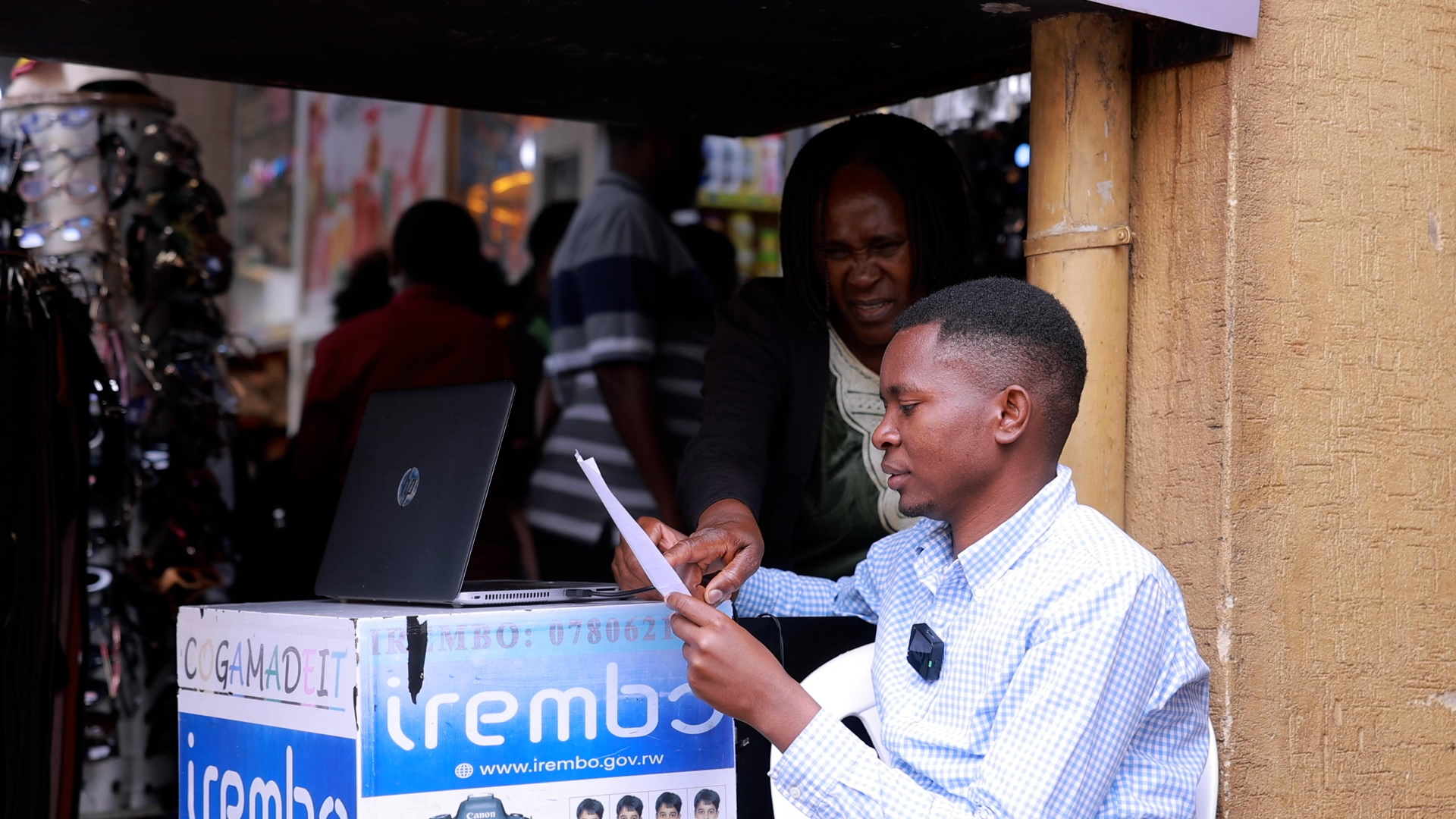
Patrick Hagenimana serves a client, viewing his role in Fintech as both a livelihood and a bridge to his future career.
KIGALI – Caesar Niyitegeka doesn’t check the calendar to decide if it’s a workday. He checks the flow of the crowd and the charge on his device.
Standing at the downtown bus park, the third-year law student at the University of Kigali is already deep into his rhythm. As an agent for Irembo, he is a human gateway to Rwanda’s digital state. While government offices across the country shutter their windows today for International Labour Day, Niyitegeka sees the quiet streets as a high-stakes opportunity to fund his next semester.
Behind his small desk, the third-year law student works with quiet urgency. “For people like us, we enjoy public holidays only when we have money,” he says, eyes fixed on a client’s land title application. “Labour Day does not necessarily mean taking a day off. It means working even harder.”
His journey to this point has not been easy. The last born in a family of seven, Niyitegeka grew up in Rusizi district (Western Province), where school was a daily test of endurance. “I used to walk more than 45 minutes to reach school,” he recalls. Resources were limited, but he stayed determined, completing his secondary education in 2017.
Sitting idle was never an option. In 2018, he moved to Kigali in search of work, taking a job as a salon cashier. A month wage of Frw40,000 or some 70-dollars then, barely covered basic survival. “It was not enough for rent or even personal development,” he says.
Faced with few choices, he turned to Fintech, learning basic digital service skills and slowly building a client base. That decision changed everything. “This job has transformed my financial development,” he says. “I pay my own fees and meet my basic needs, one commission at a time.”
The Irony of the Pause
There is a quiet irony in Kigali this May 1st. While formal employees pause to celebrate the “worker,” the city’s digital pulse is actually quickening. Niyitegeka is part of a growing “shadow” workforce—the Fintech agents—who have become the indispensable engine of Rwanda’s economy.
Located at the bustling heart of Kigali’s Central Business District, the CHIC Building (City Hill Investment Cooperative) occupies a prime strategic position at the intersection of the city’s commercial and transit hubs. It is here that Marie Claire Ingabire, an MTN Rwanda mobile money agent, operates from a space no larger than a telephone booth.
Positioned where thousands of commuters, entrepreneurs, and shoppers converge daily, her tiny stall serves as a vital financial gateway. Through her hands, the digital lifeblood of the Rwandan economy flows, proving that in this high-traffic landmark, strategic location matters far more than square footage.
“Office workers rest today, but for us, services must remain available,” she explains. “We get paid daily based on transactions. The system rewards consistency. No work means no income, even on a holiday.”
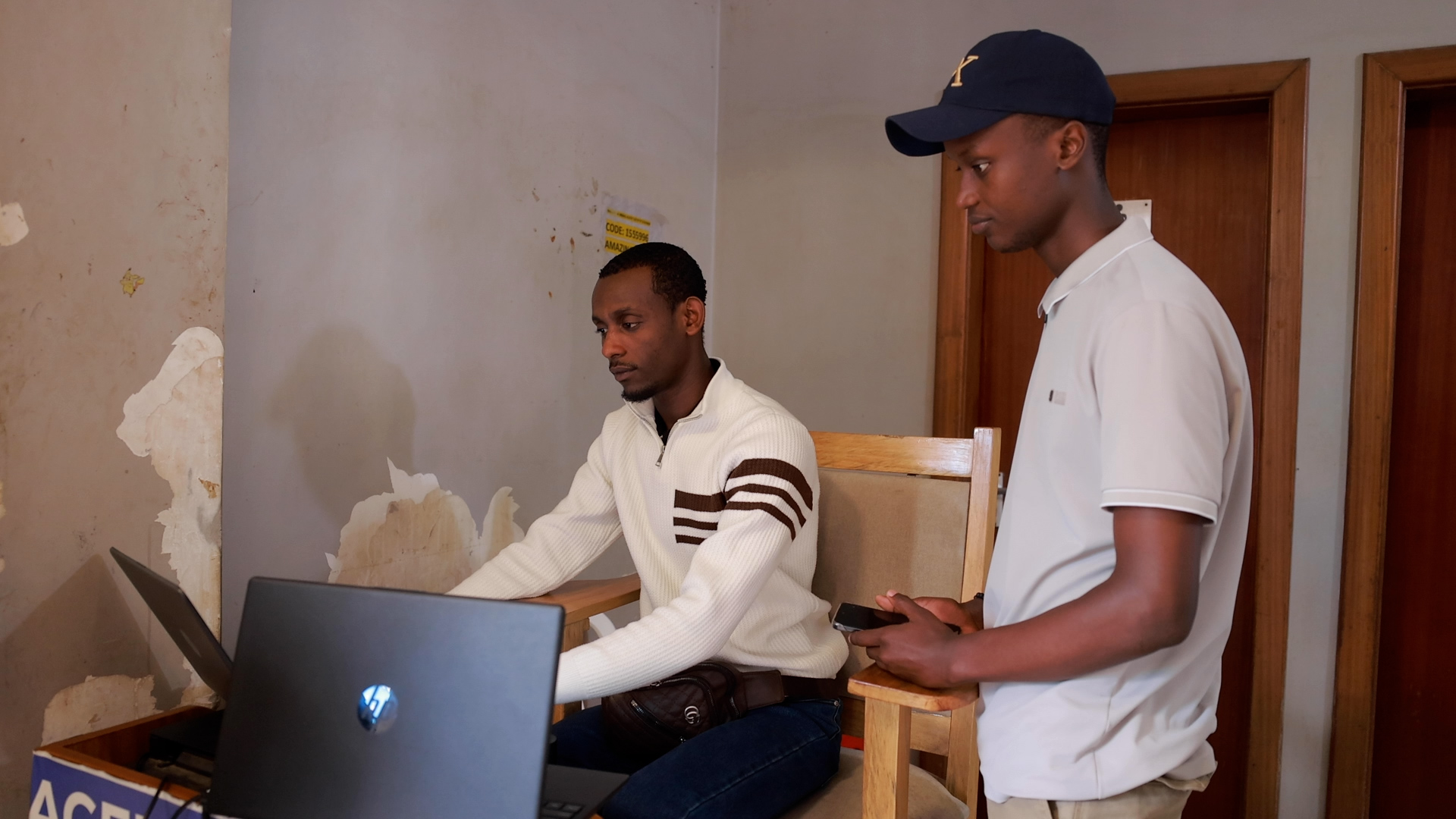
Caesar Niyitegeka processes applications at a Kigali bus park. As a Fintech agent, his “Labour Day” is defined by transaction volume rather than the official holiday.
The High-Tech “Hustle”
This street-level consistency is the primary driver behind Rwanda’s staggering 96% financial inclusion rate. However, the sector is no longer just about cash-in and cash-out. It is becoming an arena for sophisticated technology.
Under the Financial Sector Development Strategy (FSDS) 2025-2029, Rwanda is aggressively pivoting toward a “Cash-Lite” economy. Behind the simple SMS notifications on an agent’s phone, Artificial Intelligence is now the silent partner. AI algorithms are increasingly used to score credit for the unbanked in real-time and optimize liquidity across agent networks.
For 27-year-old Patrick Hagenimana, a bank agent preparing for university, this tech-heavy future is already his reality. “We attend sensitization workshops to understand how to serve clients properly. Our income depends on trust and location,” he says. In this new economy, the agent isn’t just a teller; they are a data point in a national digital transformation.
The Algorithm of the Street
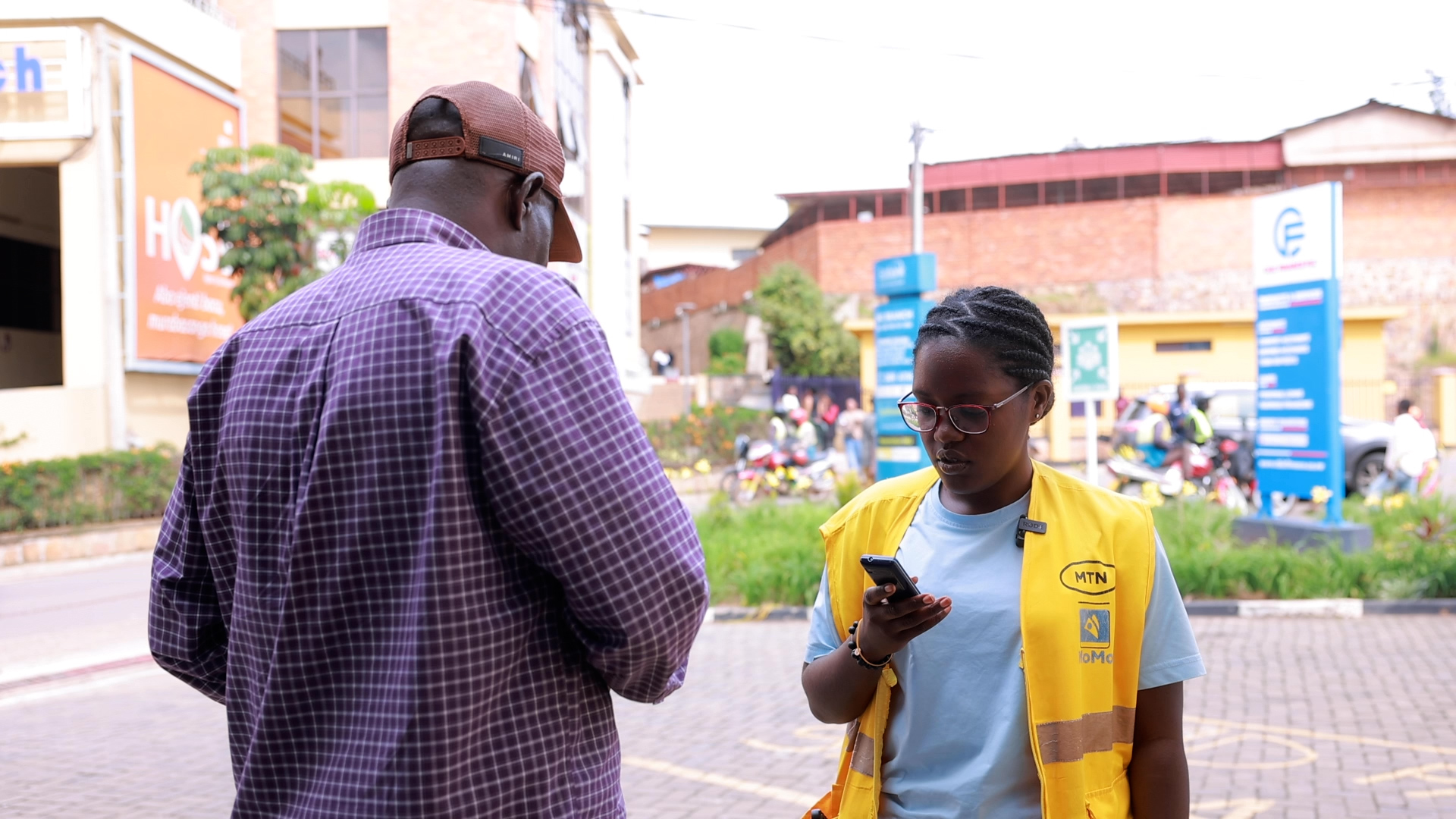
“Marie Claire Ingabire at her MTN agent stall in the CHIC Building. While the formal sector observes Labour Day, agents like Ingabire remain at their posts, serving as the vital link in Rwanda’s transition to a ‘Cash-Lite’ economy.
Situated along the high-traffic Nyamirambo–Town highway near Pele Stadium, Shemu Dukuzumuremyi operates a Tap & Go station with a strategy as rhythmic as the traffic: he follows the movement of the buses. This contactless NFC payment system, developed by the Rwandan tech firm AC Group, serves as the backbone of Kigali’s “Smart City” transit initiative by replacing traditional cash fares with a digitized smart-card system that allows commuters to board with a simple tap.
“There is no limit to this business,” Shemu says. “Whether it is a public holiday or not, it doesn’t matter. I only fail to show up when I am not feeling well or decide to go to church. Otherwise, every day is a working day.”
Beyond convenience, the system acts as a critical tool for economic transparency and financial inclusion, preventing revenue leakage for operators while bridging the gap for citizens into the formal digital economy. As Rwanda aims to double its national savings rate, agents like Shemu shoulder the weight of this transition, serving as the essential human link between a rural grandmother with a basic handset and a sophisticated, AI-driven financial backend in the cloud.
A Different Meaning of Labour
As the sun sets on another Labour Day, the formal celebrations wind down. But the glow of mobile phone screens remains bright in the hands of agents across the city.
The Fintech sector has matured into the strongest driver of economic participation in the country, with 73% of adults now active in the digital economy—a massive surge from just 30% in 2020.
While the country officially celebrates the “worker,” the people truly keeping the wheels of the modern Rwandan economy turning are still at their stations. They are transacting, counting, and connecting—keeping the Fintech economy alive, one “beep” at a time.

Caesar Niyitegeka is a third-year law student at the University of Kigali, and works as an agent for Irembo.