



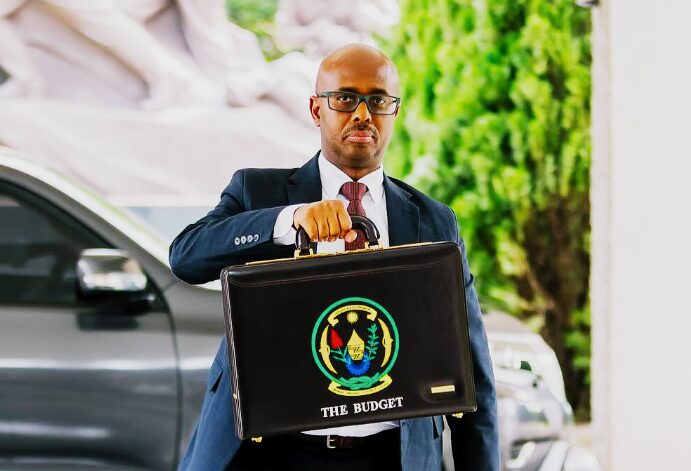
Finance Minister Yusuf Murangwa arrives at Parliament for presentation of the national budget, June 12, 2025
KIGALI — Somewhere deep inside Rwanda’s latest government audit reports lies a number that says a great deal about where the country is heading.
Over the past financial year, Rwanda’s tax revenues grew by more than 34 percent.
For most readers, the figure may sound technical — another statistic buried inside budget documents and accounting tables. But to economists and policymakers, it tells a much bigger story about the changing relationship between the Rwandan state and its economy.
Just a year earlier, Rwanda had collected about Frw 2.55 trillion in taxes. Then, during the 2024/25 fiscal year, government planners set themselves a difficult target: collect around Frw 3 trillion.
By the end of the year, the number turned out to be even higher.
According to audited government financial statements, actual tax collections rose above Frw 3.2 trillion, while broader consolidated accounts placed total tax revenues at over Frw 3.4 trillion.
In simple terms, Rwanda did not only collect more taxes than the previous year. It also collected substantially more than it expected.
The difference matters.
Governments routinely set tax targets during budget planning. Some fall short. Others barely meet expectations. Exceeding targets by nearly 8 percent while also recording year-on-year growth of more than a third is something else entirely.
To understand why, imagine a business owner who earned Rwf 2.5 million last year. At the beginning of the next year, she tells herself that if things go well, perhaps she can make Rwf 3 million. But when the year ends, her earnings reach Rwf 3.24 million.
That would mean two things happened at once:
her income grew dramatically compared to the previous year, and she also performed better than she herself had predicted.
That is roughly what Rwanda’s latest numbers show.
The government’s audit reports suggest the increase did not happen by accident. Over the last several years, Rwanda has aggressively modernized how public money is collected and tracked.
Digital tax systems have expanded. Financial reporting has become more centralized. Thousands of public institutions — from schools to hospitals and local administrative entities — have been integrated into electronic financial management systems.
At the same time, the government has been trying to widen the formal economy, bringing more businesses and workers into taxable systems.
The result is increasingly visible in the numbers.
According to the audit reports, domestic resources now account for roughly 65 percent of Rwanda’s total government financing, while foreign grants and external support make up about 35 percent.
For a country whose post-genocide reconstruction years were heavily associated with donor assistance, the shift is politically significant.
It reflects a long-term ambition that Rwandan officials rarely hide: building a state that finances more of its own development from within.
That ambition is becoming more urgent as government spending rapidly expands.
Rwanda is currently financing large infrastructure projects, airport construction, road expansion, energy investments, education reforms and digital systems. The national budget for the 2025/26 fiscal year surpassed Frw 7 trillion for the first time.
Such ambitions require money on a scale that donor aid alone can no longer sustain.
Yet the revenue surge also raises difficult questions.
Can this pace continue without placing too much pressure on businesses and households? How much of the increase reflects genuine economic expansion, and how much comes from stricter tax enforcement or inflation effects? Can domestic revenues keep rising fast enough to support the government’s growing spending plans?
Even with the strong performance, Rwanda still recorded a sizeable fiscal deficit, and public debt continues to rise alongside major infrastructure investments.
Still, the broader direction is becoming harder to ignore.
The latest audit reports portray a government increasingly focused on measurement, accountability and self-financing. From asset registration to digital accounting systems and improved revenue collection, the state appears to be building institutions designed for a future in which Rwanda depends less on external assistance and more on the strength of its own economy.
Whether the momentum lasts remains uncertain.
But for now, one figure buried inside the government’s financial statements captures the scale of the shift: more than 34 percent growth in tax revenue in a single year.
The AU will surely be eagerly waiting for the Government’s books come this June.
