


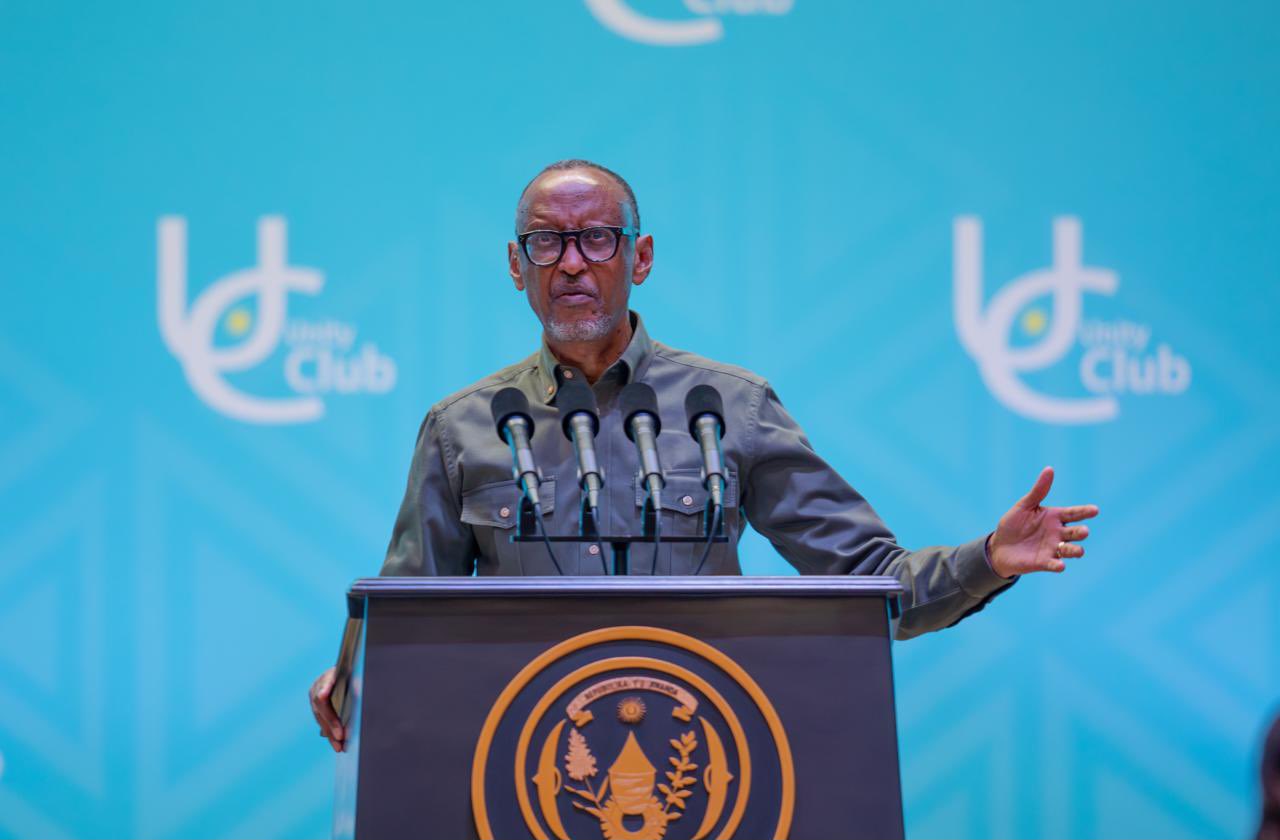
KIGALI, Rwanda — Thirty-two years after the Genocide against the Tutsi tore Rwanda apart, President Paul Kagame says the country’s greatest accomplishment is not simply that it ended one of the twentieth century’s worst atrocities, but that it chose reconciliation over revenge in circumstances many believed made such a choice impossible.
Speaking during a national forum on Saturday at the Intare Conference Arena, Kagame described Rwanda’s post-genocide recovery as an unprecedented exercise in rebuilding a nation from devastation, arguing that the country’s experience should serve as a global case study rather than a target for criticism or political manipulation.
“We did the unthinkable in an impossible situation,” Kagame told an audience that included senior government officials, members of Unity Club Intwararumuri, and hundreds of young Rwandans.
His remarks came in a reflective reflective address on the legacy of the 1994 Genocide against the Tutsi, the liberation struggle that brought it to an end, and the enduring lessons for future generations.
Kagame said that after the genocide, Rwanda faced choices that few societies emerging from mass violence had confronted.
Instead of pursuing collective vengeance, he said, the country embarked on a deliberate policy of accountability alongside reconciliation.
He recalled how Rwandan authorities tracked genocide suspects who had fled to refugee camps in Tingitingi in what is now the Democratic Republic of the Congo, Ngara in Tanzania, and countries across Europe. Those who returned, he said, were not all permanently excluded from national life.
Some former perpetrators, Kagame noted, later held positions in government. Others resumed their education, while younger returnees rebuilt their lives, with some even becoming student leaders.
For Kagame, those decisions reflected a conscious effort to rebuild a fractured society rather than perpetuate conflict.
“Rwanda should be a case study because we did the unthinkable in an impossible situation,” he said.
But the president also argued that reconciliation has limits.
He said Rwanda has spent decades extending opportunities for forgiveness, reintegration and dialogue, including to individuals who had once sought to destroy the country. Yet he warned that the nation cannot continue indefinitely accommodating those who deny, distort or seek to undermine the progress made since 1994.
“We have pleaded,” Kagame said. “But there comes a point where it must stop.”
Throughout the address, Kagame returned repeatedly to the idea that reconciliation should not be mistaken for weakness. He said Rwanda’s willingness to forgive was an act of national confidence rather than submission, and insisted that the country’s achievements should be understood within the context of the extraordinary challenges it overcame.
The president also urged younger generations to appreciate the scale of what was accomplished after the genocide, arguing that many who did not experience the violence firsthand may underestimate the difficulty of rebuilding trust between victims and perpetrators living side by side.
His comments formed part of a broader message that Rwanda must continue protecting both the truth of its history and the institutions built in the aftermath of the genocide.
The dialogue, organized by Unity Club Intwararumuri, brought together current and former government leaders, their spouses, public servants and young people for a discussion on Rwanda’s history, national unity and the continuing responsibility to prevent genocide.
For Kagame, the lesson of Rwanda’s recovery extends well beyond its borders. A nation once defined by genocide, he argued, has demonstrated that even the deepest divisions can be overcome—provided reconciliation is anchored in truth, accountability and a shared determination never to return to the past.
