



History has not always been kind to Africa when it comes to technological revolutions.
The Industrial Revolution transformed economies elsewhere while much of Africa remained under colonial rule. The digital revolution connected the world, but the continent largely became a consumer of platforms, software and technologies designed elsewhere. Even today, Africa imports much of the technology that powers its economies, often paying for innovations it had little role in creating.
Artificial Intelligence (AI) presents a rare break from that historical pattern.
Unlike previous waves of innovation, AI is still evolving. While a handful of countries currently lead in investment, computing power and frontier research, the technology remains sufficiently young that no nation has a monopoly on its future applications. The rules governing AI are still being written. The institutions that will shape its development are still emerging. This gives developing economies a unique opportunity not simply to adopt AI, but to influence how it is built, governed and applied.
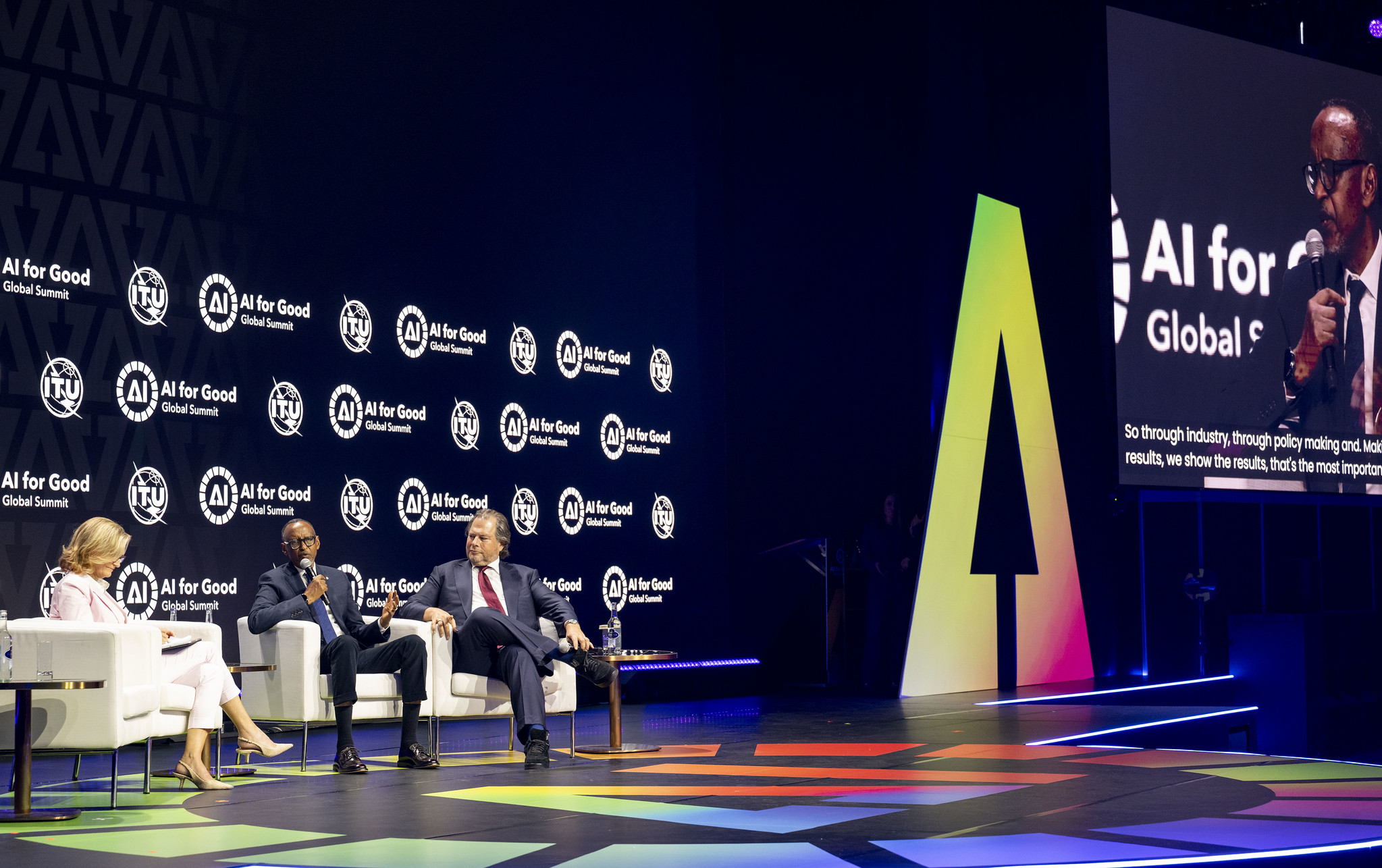
That was the underlying message from this year’s United Nations AI for Good Global Summit in Geneva.
Rather than framing AI as a geopolitical contest, discussions at the summit focused on inclusion, cooperation and shared responsibility. The central question was not who will dominate AI, but whether its benefits will reach every region of the world.
President Paul Kagame captured that sentiment when he observed that if AI is to serve humanity, it must work “in Africa and everywhere else.”
His remarks challenged a narrative that has often placed Africa on the margins of technological progress.
“In Africa, we are no longer satisfied with being passive consumers of technology,” he said. “We want to build it, deploy it, and scale it ourselves.”
That statement reflects more than ambition. It signals a changing mindset across the continent.
Earlier this year, Rwanda hosted the inaugural Global AI Summit on Africa, the first continental summit dedicated entirely to artificial intelligence. It was more than another international conference. It represented Africa’s declaration that the continent intends to participate in shaping AI rather than merely adapting to it.
The summit concluded with several important priorities. Leaders called for greater investment in AI infrastructure, including high-speed connectivity and computing capacity. They emphasized the need to develop African talent through education and research, strengthen regional collaboration, promote ethical and inclusive AI governance, encourage local innovation ecosystems, and mobilize financing that enables African startups and researchers to compete globally.
Taken together, those commitments acknowledge an important reality: Africa’s greatest AI resource is not data centres or supercomputers. It is its people.
The continent has one of the world’s youngest populations. Every year, thousands of talented engineers, researchers and entrepreneurs graduate from African universities. Yet many struggle to access advanced computing resources, research funding or markets capable of turning ideas into scalable solutions.
Closing that gap requires more than optimism. It requires deliberate policy.
Here again, Rwanda offers an instructive example.
Recognising that AI cannot flourish without clear direction, Rwanda adopted a National Artificial Intelligence Policy that provides a framework for responsible innovation and practical implementation. The policy seeks to encourage research, strengthen digital skills, promote ethical governance, attract investment and accelerate AI adoption across priority sectors such as healthcare, agriculture, education and public service delivery.
The country’s Health Intelligence Center demonstrates what that looks like in practice. By integrating real-time health data with AI-powered analytics, Rwanda is improving disease surveillance, strengthening early warning systems and supporting evidence-based decision-making. These are practical examples of AI improving public welfare rather than simply showcasing technological sophistication.
This distinction matters.
Across the world, public conversations about AI are increasingly dominated by concerns over automation and job displacement. Those concerns are legitimate. AI will undoubtedly transform labour markets, eliminate certain tasks and require workers to develop new skills.
However, fear should not become the defining narrative.
Every major technological revolution has disrupted existing jobs while creating entirely new industries and professions. The countries that benefit most are not those that resist technological change, but those that prepare their people to participate in it.
Artificial intelligence should therefore become a source of welfare, not widespread anxiety. It should improve healthcare, increase agricultural productivity, modernise education, strengthen disaster preparedness, expand financial inclusion and improve public services. It should create opportunities for entrepreneurs while making governments more efficient and responsive.
That future, however, depends on political choices.
Governments cannot treat AI as an isolated technology policy discussed only by specialists. It must become a national development priority.
This means investing in reliable electricity, digital infrastructure and affordable internet. It means modernising education systems to equip young people with digital and analytical skills. It means supporting universities and research institutions. It means creating regulatory frameworks that encourage innovation while protecting privacy, transparency and public trust. It also means ensuring that small businesses, not only multinational corporations, have access to AI tools that improve productivity and competitiveness.
For Africa, perhaps the most important lesson is that AI should become a point of shared global ownership.
Previous technological revolutions often divided the world into producers and consumers. Wealthier countries developed technologies while developing economies imported them. AI presents an opportunity to break that cycle.
Because the technology is still evolving, every country has the opportunity to become a stakeholder. African nations possess unique languages, cultures, datasets and development challenges that can enrich global AI systems. If these perspectives are excluded, AI will become less representative and less effective for billions of people.
In that sense, inclusion is not an act of charity. It is essential to building better artificial intelligence.
The launch of the AI for Good Global Commission in Geneva, co-chaired by President Kagame and Salesforce CEO Marc Benioff, reflects growing recognition that governments, industry and international organisations must work together to ensure AI benefits humanity as a whole rather than deepening existing inequalities.
Whether that ambition succeeds will depend less on speeches than on sustained investment, collaboration and political commitment.
Africa has missed previous technological revolutions not because of a lack of talent, but because it entered them too late and with too little influence over their direction.
Artificial intelligence offers something history rarely provides: a second chance.
The continent should not settle for becoming the world’s next AI market.
It should strive to become one of the places where AI is imagined, built, governed and exported.
If governments make AI a genuine national priority, invest in people as much as technology, and strengthen partnerships across borders, Africa will not simply participate in the AI era.
It will help define it.
Sylivanus M. Karemera is Station Manager, KT Radio 96.7FM, which is under Kigali Today Ltd

1 comment
I think the article identifies the right opportunity but the wrong starting point.
The argument is that Africa missed previous technological revolutions because it arrived too late and lacked investment, infrastructure and influence. I disagree. Those are consequences, not causes.
The real question is: what kind of education produces a continent that continually waits for the next revolution instead of creating it?
We speak of investing in AI infrastructure, computing power and research, yet every year our universities graduate thousands of computer scientists, software engineers and IT professionals who immediately begin searching for employment. Why? If four years of studying technology cannot produce a builder, then perhaps we should question the philosophy behind the education itself.
I say this from personal experience. I studied law, practised law, then walked away and taught myself software engineering. Today I write code and build AI products. I didn’t return to university for another degree. The knowledge was already there. AI, large language models and software development are no longer locked behind elite institutions; they are available to anyone willing to learn.
That is why I believe Africa’s greatest deficit is no longer information or even technology. It is mindset.
Our universities still largely operate on a colonial philosophy, educating people to fit into existing systems rather than to create new ones. We celebrate employment statistics instead of companies founded, patents filed, technologies exported and industries created.
Perhaps the success of a technology degree should no longer be measured by how many graduates find jobs. It should be measured by how many graduates eliminate the need to look for one.
If we truly want Africa to lead in AI, we don’t begin with data centres. We begin by redefining education. We need universities that produce founders instead of applicants, inventors instead of employees, and problem-solvers instead of certificate holders.
Africa has never lacked talent. It has lacked an education system that teaches young people to believe they can build the future rather than ask permission to participate in it. Until we change that, AI will simply become another technology we learn to consume before we learn to create.
Comments are closed.