



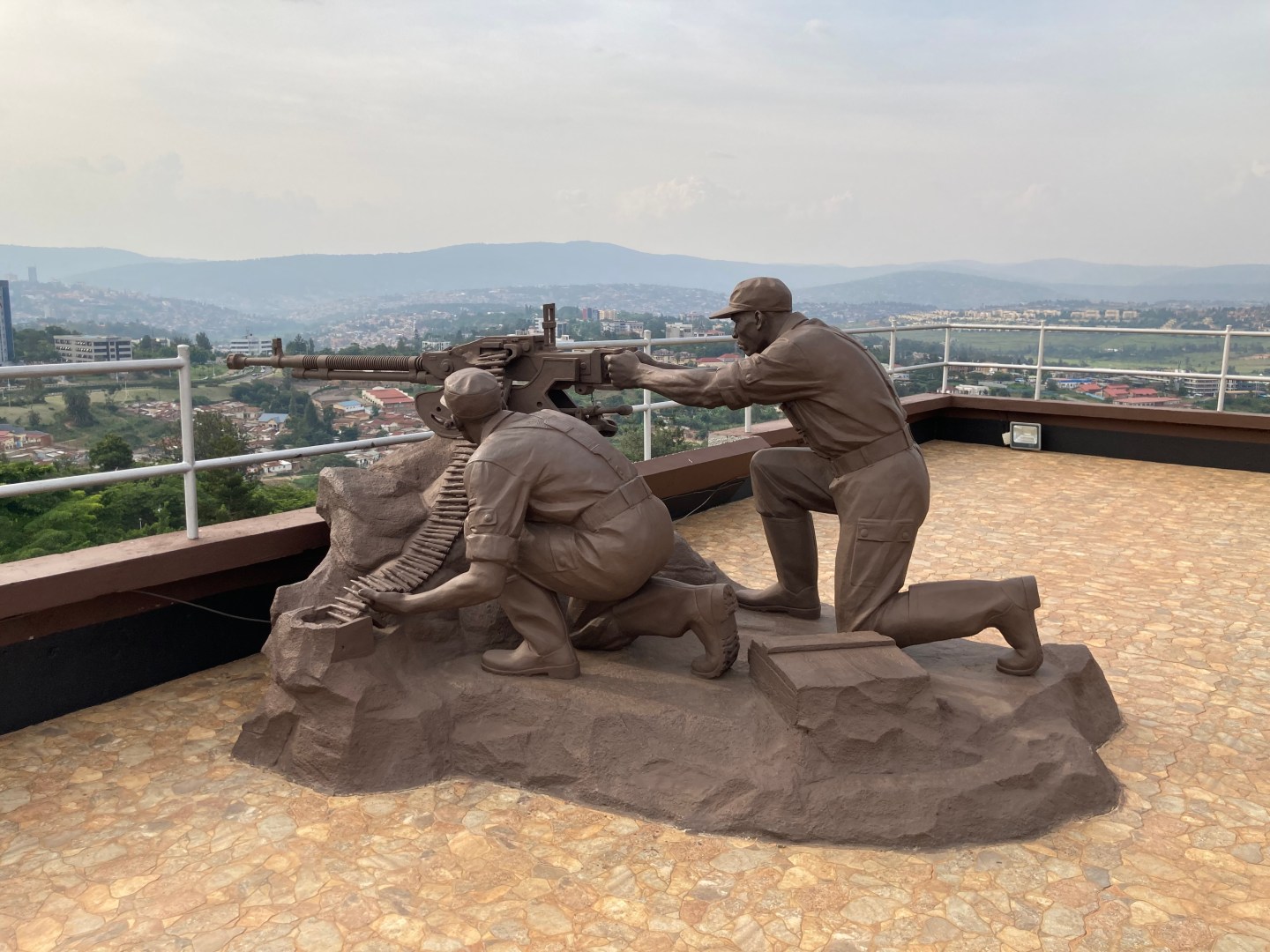
Statue to commemorate the RPA’s 3rd Battalion at the Parliament
“If you claim to be fighting thieves and you’re also a thief, what difference does it make? Can you claim to be fighting tribalism if you practice it?”
These were questions that President Kagame, then Chairman of High Command of the Rwanda Patriotic Army (RPA-Inkotanyi), asked his soldiers in 1992, as he urged them to be different from the enemy they were fighting.
For Kagame, the difference between the genocidal army and the RPA could not be reduced to uniforms and names; it had to be the values each side stood for. That difference was what gave meaning to the liberation struggle and an identity to the RPA and its successor, the Rwanda Defence Force (RDF).
Thus, the identity of the RDF cannot be understood without looking at its origin story. This was an army born out of necessity and forged in the fire of one of the darkest chapters in human history. The force’s modern legacy began by stopping the 1994 Genocide against the Tutsi, stepping into a vacuum of global inaction to save hundreds of thousands of lives.
It then took upon itself to rebuild bridges, cultivate crops, do administrative work, assist the wounded, survivors and elderly, and later repatriate refugees that were held hostages by genocidal forces in Zaire. From the early days of liberation, the military’s mission was inextricably linked to the survival and dignity of the Rwandan people.
This foundational ethos survived war and genocide and evolved into a peacetime doctrine because liberation, in the Rwandan context, was never viewed as a single historical event, but as an ongoing process of socio-economic transformation.
The military Kagame envisioned then was not just a force to fight; it was a force that is part of the people. One that must be involved in people’s everyday lives, investing in their communities, participating in social activities, mediating disputes, and contributing to economic development.
It is worth noting that Kagame’s vision run counter to the traditional view of security forces, one of detached institutions that remain confined to barracks and offices until called upon to fight an external enemy or, worse, used as a blunt instrument of domestic coercion. This explains why Rwanda, under his leadership, has spent the last three decades rewriting the role of security institutions.
Today, the RDF operates on the concept of a “People’s Army,” whose identity many armies claim but rarely embody.
For Rwanda’s security architects, true security and long-term stability are not achieved merely through the barrel of a gun. The country’s security forces must become one with the people they protect.
Today, this ethos manifests in the military’s involvement in the everyday lives of ordinary citizens. Through initiatives like the annual RDF Citizen Outreach Program, soldiers swap rifles for stethoscopes, shovels, and blueprints.
Military medical personnel regularly deploy to rural areas, providing free, high-quality specialized healthcare, performing surgeries, and treating thousands of vulnerable patients.
RDF engineers and soldiers are on the front lines of poverty reduction, constructing affordable housing for genocide survivors and vulnerable families, building schools, and connecting remote villages to roads and bridges.
Whether planting trees to combat climate change or participating in Umuganda (community work) to clear land for farming, the uniform is a constant fixture in local progress.
In brief, the RDF has fundamentally redefined the soldier’s role. They are never seen as a repressive tool of the state, but rather as a trusted friend in times of need. It is no surprise, then, that independent statistics consistently rank the security forces among the most trusted institutions in the country.
The philosophy of the People’s Army does not stop at Rwanda’s borders. The RDF has extended this ethos to the broader continent, reinforcing the idea that this is a force dedicated to the protection of not just Rwandans, but Africans at large.
Rwanda has become one of the world’s top contributors to United Nations peacekeeping missions. From the Central African Republic (CAR) to Darfur, and through critical bilateral interventions in Mozambique’s Cabo Delgado province, Rwandan forces have brought their unique brand of community-coping mechanisms abroad. Even in foreign theatres, RDF soldiers build clinics, engage with local populations, and restore dignity to communities torn apart by conflict.
Back home, the mission remains as critical as ever. Security is a fragile commodity in the Great Lakes region, and the RDF remains the ultimate shield against Congo-backed genocidal forces such as the FDLR, forces that actively threaten to undermine Rwanda’s hard-earned peace and progress.
By maintaining an unbreakable bond with the population, the RDF ensures that subversive elements find no fertile ground within Rwanda’s borders. The citizens stand with the military, and the military stands with the citizens.
Ultimately, the RDF has proven that a modern military’s greatest weapon is not its arsenal, but its alignment with the hearts and minds of the people. It stands as a powerful reminder that when an army belongs to the people, peace is not just maintained, it is sustained.
