


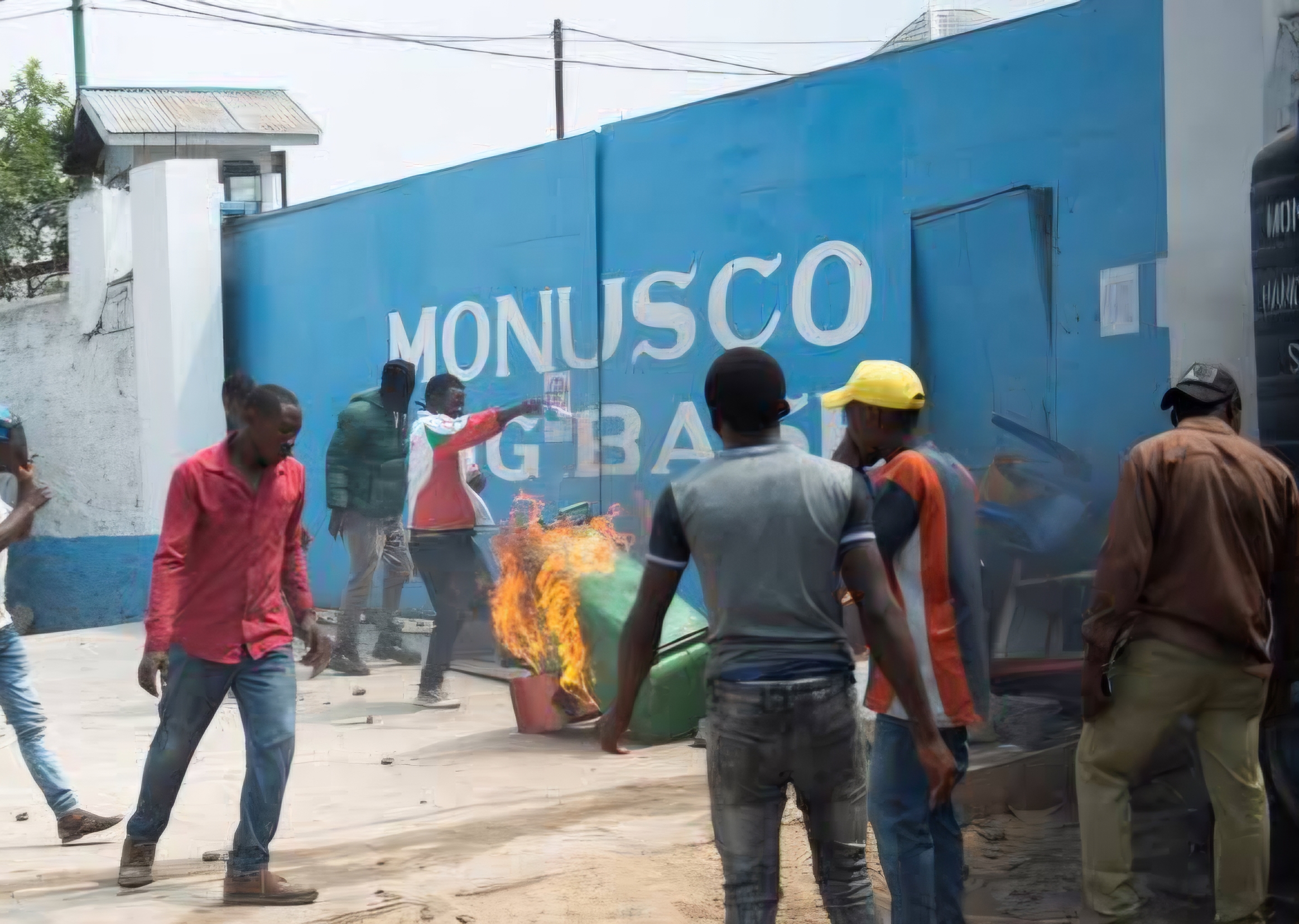
The recent incident only reinforces the growing conviction that MONUSCO has become part of the problem in DR Congo.
On one fateful morning, Céline Masika (not her real name), a Congolese national, was mourning the loss of her husband and desperately worrying about the future of the children he had left behind. Then, out of the blue, a strange but highly respected visitor arrived at her door with a “hot deal.”
The visitor, she says, was a staff member of the United Nations Organization Stabilization Mission in the Democratic Republic of the Congo (MONUSCO). The offer was simple: pose as an FDLR fighter, a United Nations and United States- sanctioned genocidal militia backed by the Congolese government, and be sent to Rwanda under the UN mission’s Disarmament, Demobilization, Repatriation, Reintegration and Resettlement (DDRRR) programme.
“MONUSCO staff came and said to me: ‘How will you survive with these children?'” Masika recalls. “He then advised me to take the children and cross into Rwanda, promising that I would get money. He also advised me to tell the Rwandan authorities that we were soldiers. He further pledged that he had arranged a military rank for me so that I could pocket more money.”
Masika went on to say that she was told she would receive $1,500 and was immediately issued a document stating that she had been an FDLR combatant in its Logistics and Supply branch (S4).
“The MONUSCO staff member was quick to give me a military rank which I know nothing about, as I have never been in the military, not even for a single day in my life,” she added.
This Kinyarwanda speaking Congolese woman shares exactly the same story as 38 other Congolese nationals, the majority of whom speak Swahili, Lingala, and other vernacular languages, whom Rwanda deported back to the DRC on Wednesday, July 29, 2026, after discovering that they had been illegally admitted to the Mutobo Demobilisation and Reintegration Centre. The centre provides rehabilitation and reintegration courses strictly reserved for former Rwandan members of armed groups.
They had been at Mutobo for the past seven months, hoping to receive the money pledged to them by MONUSCO staff members who had mobilised them to pose as FDLR combatants. However, they waited in vain until they finally decided to spill the beans to the centre’s authorities.
“I want to return home to Congo because what I was told before coming to Rwanda were lies. I am a resident of Kitshanga in North Kivu Province,” another member of the group, a visibly disappointed father of two, told the media.
The Rwanda Demobilization and Reintegration Commission (RDRC) said its due diligence and scrutiny of the Congolese nationals confirmed that these people had never been FDLR fighters.
“Two weeks ago, we told the head of the DDRRR programme and their staff that we were dissatisfied because, instead of sending us FDLR fighters for whom we are responsible, they were sending us the wrong elements,” said Valérie Nyirahabineza, the RDRC chairperson.
Many observers share a common conviction that this incident lays bare a troubling reality: throughout its 27 year presence in the DRC, MONUSCO has never been pragmatic in neutralising the FDLR, despite it being one of its core mandates. The UN force, they argue, has instead been playing a dangerous game of hide and seek with a genocidal group that remains an existential threat to Rwanda.
“The UN force has often chosen to deflect blame onto Rwanda for its failure to fulfil its mandate, part of which is to neutralise the perpetrators of the 1994 Genocide against the Tutsi and the armed groups they have created. Clearly, MONUSCO has become a stumbling block to peace and stability in the region, despite the billions of dollars spent on it.” a security analyst noted.
Nearly three decades after the UN mandated the mission to deal with genocidal and terrorist groups such as the FDLR and ADF, these groups continue to operate, killing scores of civilians while destabilising the Great Lakes region. The recent incident only reinforces the growing conviction that MONUSCO has become part of the problem.
