


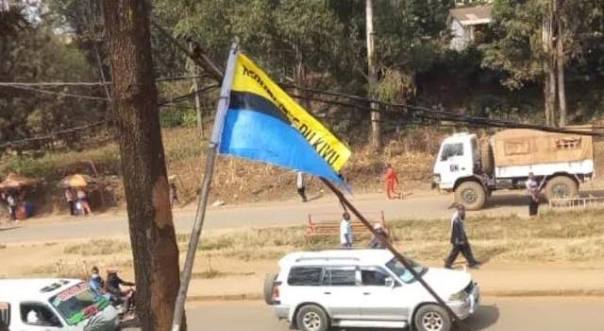
These flags of a “Republic of Kivu” are slowly becoming a trend on social. Kinshaka is working over-time to create conditions for the reality of the Kivu colours.
The arithmetic of the conflict in eastern Democratic Republic of Congo (DRC) is simple, yet Kinshasa refuses to do the math.
For years, President Félix Tshisekedi has searched for explanations for his army’s steady retreat in the Kivus. He has blamed Rwanda, the M23, and former President Kabila. He has even blamed the international community.
But the one culprit he refuses to name is the very force that is dragging his military into the abyss: the genocidal FDLR.
Had Tshisekedi not been blinded by the belief in an elusive military victory, he would have realized that the refusal to neutralize the FDLR is the main reason his government is losing the Kivus.
Consider this. The FDLR is a militia founded by the perpetrators of the 1994 Genocide against the Tutsi. It has spent decades terrorizing Congolese communities, particularly the Tutsis.
It operates openly in the Kivus, often in coordination with the Congolese army itself. And yet, instead of dismantling this group, Kinshasa has chosen to embrace it.
The recent diplomatic tour by Minister Floribert Anzuluni, who traveled across Africa and Europe carrying a letter signed by FDLR leader Gaston Iyamuremye alias Victor Byiringiro, is the most brazen example yet.
A sovereign state dispatched its minister to lobby on behalf of a foreign genocidal militia while fighting its own people. This is a strategy for defeat, and here is why.
As long as the FDLR remains active, the M23 will have a reason to exist. Indeed, for the M23, the FDLR is not a distant threat; it is an immediate enemy that must be confronted.
Every attack by the FDLR and its affiliated militias against Tutsi communities strengthens the M23’s determination to continue fighting. The alliance between Kinshasa and the FDLR validates the M23’s claim that the Congolese state is captive to genocidal forces.
The longer Kinshasa shields the FDLR, the more recruits the M23 gains and the more territory it captures. This is the current logic of the battlefield.
It is therefore not surprising that the M23, now the AFC/M23, has grown like bamboo, rapid, resilient, and impossible to ignore. It now controls significant parts of the Kivus, and its ranks are swelling. None of this would be possible if Kinshasa had made the strategic choice to dismantle the FDLR.
Without the FDLR, the M23 would lose one of its core grievances. Without the FDLR, Rwanda would have no justification for vigilance. Without the FDLR, Kinshasa would have a credible argument for regional support. But Kinshasa has chosen otherwise, and it is paying the price.
Every delay in implementing the Washington Accords, every diplomatic stunt, every letter carried across continents buys the FDLR time but costs Tshisekedi ground.
The Kivus are slipping further from his grasp, not in spite of his strategy, but because of it. His army is stretched thin and, with every battlefield loss, his legitimacy is eroding.
Meanwhile, his allies are growing impatient. And at the center of this unraveling is a single, avoidable choice.
Kinshasa cannot defeat an enemy it refuses to acknowledge, let alone one it actively protects. The alliance with the FDLR has not made the DRC stronger; it has made it weaker. Worse, it has turned a manageable security problem into an existential crisis.
The international community must understand this. The conflict in the Kivus is not about Rwanda. It is not about the M23. It is about a Congolese state that has chosen to shield a genocidal militia instead of confronting it.
Rwanda’s security measures and the M23 rebellion are mere reactions to this choice. And until that choice is reversed, the conflict will continue and Kinshasa’s defeat will keep deepening, with the loss of territory its most visible feature.
The path forward for Kinshasa is clear. End this unholy alliance, neutralize the FDLR, and stop the excuses. Keeping the Kivus is still possible, but only if Kinshasa finally does the math.
