



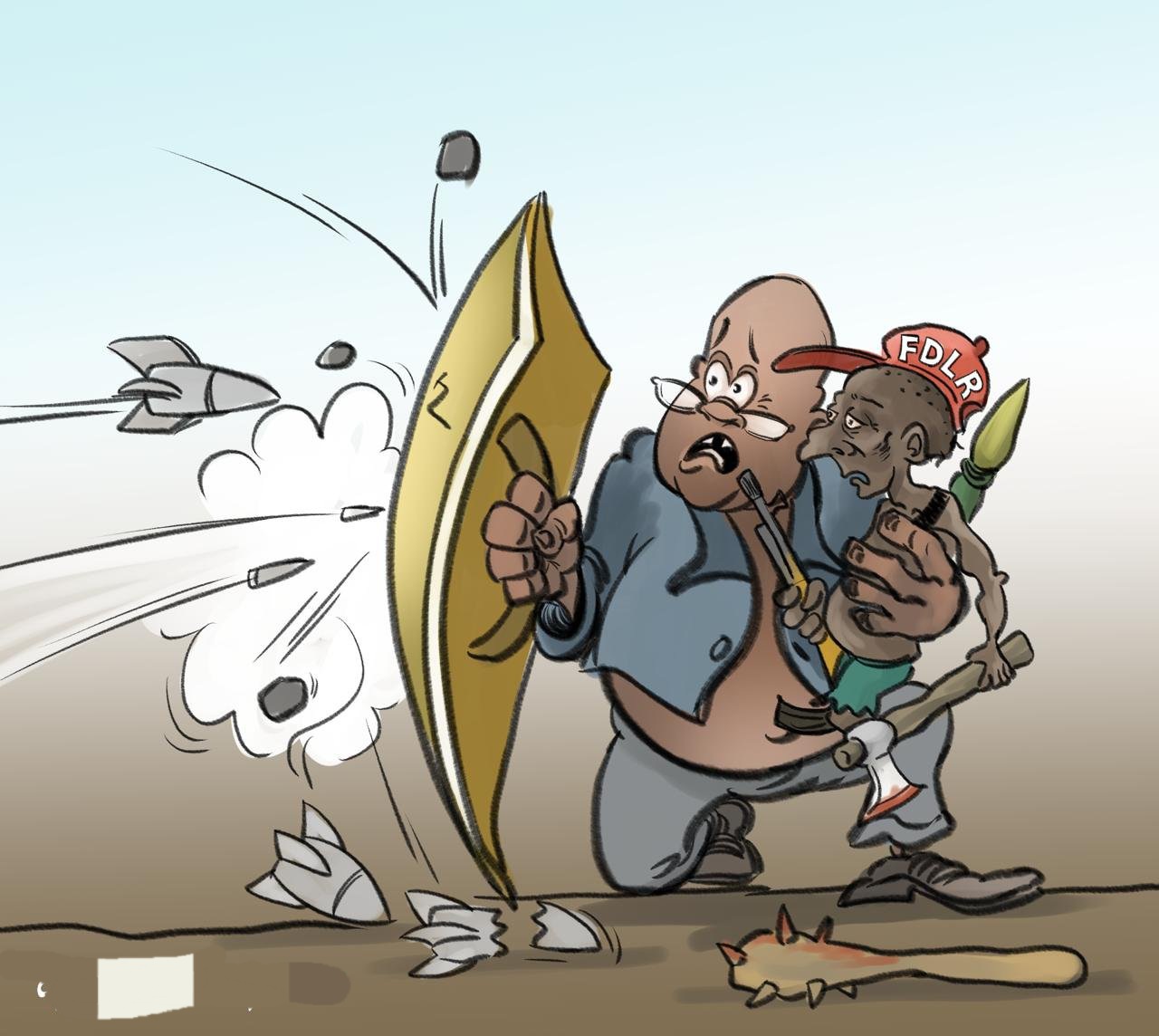
DRC leader Félix Tshisekedi has moved the notch even higher, not only providing protection to FDLR genocidal forces, but mobilized a coalition for regime change in Rwanda
One of the most misleading debates about the conflict in eastern Democratic Republic of the Congo (DRC) is the persistent question: Where is the FDLR?
This question has become a distraction from the real issue. The problem is not that the FDLR cannot be found. The problem is that many continue to look for it as if it still existed as a distinct and separate armed group.
The Washington peace process was built on a simple principle of reciprocal obligations. Rwanda was expected to lift its defensive measures. At the same time, the DRC committed to neutralizing the Democratic Forces for the Liberation of Rwanda (FDLR), which crossed into the DRC after committing the 1994 genocide against the Tutsi in Rwanda.
Washington Accord commitments were intended to be implemented simultaneously because each was considered essential to restoring confidence and creating the conditions for lasting peace.
More than a year later, the implementation of these commitments appears uneven.
Rwanda maintains that it has begun to lift its defensive measures gradually. By contrast, there has been little visible progress in neutralizing the FDLR. Yet international attention has focused overwhelmingly on Rwanda’s obligations. Sanctions have been imposed, diplomatic pressure has intensified, and compliance has been closely scrutinized. Meanwhile, the DRC has faced comparatively little public pressure regarding its commitment to dismantle the FDLR.
This imbalance raises an important question: Can a peace agreement succeed when one party’s obligations receive far greater scrutiny than the other’s?
The debate becomes even more troubling when some Congolese officials, and at times voices associated with mediation efforts, claim that the FDLR is concentrated in territories controlled by the M23. If this narrative is accepted without scrutiny, it risks creating the false impression that neutralizing the FDLR depends primarily on developments in M23-held areas.
However, this overlooks a critical reality, as highlighted by former combatants, researchers, and regional observers.
The FDLR has evolved.
It is no longer accurate to view the organization solely as a conventional armed movement occupying clearly defined territory. Over time, many of its fighters have reportedly become integrated into broader military coalitions that fight alongside the Congolese army.
The formation of the Wazalendo coalition illustrates this evolution. By uniting numerous armed groups operating in North and South Kivu, the coalition has become a key component of military operations against the M23. Testimonies from former FDLR members, including former combatant Col. Augustin Nshimiyimana, aka Bora, and other returnees, indicate that FDLR fighters now operate within or alongside Wazalendo formations. Some have also asserted that senior FDLR members hold influential positions within the FARDC.
Based on firsthand and corroborated testimony, asking where the FDLR is located misses the point.
The organization cannot be understood solely in territorial terms. It must also be understood in terms of networks, integration, and influence.
This distinction matters because peace agreements are implemented through action, not through narratives.
If the FDLR has become embedded within military structures allied with the Congolese state, the obligation to neutralize it cannot be met merely by pointing to territory under M23 control. Nor can it be achieved by redefining the problem instead of addressing it.
The continued presence of the FDLR should concern everyone committed to lasting peace in the Great Lakes region not only because of its military activities but also because of the extremist ideology it promotes. An armed group can be disbanded, but an ideology that is allowed to spread through institutions and allied forces becomes far more difficult to eradicate.
This is why debates about geography risk obscuring the larger challenge.
The more important question is, “Has the FDLR been effectively dismantled, or has it simply changed form?”
Until that question is answered honestly and addressed with equal commitment from all parties, the Washington peace process will remain incomplete.
Peace in eastern DRC requires more than ceasefires, diplomatic declarations, and political symbolism. It requires every party to fulfill its obligations without exception and without double standards. Rwanda’s commitments should be evaluated, as should the DRC’s obligation to neutralize the FDLR.
Ignoring that obligation does not advance peace. It only delays it.
A durable settlement will be possible only when the FDLR is confronted in all its forms, as an armed network, as an organizational structure, and as an ideology. Pretending that the problem lies only on the map will not resolve one of the region’s longest-running security threats.
