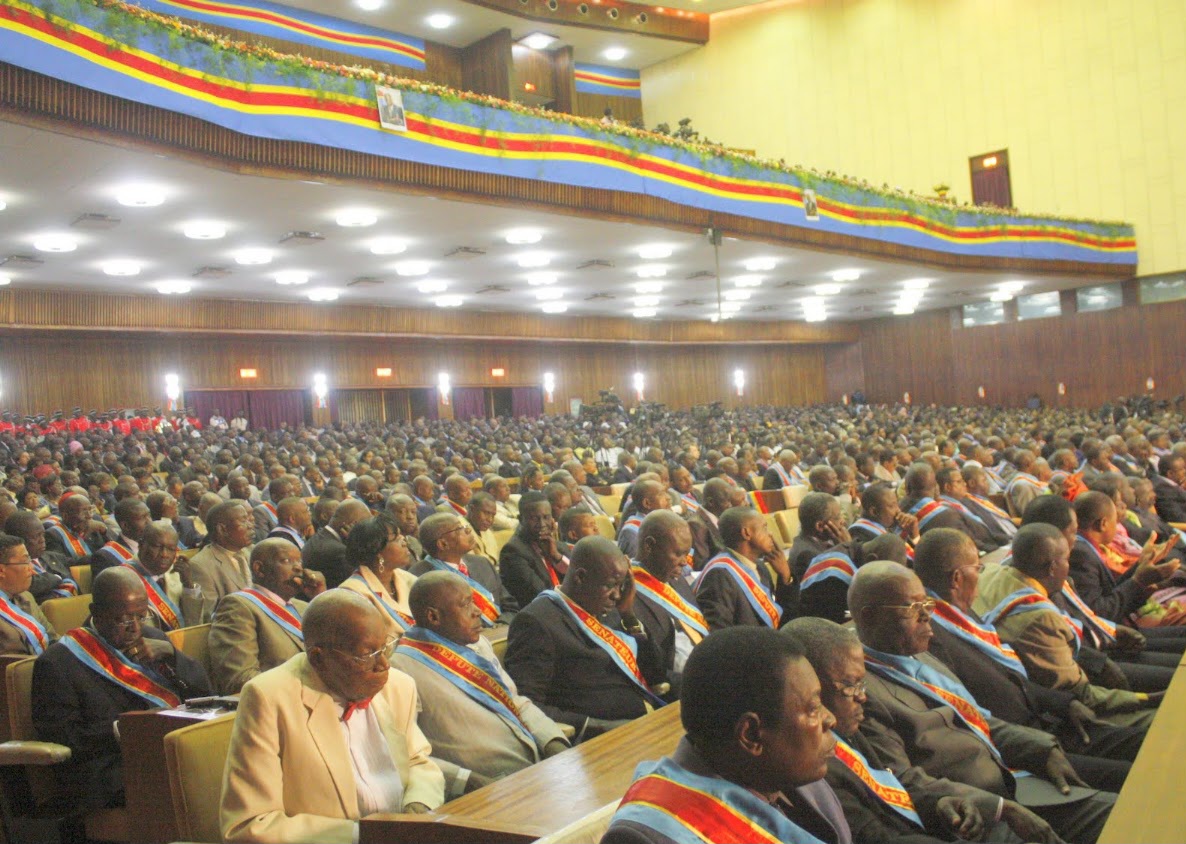
Inside DR Congo Parliament based in Kinshasa
KIGALI, Rwanda — The Democratic Republic of Congo’s pledge to dismantle the FDLR has come under renewed scrutiny, with former senior members of the Rwandan ethnic-extremist militia group reporting that it has allies within Congo’s political and security establishment.
The former FDLR officers say that the group’s influence extends beyond its armed fighters in eastern Congo, alleging that some politicians and military officers serve its interests or help give it a voice within the Congolese state.
Their revelations come after Kinshasa announced last month that the FDLR had agreed to lay down its weapons, a development the Congolese government presented as part of its obligations under the Washington peace agreement with Rwanda.
The agreement, signed in Washington on June 27, 2025, calls for the dismantling of the FDLR, the disarmament of armed groups operating in eastern Congo, the removal of Rwanda’s defensive measures and the facilitation of refugee returns.
The agreement was formally endorsed by Rwandan and Congolese leader, witnessed by U.S. President Donald Trump in December 2025.
But former FDLR officers interviewed by range of local media argue that declarations about disarmament do not amount to the group’s elimination.
Major (Rtd) Peter Kubwayo, a former FDLR commander, described Kinshasa’s latest announcement as an attempt to distract public attention from the group’s continued existence.
He pointed to an earlier disarmament exercise in Kamina in 2001, saying fighters had handed over or displayed some weapons while retaining others.
“We did it in Kamina, and I was there,” Kubwayo said, recalling how former FDLR members presented themselves to MONUSCO in September 2001.
He reports that fighters had kept weapons elsewhere and later used them when attacked by Congolese forces before escaping toward Masisi.
Lieutenant Colonel (Rtd) Emilien Mpakaniye, another former FDLR officer, similarly argued that previous attempts to relocate or disarm FDLR members had failed to eliminate the group.
He cited operations in 2014 that moved some FDLR members to Kisangani, Walungu and Kanyabayonga.
According to Mpakaniye, those transferred included elderly and sick people, while the group retained other capabilities.
“Dismantling the FDLR is possible, but the DRC government cannot do it,” he said.
Political connections
Kubwayo went further, revealing that the FDLR has political representatives within Congo’s National Assembly.
He reported that politicians elected in areas where the FDLR has exercised influence have effectively become voices for the group inside the Congolese political system.
He named Jean Bosco Sebishyimbo, Safari Nyagatare, Jacques Nganizi and Justin Bitakwira, alleging that they were elected with FDLR support. All these are member of parliament representing regions in North and South Kivu that have been FDLR control for past two decades.
“They are FDLR representatives within the government,” Kubwayo said.
Kubwayo also reported that the FDLR maintains links with elements of Congo’s security establishment.
He cited several military officers, including Col. Karateka in Masisi, Col. Nsengiyumva Anaclet, whom he said works for Demiapu in Kinshasa, Col. Rucyahana Jean Baptiste in the police in Lubumbashi, and Col. Mbango Mbau, whom he described as a commander in Beni.
Kubwayo questioned whether a pledge to disarm could be considered meaningful without addressing such networks.
“If they say the FDLR members are old men whom they are going to bring back, what about those who have gone to train in drone operations?” he asked.
He also questioned whether the officers he named would be removed from their positions.
Rwanda says the FDLR must be dismantled
The latest details come as Rwanda continues to insist that the FDLR must be completely dismantled before Kigali removes the defensive measures it says were put in place to address the threat posed by armed groups operating near its border.
Rwanda’s Foreign Minister, Olivier Nduhungirehe, recently said the FDLR has no place in the implementation of the Washington agreement other than being dismantled.
“The FDLR must be dismantled, as provided for in the Washington Agreement,” Nduhungirehe said.
He argued that the group was specifically addressed in the agreement because it was not a signatory to the accord.
Nduhungirehe also accused the FDLR of working with the Congolese army, saying elements of the group had been incorporated into the FARDC.
He dismissed recent exchanges between the FDLR and the Congolese government as a form of political theatre.
“The FDLR writes to the DRC government, and the DRC government responds,” he said, describing the exchanges as tactics designed to delay implementation of the agreement.
A decades-old armed group
The FDLR has operated for more than three decades in eastern Congo.
Its origins are traced to former members of Rwanda’s army and Interahamwe militia members who fled into what was then Zaire after taking part in the 1994 Genocide against the Tutsi in Rwanda.
The organisation initially operated under the name RDR in 1995, later becoming ALiR and eventually the FDLR-FOCA in 2000.
The group has remained one of the central security issues in the Great Lakes region and a longstanding point of tension between Rwanda and Congo.
For Kigali, its presence in eastern Congo represents an unresolved security threat.
Kinshasa has repeatedly announced efforts to neutralise armed groups operating in the east, while international peace and diplomatic initiatives have sought to address the region’s overlapping security and political crises.