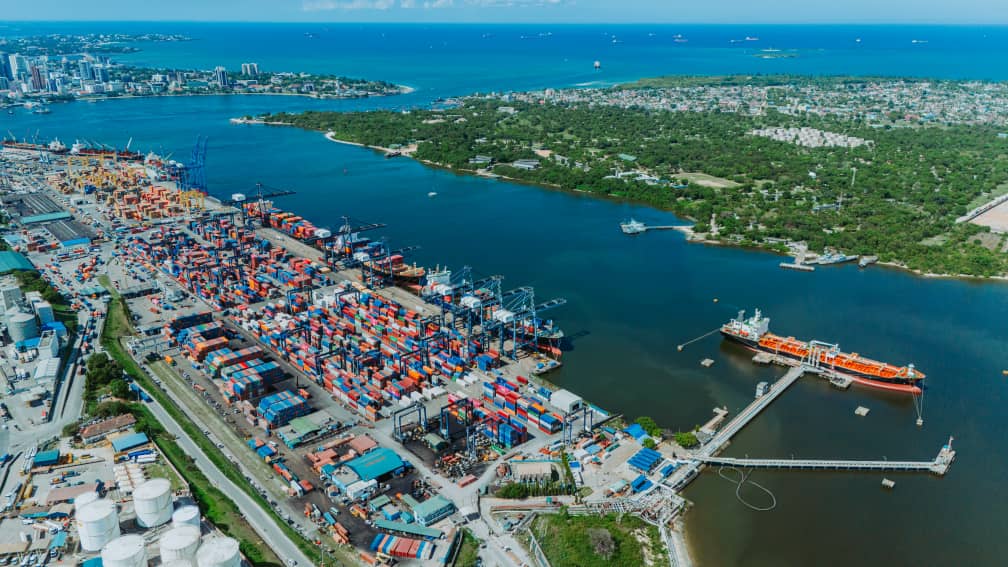
DAR ES SALAAM — More Rwandan cargo is moving through Tanzania’s Dar es Salaam Port as improvements at the port and along the wider transport corridor begin to change how goods move between the Indian Ocean and inland markets.
Transit cargo through Dar es Salaam rose 17% to 14.61 million tonnes in the 2025/26 financial year, with Rwanda-bound cargo increasing 24% to 2.18 million tonnes.
The Democratic Republic of Congo remained the largest transit market, with cargo rising 30% to 7.77 million tonnes. Zambia accounted for 3.41 million tonnes.
The figures show that Dar es Salaam is handling a growing share of regional trade as businesses look at the cost, speed and reliability of different routes into landlocked countries.
For Rwanda, the increase comes as Tanzania invests in roads and railways and private operator DP World upgrades operations at Dar es Salaam Port.
Faster at the Port
The port handled 33.71 million tonnes of total cargo in 2025/26, up 21.5% from the previous year.
The improvement has also been visible in how quickly ships are handled.
Average container-vessel time at berth has fallen from about 10 days in 2020/21 to around three days in 2024/25.
At Terminal 1, operated by DP World, reported discharge times for comparable operations have fallen from more than 300 hours to less than 28 hours since the company began operating the terminal in April 2024 under a 30-year concession.
DP World says it had invested $123 million in the port by April 2026, including equipment, infrastructure, technology and operating systems.
Eight new diesel-electric rubber-tyred gantry cranes were commissioned in June to improve container handling.
Container traffic has also climbed sharply.
The terminal handled 44,001 containers in May, 45,856 in June, 46,582 in July and 48,793 in August, according to regulatory data.
Before 2024, monthly volumes were generally between 8,000 and 13,000 containers.
The port is also handling larger vehicle carriers and more dry bulk, general cargo and roll-on/roll-off traffic.
The Race Continues Inland
But getting cargo off a ship faster is only one part of the journey.
For Rwanda and other landlocked countries, the real test comes after cargo leaves the port.
Trucks and trains must move efficiently through Tanzania, cargo must clear borders quickly, and transport operators must be able to offer predictable delivery times.
Tanzania began commercial freight services on the Standard Gauge Railway between Dar es Salaam and Dodoma in July 2025. Work is continuing on sections that will eventually extend the railway farther west.
The Kwala dry port is also being developed as an inland logistics centre. It is designed to handle about 300,000 containers a year and has space allocated for cargo serving countries including Rwanda, DRC and Zambia.
Tanzania is also working to revive the Tanzania-Zambia Railway, or TAZARA, which links the Tanzanian coast with Zambia and the wider Southern African market.
Road infrastructure is being upgraded as well.
At Tunduma, on the Tanzania-Zambia border, the approach is being widened from one lane to four to reduce congestion affecting trucks travelling between Tanzania, Zambia, DRC and other markets.
More Choices for Rwanda
The changes are significant for Rwanda because importers and exporters have several corridors to consider when moving goods to and from the coast.
Dar es Salaam is competing with other regional routes on more than port capacity.
The cost of trucking, rail availability, border procedures, customs clearance and the time it takes for cargo to reach Kigali all matter.
The 24% increase in Rwanda-bound cargo suggests that Dar es Salaam is becoming more attractive for some Rwandan traders and businesses.
But the growing volumes do not settle the wider competition between regional corridors.
Zambia, for example, recorded lower cargo volumes through Dar es Salaam even as the port’s overall transit business expanded.
That shows that better port performance alone does not guarantee that cargo owners will change routes.
The competition is increasingly about the entire journey.
A faster ship turnaround helps. So does a reliable railway, a less congested road, quicker border clearance and predictable delivery times.
For Dar es Salaam, the next challenge is to make sure the gains at the port continue all the way to customers hundreds or thousands of kilometres inland.