



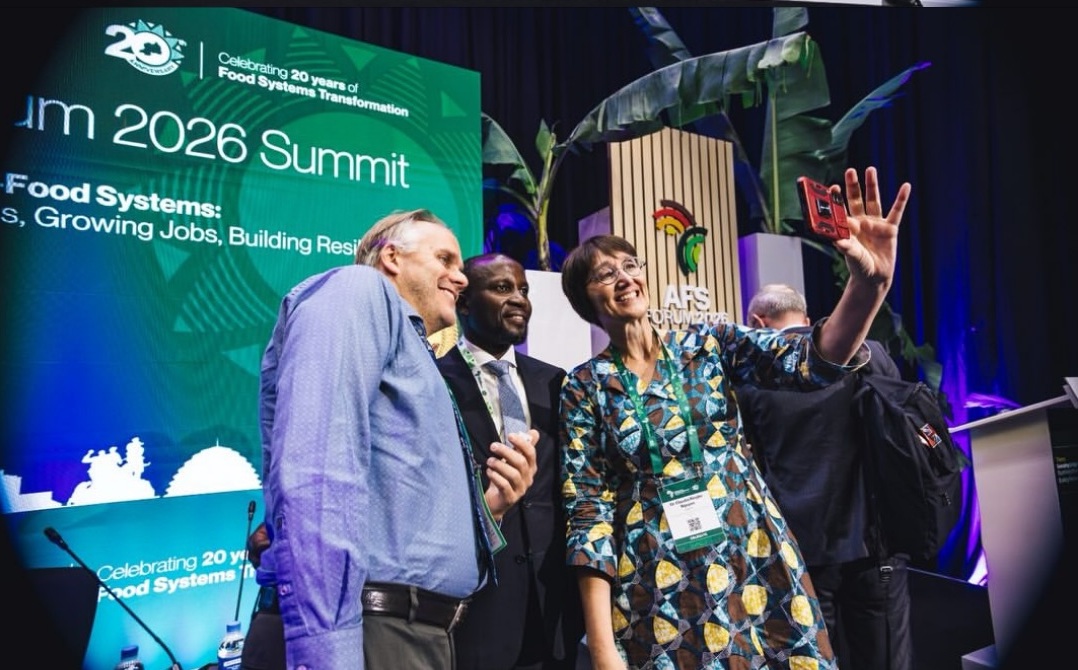
Former Agriculture Minister Dr. Ildephonse Musafiri (center) in light moment with other delegates at the AFSF 2026
KIGALI — If you wanted to understand why the Africa Food Systems Forum 2026 was such a big deal, you had to look beyond the plenary speeches and follow the action inside the Deal Room.
For five days, Kigali became the place where Africa’s agricultural ambitions met the harder realities of finance, technology, policy and delivery.
The scale of the ambition was clear from the start. The African Union is seeking to mobilise $100 billion in public and private investment for food systems by 2035, under the new Comprehensive Africa Agriculture Development Programme 2026–2035. The framework targets a 45% increase in agrifood output and a tripling of trade in agricultural and food products between African countries.
But the mood was not simply celebratory.
The Alliance for a Green Revolution in Africa, through its 20-year impact, learning and foresight report, offered a candid assessment of two decades of agricultural transformation. Productivity has improved, but income gains for farmers remain partial. Markets and finance have not expanded fast enough.
That gap — between what Africa knows and what it can actually deliver — became one of the forum’s central themes.
The Deal Room provided a practical response.
Liberia presented a $907.75 million investment programme aimed at reducing its dependence on imported rice, while Tanzania presented opportunities built around its maize surplus, edible-oil deficit and growing avocado exports.
Several major financing announcements reinforced the message.
The International Fund for Agricultural Development, a United Nations institution that finances rural development and agriculture, launched a $200 million blended-finance facility for climate adaptation in Rwanda, Kenya, Tanzania and Uganda.
A separate $21 million partnership with Bank of Kigali is expected to expand financing for farmer organisations in Rwanda.
But perhaps the most striking innovation came from the host country itself.
Rwanda announced an ambition to use artificial intelligence to reach more than 2.5 million farmers within the next three years, using the technology to strengthen agricultural extension services — the system through which farmers receive expert advice on crops, livestock, pests, weather and farming practices.
The approach is already being tested through tools such as Tunga, an artificial-intelligence-powered Kinyarwanda voice assistant that allows farmers to ask agricultural questions and receive advice from a validated knowledge base.
This matters because the forum was not only about putting more money into farming. It was increasingly about changing the infrastructure through which farmers access knowledge, finance, markets and technology.
The same principle emerged from the Consultative Group on International Agricultural Research, the world’s largest agricultural research partnership. It highlighted hundreds of innovations developed for African agriculture but warned that too many remain trapped in pilot projects.
The missing link is the ability to connect research, finance and delivery at scale.
The strongest message from Kigali was therefore simple: Africa does not lack ideas. It lacks scale and implementation.
That is what made the 2026 forum significant.
The real test begins after the delegates leave.
Will the money reach farmers? Will technology move beyond pilots? Will investment create jobs, stronger markets and better food systems?
Kigali created the marketplace. Now Africa has to deliver.
