



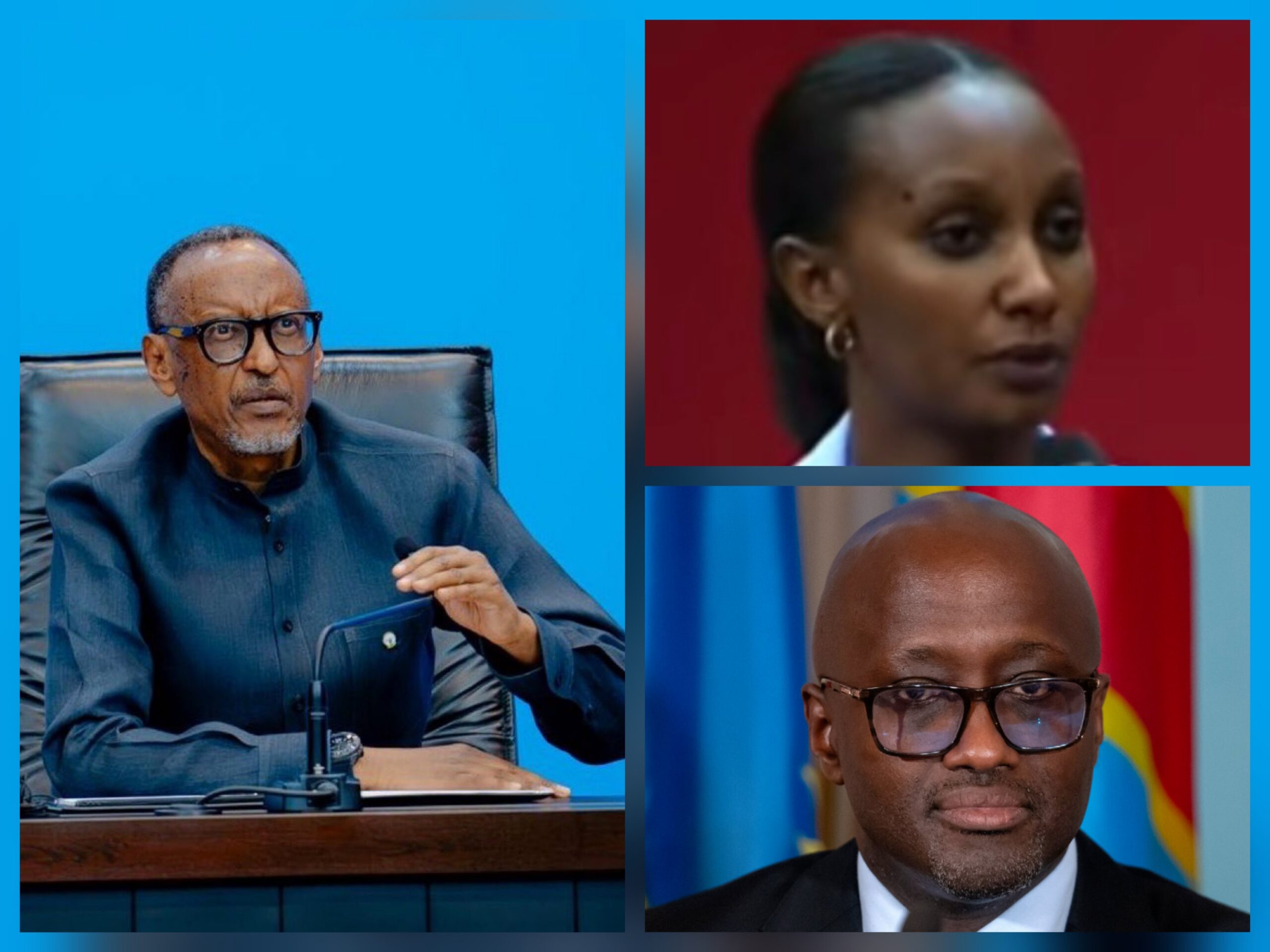
President Kagame (L), journalist and media owner Umutesi Scovia (top), and Foreign Minister Olivier Nduhungirehe (below)
KIGALI, Rwanda — President Paul Kagame on Monday delivered one of his most striking public interventions on the relationship between Rwanda’s political leadership and the media, siding with journalist Scovia Umutesi in a bitter dispute with Foreign Minister Olivier Nduhungirehe.
The extraordinary exchange came during a more than three-and-a-half-hour press conference at the Kigali Convention Centre, where Kagame spent more than 30 minutes addressing the dispute.
The president’s intervention was unusually direct.
Kagame rejected the notion that Nduhungirehe, by virtue of being a senior government official and having attended the regional meeting at the center of the dispute, possessed an unquestionable version of events.
“Because Olivier does not have a monopoly of facts,” Kagame said, before questioning why the minister had behaved in the exchange as though he “owned the facts.”
He said Umutesi had no reason to apologize.
“I saw her apologizing, and I thought she didn’t have to apologize. Apologize for what?” Kagame said.
He then turned his criticism toward his own Foreign Minister.
“Olivier, the minister should have apologized for even himself going into an exchange with a journalist over this nonsense. This is absolute nonsense,” Kagame said.
The remarks have immediately become one of the most discussed moments of Kagame’s lengthy press conference, with the episode dominating Rwanda’s media and social-media conversations Monday night.
But the significance of the confrontation goes beyond a quarrel between one minister and one journalist.
It comes against a long history of Kagame publicly defending the media’s ability to scrutinize government — sometimes even when his own ministers have taken the opposite position.
A dispute over who owns the facts
At the center of the latest confrontation was a deceptively simple question: Who gets to establish what is a fact?
The dispute began after Nduhungirehe attended a regional summit a few weeks ago at which representatives from the Democratic Republic of Congo were expected to participate.
The minister subsequently reported that the Congolese were not present.
Congolese officials, however, said they had attended.
That discrepancy became the subject of discussion during Umutesi’s evening news commentary program on her television station.
Rather than simply accepting either account, Umutesi suggested that another social-media influencer who had attended the event could be consulted to establish what had actually happened.
Her argument was essentially that hearing from another person who had been present could provide a more balanced picture.
Nduhungirehe took a very different view.
He publicly challenged Umutesi’s interpretation on X, arguing that she had dismissed or misrepresented his account not because the facts were wrong, but because she did not properly understand the French in which he had originally communicated his account.
The dispute escalated into a public exchange between the minister and journalist.
It became sufficiently heated that Umutesi eventually issued a public apology.
That apology was precisely what Kagame questioned on Monday.
According to the president, the fact that a journalist challenges a minister’s account is not, in itself, an offense.
A minister can correct a journalist if something has been reported incorrectly. But that does not mean the journalist is required to accept the minister’s version as beyond scrutiny.
Kagame’s intervention therefore went to the heart of journalism: facts reported by officials can still be questioned, tested and independently verified.
Kigali Today reported that Kagame said journalists have the right to examine information provided by ministers and determine whether it is accurate.
And in Kagame’s telling, the disagreement should never have reached the level of a public confrontation.
If the journalist had misunderstood something, the minister could simply have corrected it.
Instead, Kagame described the entire episode as “absolute nonsense.”
It is not the first time Kagame has defended the media
During the press conference, two othe4 senior media personalities Oswald Mutuyemungu and Albert Rudatsimburwa, attempted to defend the Minister, by trying to shape a narrative that Umutesi did indeed go overboard. Kagame wasn’t taking any of that.
The episode stands out because it is not an isolated instance of Kagame publicly defending media access or the media industry.
Over the years, the president has intervened in several debates where government policy threatened, directly or indirectly, to compete with or undermine the private media.
One of the clearest examples came several years ago when it emerged that government institutions were considering establishing their own radio stations.
The institutions had reportedly gone as far as planning and budgeting for the stations, with the stated objective of communicating government programmes and activities more directly to citizens.
Journalists challenged Kagame at a press conference, warning that such a move could seriously damage the private media industry.
The concern was straightforward: Rwanda’s private media depend, at least in part, on government advertising and communication contracts to survive. If individual government institutions began establishing their own broadcasting platforms, they could potentially divert both audiences and advertising away from independent media.
Government ministers defended the proposed arrangement during the discussion.
Kagame, however, questioned the logic.
If the government already had Rwanda Broadcasting Agency, the state broadcaster, what was the purpose of every government institution creating its own media outlet?
The proposed expansion of government-owned radio stations was eventually abandoned.
The episode was significant because Kagame was not merely defending the abstract principle of press freedom. He was questioning a government policy that could have created a structural economic disadvantage for the private media industry.
Kagame and the idea of a media fund
The president has also personally advocated for the creation of a media fund modeled on systems used in countries such as Sweden, designed to provide support for public-interest journalism.
The idea was to create a mechanism through which journalism could receive structured support without simply becoming dependent on individual government institutions or advertising contracts.
Yet attempts by members of Rwanda’s media fraternity to organize themselves around such a platform have repeatedly encountered bureaucratic obstacles.
That tension has remained one of the unresolved contradictions in Rwanda’s media landscape: the political leadership has at times publicly acknowledged the need to strengthen journalism, while the institutional machinery required to make some of those ideas work has proven considerably harder to establish.
The open-government architecture
There is another, less visible part of Kagame’s approach to media access.
Under his government, public institutions have been pushed toward a model of open government in which government bodies are expected to maintain websites, appoint media or communications officers and make information accessible to journalists and the wider public.
The result is an unusually large volume of government information available online.
Government institutions routinely publish reports, statistics, announcements and policy documents.
The Office of the Auditor General publishes its reports.
The National Institute of Statistics of Rwanda publishes extensive datasets and reports.
Government ministries and agencies maintain websites containing documents and information that, in many other political systems, might remain difficult for journalists or citizens to obtain.
Not all of this means Rwanda has resolved every question surrounding press freedom or media independence.
It does, however, provide a glimpse into a recurring feature of Kagame’s governance philosophy: government information should, at least in principle, be accessible enough for journalists to interrogate it.
The latest confrontation with Nduhungirehe fits into that broader history.
A president defending a journalist against a minister
That is what makes Monday’s episode particularly striking.
Kagame was not defending a journalist against a junior bureaucrat.
He was defending Umutesi against Olivier Nduhungirehe, Rwanda’s Foreign Minister, one of the government’s most senior and prominent officials.
The president did not simply say that both sides should calm down.
He assigned responsibility.
He said the journalist had nothing to apologize for.
And he suggested that the minister should have apologized for entering into the argument in the first place.
“Minisitiri yagombaga gusaba imbabazi … si wowe wagombaga kuzisaba” — roughly, “The minister should have apologized … you were not the one who should have apologized.” Kigali Today reported the same conclusion from the exchange.
That was a remarkable public rebuke.
There was also an element of irony in the fact that the dispute concerned the minister’s insistence on the authority of his own account.
Kagame’s answer was essentially that authority does not transform an official’s account into an unquestionable fact.
A minister can know something.
A journalist can question it.
Another source can contradict it.
And the public can be left to examine the competing accounts.
That is, at its core, the logic of journalism.
The Congo factor
The dispute also carries unusual political weight because the original subject was the Democratic Republic of Congo, one of the most sensitive issues in Rwanda’s foreign policy.
The question of what happened at a regional summit may therefore appear small compared with the larger Congo crisis.
But it illustrates why the ability of journalists to challenge official accounts matters.
If government officials provide one version of an event and another party provides a conflicting version, the journalist’s job is not necessarily to accept either one automatically.
It is to ask questions.
It is to seek additional witnesses.
It is to test claims.
And, where necessary, to acknowledge mistakes and correct them.
Kagame appeared to be defending precisely that principle.
Why the moment matters
The most consequential part of Monday’s exchange may therefore not be the personal disagreement between Kagame, Nduhungirehe and Umutesi.
It is the principle the president appeared to articulate: government officials do not own the facts.
That principle has particular resonance in Rwanda, where the state remains a powerful actor in the media economy and where journalists often operate in an environment in which access to officials, advertising and government information can have significant professional and commercial consequences.
Umutesi herself is not an ordinary participant in Rwanda’s media landscape. She is a journalist and chair of the Rwanda Media Commission, the industry’s self-regulatory body.
Her apology, therefore, was not merely a personal matter. It became a test of how far a journalist could challenge the account of a powerful government official without being forced into submission.
Kagame’s answer on Monday was unusually unequivocal.
She did not need to apologize.
The minister should have avoided the confrontation. In any case, the minister should be the one apologizing!
And if the journalist had misunderstood the minister’s statement, the answer was correction — not a prolonged public quarrel.
A moment likely to linger
The press conference itself lasted more than three and a half hours and covered a wide range of domestic, regional and international issues. It was broadcast live and drew journalists, international media representatives and social-media personalities.
Yet it was the more than 30-minute discussion over a journalist’s dispute with a minister that appeared to capture the public imagination.
By Monday night, the Nduhungirehe-Umutesi situation was dominating conversations across Rwanda’s media and social-media platforms.
And it is likely to remain a subject of discussion for days, perhaps weeks.
For Rwanda’s journalists, the episode offers something more significant than an entertaining political confrontation.
For the media industry, it also reconnects the latest episode to a much longer history: Kagame questioning government plans to compete with private broadcasters; advocating for a public-interest media fund; building an open-government system that has made vast quantities of official information publicly available; and, now, publicly telling one of his most senior ministers that he does not own the facts.
The irony is difficult to miss.
The argument began over what happened at a meeting involving Congo.
It ended with Rwanda’s president reminding his own Foreign Minister that, when it comes to facts, no government official has a monopoly.
