



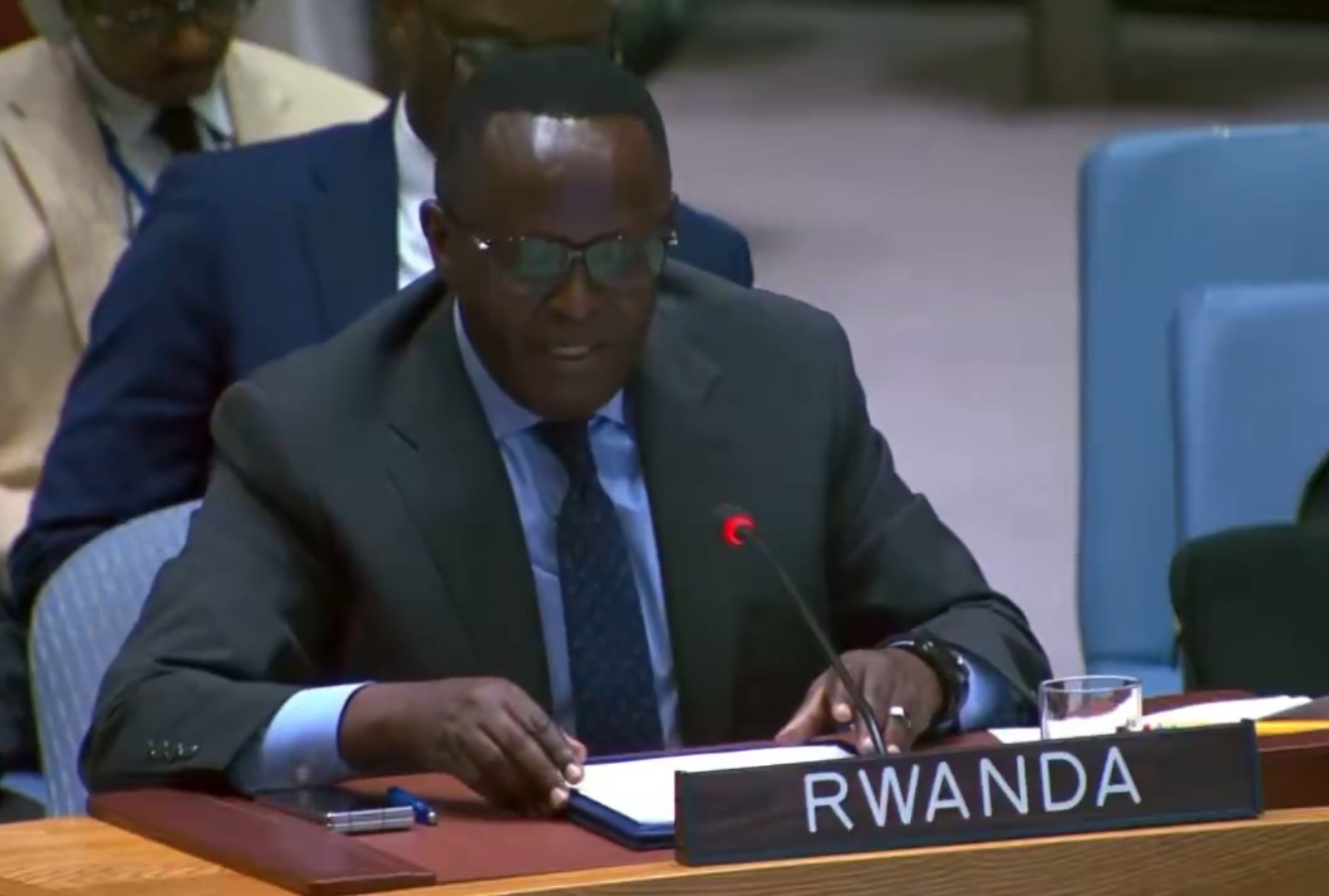
Martin Ngoga, Rwanda’s Permanent Representative to the UN speaking on Tuesday
UNITED NATIONS, New York — Rwanda told the UN Security Council on Tuesday that it and the Democratic Republic of Congo have identified and mapped the locations of the FDLR armed group, including its political and military command structures.
Kigali accused Kinshasa of delaying action to neutralize the group.
Rwanda’s Permanent Representative to the United Nations, Martin Ngoga, made the remarks during a Security Council briefing on the UN stabilization mission in the Democratic Republic of Congo, known as MONUSCO. The briefing was delivered by the mission’s head, Special Representative James Swan.
Ngoga said the mapping was carried out through the Joint Security Coordination Mechanism, one of the bodies created under the Washington peace process.
He said the locations of the FDLR are therefore already known. Its continued presence in eastern Congo, he argued, cannot be explained by a lack of information about where the group operates.
“The Washington Peace Agreement, together with the agreed CONOPS and OPORD, already establishes clear obligations, operational arrangements, sequencing, verification mechanisms and implementation timelines,” Ngoga told the Council.
He said those commitments cannot be “unilaterally or selectively reinterpreted, subjected to new preconditions, or substituted with separate bilateral arrangements.”
Ngoga also said the UN secretary-general’s report confirms that the FDLR remains operational in Rutshuru, Masisi, Nyiragongo and Walikale.
FARDC-FDLR cooperation
Ngoga said information available to Rwanda indicates continued operational cooperation in 2026 between the Congolese army, known as FARDC, the FDLR, Wazalendo militias and other allied forces.
He cited several incidents.
On 10 and 11 February, he alleged that a FARDC helicopter and military trucks transported 13 tons of small-calibre ammunition to Pinga and Kibua. Six tons were later distributed to FDLR and other armed-group commanders, he said.
On 8 March, he said a FARDC helicopter transported 12 tons of ammunition and food rations to Ntoto. The supplies were later shared among FARDC, FDLR, PARECO and APCLS elements, according to Rwanda.
On 31 March, Ngoga said FARDC helicopters delivered 693 rifles, six tons of ammunition and cash incentives to the FDLR and other armed groups.
On 15 August, he alleged that FARDC forces were operating alongside CNRD/FLN, FDLR and Wazalendo/Nyatura fighters in Walungu Territory.
He said similar activity continued in April, June and July.
According to Ngoga, the information was shared “in real time” through the Joint Oversight Committee and the Joint Security Coordination Mechanism.
“The significance is not any single incident,” he said. “It is the continuity of the pattern from January to August.”
Rejects DRC-FDLR arrangement
Ngoga also criticized what he described as an arrangement being pursued between the Congolese government and the FDLR.
He said the arrangement does not amount to the neutralization agreed under the Washington process and was not part of the accords.
He described it as “an attempt to substitute a separate arrangement for a clear commitment already undertaken” and “a delaying tactic.”
Ngoga said the Congolese government has concluded protocols with FDLR leaders and affiliated groups on several occasions. The most recent, he said, was signed on 29 August 2026.
“The obligation is clear: the FDLR must be neutralized, and that neutralization must be effective, complete and verifiable,” he said.
FDLR is “existential threat”
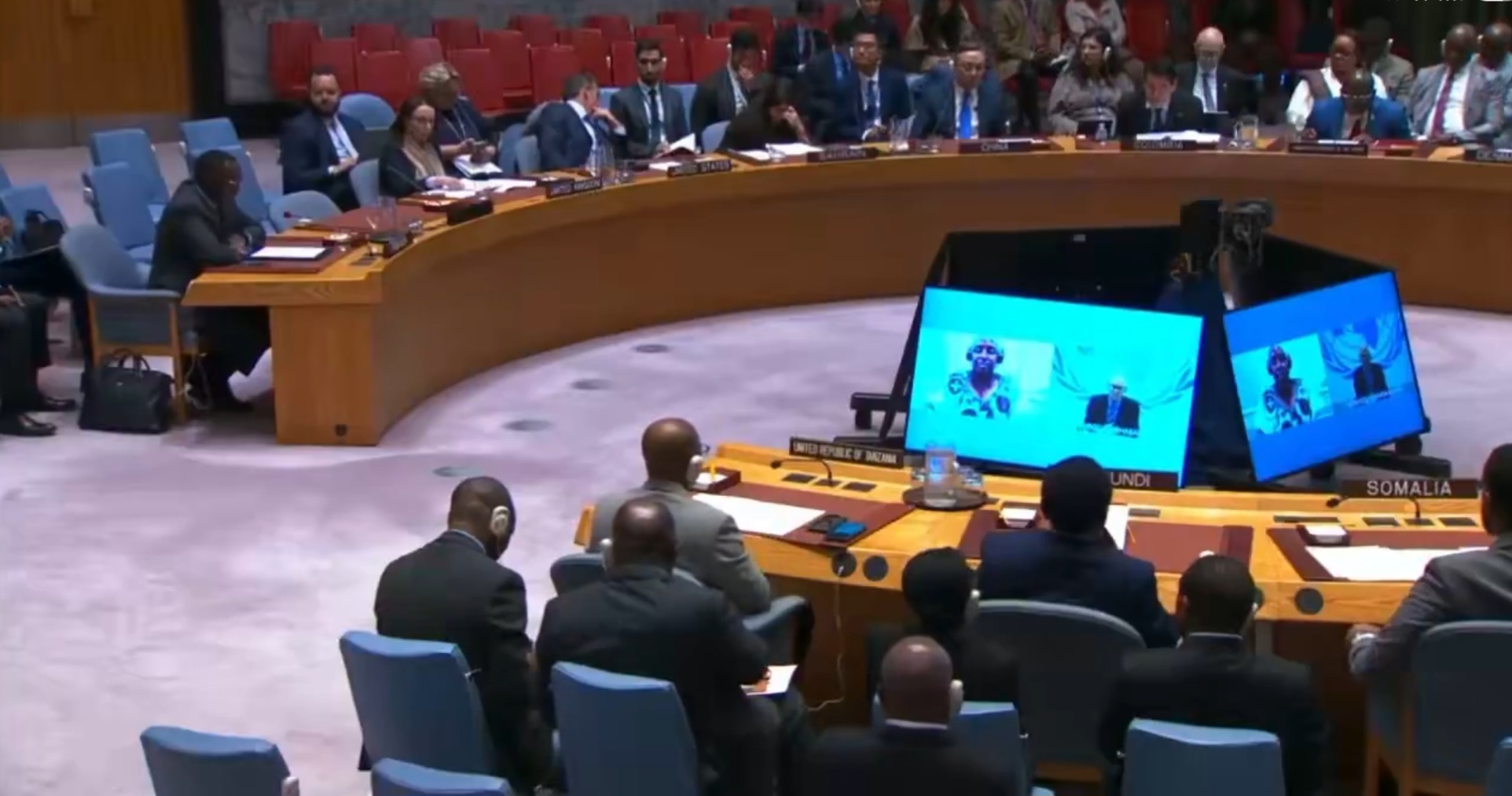
Ngoga described the FDLR’s presence as “a direct and existential security threat to Rwanda.”
He cited the group’s genocidal ideology and what he described as support from the Congolese government.
He also highlighted the geographical proximity of eastern Congo to Rwanda.
Goma and Bukavu, he said, are three to five hours by road from Kigali but about 1,500 kilometres from Kinshasa.
He compared Rwanda’s size to Maryland in the United States. He said the Democratic Republic of Congo is roughly the size of Texas, California, Montana, New Mexico, Arizona and Nevada combined.
An armed group operating next to Rwanda’s border, he said, “cannot reasonably be treated as a remote security concern merely because it operates far from that State’s capital.”
Rwanda proposes joint verification
Ngoga said Rwanda remains committed to the Washington Accords and continues to participate in the Joint Oversight Committee and Joint Security Coordination Mechanism.
He said Rwanda has also taken steps to lift its defensive measures and reported those steps through the Washington mechanisms.
Rwanda has proposed a tripartite verification mechanism involving Rwanda, the Democratic Republic of Congo and the United States as mediator.
“Rwanda is implementing its commitments and is prepared for those steps to be verified,” Ngoga said.
He also expressed concern that international accountability has increasingly focused on Rwanda while what he described as failures by the Congolese government receive less scrutiny.
He warned that this could encourage further inaction by Kinshasa and affect the Doha peace process.
Over 700,000 Banyamulenge and Rwandophone communities
Ngoga urged the Security Council to address violence against Banyamulenge and other Kinyarwanda-speaking Congolese.
Citing information in the public domain, he said that since 2017 more than 650 villages have been destroyed or burned in the South Kivu Highlands.
He also cited the looting of more than 700,000 cattle, the destruction of at least 147 schools and 57 health facilities, and the displacement of more than 80 percent of the Banyamulenge and other Rwandophone population into exile.
He described the Minembwe blockade as one of the longest restrictions imposed on civilians without effective international intervention.
Ngoga also questioned the reported reinstatement of Maj. Gen. Sylvain Ekenge as FARDC spokesperson after his suspension over remarks targeting Kinyarwanda-speaking Congolese.
Rwanda disputes “self-defence” terminology
Ngoga also disputed the Secretary-General’s report’s description of some groups fighting alongside FARDC as “self-defence groups.”
He pointed to the same UN reporting, which he said attributed 143 human rights abuses to Wazalendo groups.
Ngoga said UN reporting shows that the Congolese government armed and financed Wazalendo groups.
He also noted that the groups have been incorporated into the Armed Defense Reserve under Congolese law.
He argued that terminology describing armed groups should be based on objective criteria and applied consistently to all groups, including Twirwaneho.
MONUSCO’s long involvement
Ngoga noted that the United Nations has committed more than $30 billion to MONUC and MONUSCO since 1999.
Despite that investment, he said, “the core security challenges that repeatedly brought this regional crisis before the Council remain unresolved.”
He said the Washington and Doha processes provide an opportunity to change the course of the conflict.
But he added: “Agreements alone will not bring peace. Implementation will.”
