


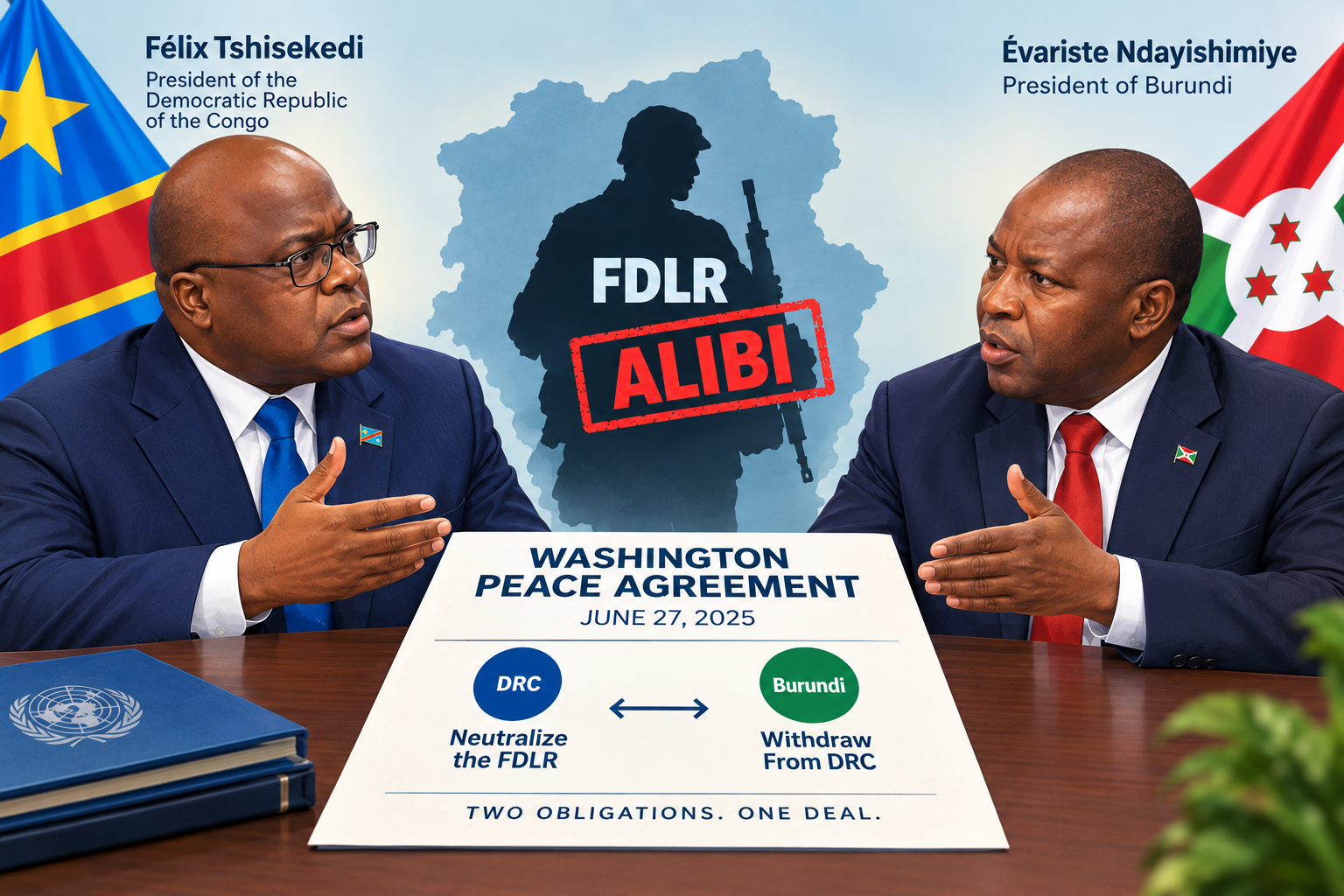
The FDLR matters politically not because Burundi considers the group important in itself, but because it is central to the competing narratives surrounding Rwanda, the DRC, and their respective allies.
The latest exchange between Rwanda’s Foreign Minister Olivier Nduhungirehe and his Burundian counterpart, Édouard Bizimana, may appear to be another episode in the increasingly tense relationship between Kigali and Gitega. But the dispute carries implications far beyond the two ministers themselves.
At the centre of their disagreement are the FDLR and the question of whether the armed group should be treated as a serious security concern for both Rwanda and the Democratic Republic of Congo (DRC).
Bizimana has repeatedly argued that the FDLR is being used as an “alibi” to conceal what he considers the deeper political causes of the conflict. Nduhungirehe, in response, has pointed to previous African Union and international positions on the FDLR, as well as commitments made by the DRC under the Washington peace process.
What makes Bizimana’s position particularly consequential is that he is not speaking only as Burundi’s foreign minister. He currently chairs the African Union Executive Council, the continental body’s principal decision-making organ between sessions of the Assembly. His statements therefore inevitably carry significance beyond the bilateral dispute with Rwanda.
This raises an uncomfortable question: when the chairperson of an important AU organ repeatedly characterizes the FDLR primarily as an “alibi,” does that not risk creating confusion about an armed group that African and international institutions have repeatedly identified as a security threat? The FDLR is not a new or invented issue.
The United Nations Security Council has for years treated the group and its leadership as part of the threat to peace and stability in the DRC. Resolution 1533, adopted in 2004, established the sanctions regime for the DRC, including an arms embargo covering armed groups operating in North and South Kivu and Ituri. Subsequent resolutions strengthened that framework, while UN sanctions have continued to target FDLR leaders and commanders.
UN reporting has also repeatedly documented allegations and evidence concerning cooperation between elements of the Congolese armed forces and armed groups, including the FDLR. More recently, the United States, citing the UN Group of Experts, described cooperation between elements of the DRC armed forces and the FDLR as “systematic” and called for it to end.
The conflict has deep political, historical, ethnic, governance, and economic dimensions. Rwanda’s broader position on the conflict in eastern DRC has featured prominently throughout the peace process. But acknowledging those wider realities does not require dismissing the FDLR as merely an “alibi.”
Indeed, doing so creates a direct problem for the Washington peace process.
The June 27, 2025, Washington Peace Agreement established a reciprocal security framework in which the DRC committed to the neutralization of the FDLR, while Rwanda committed to lifting its defensive measures. The agreement also envisaged mechanisms for coordinating on security matters.
That reciprocity is the central point. Although the agreement does not clearly explain whether the FDLR is the sole cause of the conflict in the Great Lakes region, it does not say that Rwanda will permanently maintain its defensive measures either. But it recognizes two security realities simultaneously: the DRC must address an armed group regarded as a security threat by Rwanda, while Rwanda must, in return, lift its defensive measures.
The two obligations are therefore not competing alternatives. They are two sides of the same bargain. This makes Bizimana’s repeated rhetoric about the FDLR more consequential than an ordinary diplomatic disagreement.
On July 3, 2025, he stated that the “FDLR is no more a threat to Rwanda,” describing it as an “alibi” for looting the DRC. Two days later, he said that the “FDLR card no longer works.” On September 13, 2026, he again described the FDLR as “just an alibi used to cover real motivations” for the war imposed on the Congolese people. In an August 2026 interview, he similarly argued that the FDLR was no longer significant and that it had no importance.
Bizimana has also rejected allegations that Burundi’s armed forces have any connection to the FDLR.
His position is therefore consistent: he disputes both the significance of the FDLR as a present security threat to Rwanda and allegations linking Burundi to the organization.
Yet there is another account that challenges Minister Bizimana’s argument.
On June 27, 2026, Colonel (Rtd.) Augustin Nshimiyimana, alias “Bora,” a former FDLR external intelligence officer, admitted that longstanding historical and ideological connections exist between the FDLR and Burundi’s ruling party, CNDD-FDD. He also said that the FDLR received support from actors in Burundi and from authorities in Kinshasa.
Bora’s testimony may be questioned by some stakeholders in the conflict, but his account is relevant because it presents a sharply contrasting narrative to the Burundian government’s repeated dismissal of the FDLR’s significance.
That contrast raises a broader political question: why has Bizimana devoted such persistent diplomatic attention to arguing that the FDLR is insignificant or merely an “alibi”?
There are several possible explanations, and they should remain analytical rather than being presented as established facts.
One possibility is that Bizimana is primarily challenging Rwanda’s broader narrative about the conflict and the FDLR as the root cause of the insecurity. By minimizing the FDLR, he may be seeking to undermine the argument that Rwanda’s security concerns constitute a legitimate explanation for its defence and security measures along its borders. In that interpretation, the FDLR matters politically not because Burundi considers the group important in itself, but because it is central to the competing narratives surrounding Rwanda, the DRC, and their respective allies.
Another possibility is that Burundi’s increasingly close political and military alignment with Kinshasa has influenced the way Gitega frames the conflict. Challenging the FDLR narrative could serve to shift diplomatic attention away from the DRC’s security obligations and towards what Burundi and other actors describe as Rwanda’s political and economic objectives.
Whatever the motivation, however, the diplomatic consequence deserves attention.
If the FDLR is repeatedly portrayed as merely a Rwandan talking point, there is a risk that political pressure on Kinshasa to fulfill its Washington commitment to neutralize the group will be weakened. In practical terms, that could undermine one half of the agreement’s reciprocal security architecture.
This is particularly sensitive given Bizimana’s position within the African Union.
The AU cannot afford to appear to apply different standards to different armed groups according to shifting political alliances. If Rwanda is expected to lift its defensive measures, then the DRC’s obligation to neutralize the FDLR must receive equal seriousness.
Otherwise, the Washington process risks becoming trapped in an argument over whose security concerns are legitimate rather than functioning as a mechanism for addressing those concerns.
The danger is not that Rwanda and Burundi disagree about the FDLR. Diplomatic disagreement is normal.
The greater danger is that the disagreement begins to weaken the very reciprocity on which the Washington Accord depends.
The FDLR may not explain everything that has happened in eastern Congo. But its existence cannot simply be dismissed because it does not explain everything.
The Washington Accord was built around precisely this difficult reality: the DRC must neutralize the FDLR, and Rwanda must lift its defensive measures.
For Burundi, therefore, the responsibility extends beyond winning an argument with Kigali. As chair of the African Union Executive Council, Bizimana has an opportunity to contribute to the credibility of a peace process that the region urgently needs to succeed.
That requires resisting language that reduces a documented armed threat to a mere political “alibi.”
The region does not need another debate over which side’s fears are legitimate. It needs the commitments already made to be implemented.
Because if the FDLR becomes merely a political argument and Rwanda’s lifting of defensive measures becomes another political argument, the Washington process could stall before its security architecture has even taken shape.
And if that happens, the region may once again find itself debating the causes of the conflict while doing little to prevent its next phase.
Sylivanus M. Karemera is Station Manager, KT Radio 96.7FM, which is under Kigali Today Ltd
