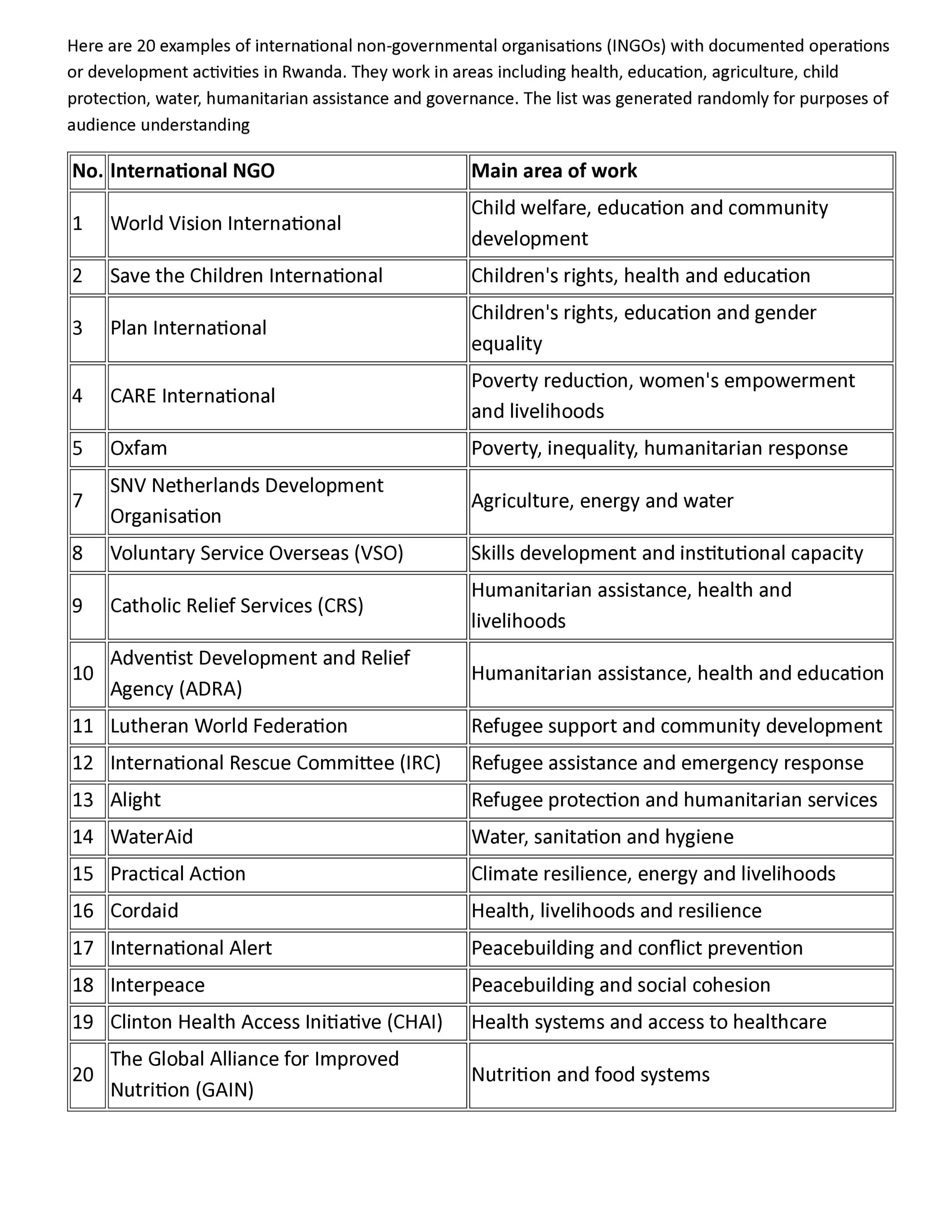

- Operating across Rwanda’s 30 districts, international NGOs manage hundreds of millions of dollars in development funding every year.
- But with 1,487 local NGOs competing for a place in the same development landscape, questions arise about funding distribution, local participation and the impact of years of interventions.
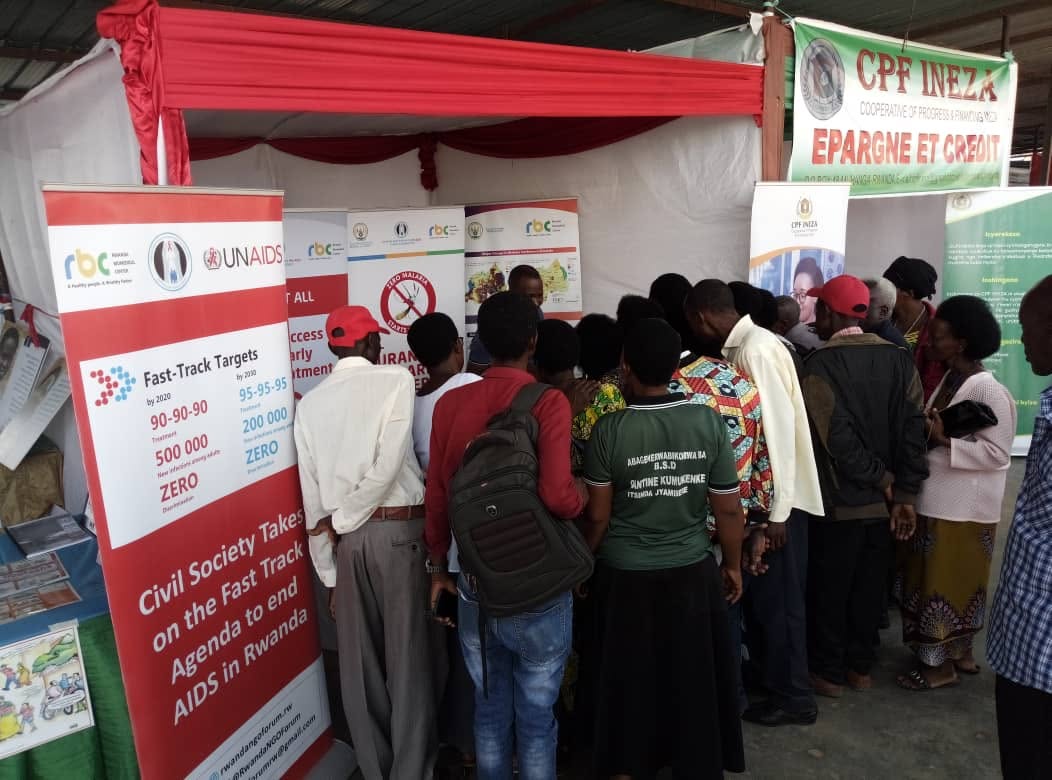
At this site in June 2024 was a campaign by the Rwanda NGOs Forum on AIDS and Health Promotion.
KIGALI – In Rwanda’s 30 districts, 182 international non-governmental organisations (INGOs) operate programmes covering healthcare, education, agriculture, poverty reduction, environmental protection and governance.
They work with communities, government institutions and local organisations, often implementing projects financed by foreign governments, international foundations, development agencies and their own headquarters.
Although their presence and activities vary from one district to another, the financial resources they manage are considerable.
During the 2024/25 financial year, the 182 international NGOs received approximately US$228.3 million in funding, following US$239.9 million recorded in the preceding financial year. Combined, the resources recorded over the two years amounted to approximately US$468.2 million.
Converted using the 2024 exchange rate, the combined amount is equivalent to roughly Rwf619 billion.
This is funding received by international NGOs alone. It does not represent the combined financial resources of all NGOs operating in Rwanda.
The figures raise an important question about the scale of international development financing in the country: after years of interventions and hundreds of millions of dollars channelled through international organisations, how much of that investment is producing visible and lasting improvements in the lives of Rwandans?
The figures are contained in the Government’s External Development Finance Report covering the 2023/24 and 2024/25 financial years, released in July this year.
Part of this government data examines development financing channelled through NGOs, including the resources received by international organisations operating in Rwanda.
A small number of organisations, substantial funding
The 182 international NGOs represent only a fraction of Rwanda’s wider civil society landscape.
A 2025 assessment by the Rwanda Governance Board (RGB) identified 1,487 local NGOs, 226 international NGOs and 76 foundations operating in the country.
The assessment therefore places the number of registered local and international NGOs at 1,713, alongside 76 foundations.
Local organisations account for the largest share of registered NGOs, but international organisations have access to substantial international funding networks that enable them to manage programmes worth millions of dollars.
The difference becomes particularly significant when their financing is examined.
The US$228.3 million recorded for 2024/25 translates into an average of approximately US$1.25 million per international NGO, if divided equally among the 182 organisations.
This is a mathematical average, not an indication that every organisation receives that amount. Funding is distributed unevenly, with some large international organisations managing considerably bigger programmes than others.
Nevertheless, the figures illustrate the financial weight of a relatively small group of organisations within Rwanda’s development landscape.
The resources also represent an important part of external development financing that is channelled outside the national budget and implemented through institutions other than government.
Where does the money go?
The sector distribution of funding provides an indication of the development priorities receiving the largest share of international NGO resources.
Social protection was the biggest recipient in 2023/24, accounting for US$92.4 million, or approximately 38.5% of the total.
Education followed with US$58.4 million, representing 24.3%, while health received US$36 million, equivalent to 15%.
Agriculture accounted for US$20.6 million, while governance and decentralisation received US$9.5 million.
The distribution changed considerably in 2024/25, although social protection retained its position as the largest area of funding.
International NGO funding by sector
| Sector | 2023/24 | 2024/25 |
|---|---|---|
| Social protection | $92.4m | $63.0m |
| Health | $36.0m | $43.0m |
| Education | $58.4m | $34.5m |
| Climate and environment | $6.6m | $25.9m |
| Agriculture | $20.6m | $20.8m |
| Governance and decentralisation | $9.5m | $14.8m |
| Private sector and youth employment | $6.4m | $10.3m |
| ICT | $0.05m | $6.9m |
Social protection funding declined from US$92.4 million to US$63 million, while education funding dropped from US$58.4 million to US$34.5 million.
Health, on the other hand, recorded an increase of approximately 20%, reaching US$43 million.
One of the most notable changes was in climate, environment and natural resources, where funding almost quadrupled from US$6.6 million to US$25.9 million.
Governance and decentralisation also recorded an increase, from US$9.5 million to US$14.8 million, while private sector development and youth employment rose from US$6.4 million to US$10.3 million.
The changing distribution suggests that international organisations are directing resources towards different priorities as development needs and donor interests evolve.
However, the amounts alone do not establish whether these interventions have achieved their intended results.
For instance, US$43 million in health funding does not tell us how many additional people accessed quality healthcare, whether maternal and child mortality declined as a result, or how much additional capacity was created in health facilities.
Similarly, US$63 million directed towards social protection does not establish how many households moved out of poverty or became economically independent.
Who provides the money?
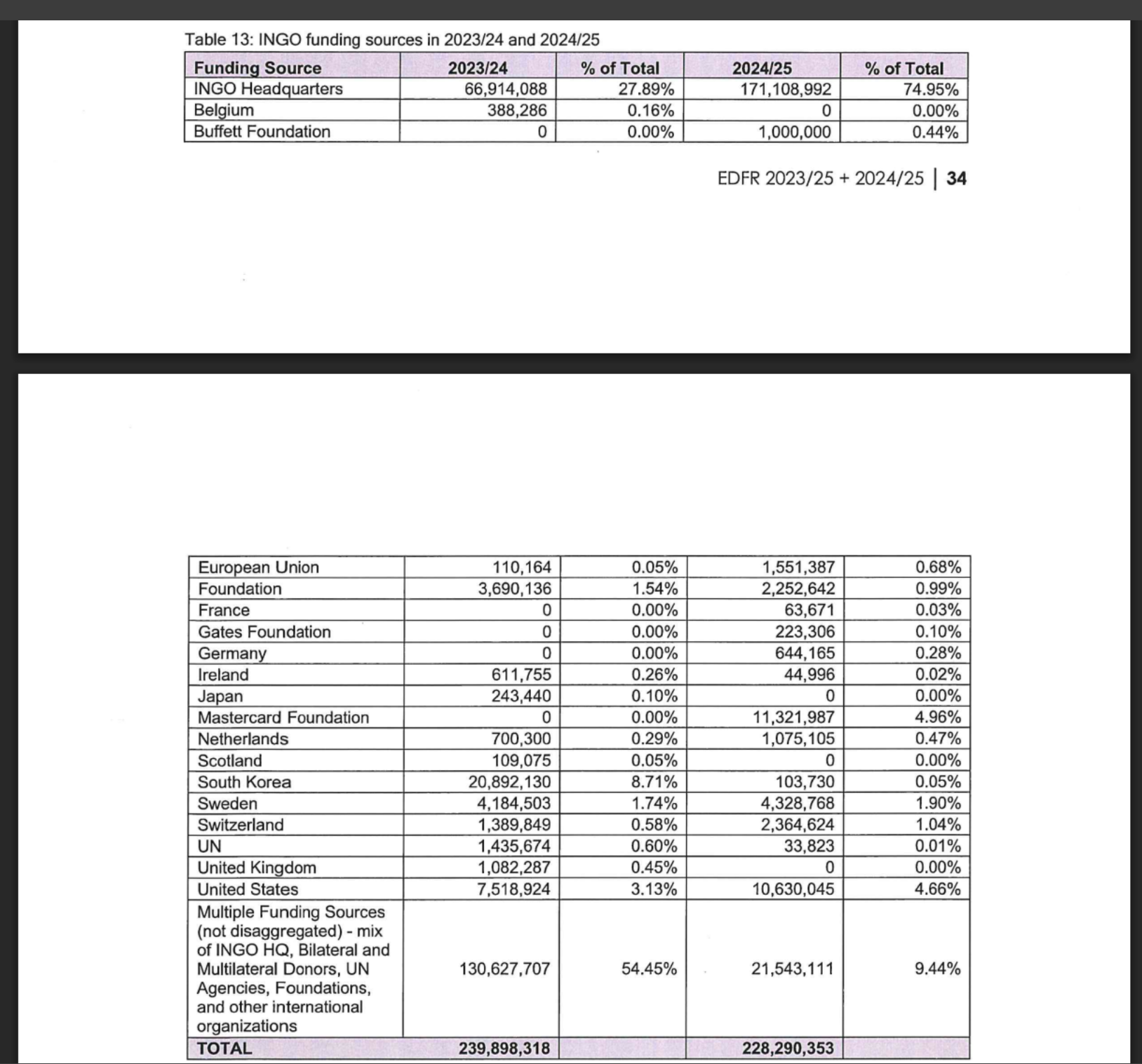
International NGOs operating in Rwanda receive funding from several sources, including their international headquarters, bilateral development partners, multilateral institutions, United Nations agencies, foundations and other international organisations.
However, tracing the money to its original source remains a challenge.
In 2023/24, approximately US$130.6 million, representing 54.45% of the funding recorded, was attributed to multiple sources that were not individually disaggregated.
Another US$66.9 million, equivalent to 27.89%, was recorded as coming directly from the headquarters of international NGOs.
This means that more than 82% of the funding was either attributed to NGO headquarters or grouped under multiple sources without identifying individual contributors.
The picture changed in 2024/25.
Funding recorded as coming from INGO headquarters increased to US$171.1 million, representing almost 75% of the total. Meanwhile, funding recorded under multiple, undisclosed sources declined to US$21.5 million, or 9.44%.
Other identifiable contributors included the Mastercard Foundation, which accounted for US$11.3 million, the United States with US$10.6 million, Sweden with US$4.3 million and Switzerland with US$2.4 million.
The report also identifies contributions from the European Union, Germany, the Netherlands, the Gates Foundation and other international partners.
The substantial reliance on headquarters financing is not necessarily unusual for international organisations, many of which raise resources globally before allocating them to country programmes.
However, the limited disaggregation makes it difficult to establish the complete financing chain: who originally provided the money, which organisation received it, which local partners participated and how much ultimately reached intended beneficiaries.
This is an important accountability issue, particularly when such substantial resources are being channelled through organisations operating outside the national budget.
The local NGO question
Perhaps one of the most important questions raised by the scale of international NGO financing concerns the position of Rwandan organisations.
With 1,487 registered local NGOs compared with 226 international NGOs, local organisations constitute the overwhelming majority of the country’s NGO landscape.
Yet international organisations continue to manage substantially larger financial resources.
The External Development Finance Report’s analysis of financing channelled outside government provides another perspective.
National NGOs received 12.9% of the resources in 2023/24 and 11.9% in 2024/25.
International NGOs and private sector entities together accounted for 43.9% and 55.5%, respectively.
The report further notes that international NGOs received approximately twice as much funding as national NGOs.
These figures relate to the wider financing channelled outside government by development partners, rather than the total funding received by the 182 international NGOs in Chapter Six.
Nevertheless, they reveal a financing imbalance that deserves attention.
Local NGOs often have closer relationships with communities, understand local circumstances and have experience working with district authorities and grassroots institutions.
International organisations, meanwhile, often have access to larger donor networks, technical expertise and institutional capacity required to manage substantial grants.
This creates opportunities for partnerships, but also raises questions about whether international organisations are doing enough to strengthen local institutions.
Are Rwandan NGOs being developed into independent organisations capable of attracting and managing major development financing, or are they largely participating as implementing partners under international organisations?
There is also the question of how much of the funding benefits Rwanda’s economy through local employment, procurement, partnerships and the development of local expertise.
The available figures do not provide a sufficiently detailed breakdown to establish this.
Rwanda tightens oversight
The scale of this financing becomes even clearer when converted into local currency. Using Rwanda’s 2024 average exchange rate of Rwf1,322.7 to the US dollar, the US$239.9 million recorded for 2023/24 translates into approximately Rwf317.2 billion, while the US$228.3 million for 2024/25 is equivalent to about Rwf302 billion.
Together, the funding received by international NGOs over the two financial years amounted to approximately Rwf619.2 billion.
To put this into perspective, the Government allocated Rwf259.7 billion to agriculture in its entire 2024/25 national budget. The annual funding received by international NGOs was therefore equivalent to about 116% of that allocation, while the combined two-year amount was approximately 2.4 times the government’s agriculture budget for a single year.
In other words, the resources channelled to international NGOs over two years were enough to finance Rwanda’s entire annual agriculture allocation more than twice over.
The scale of international NGO financing makes accountability an important issue for the government.
Rwanda has been moving towards a more unified regulatory framework through Law No. 058/2024 Governing Non-Governmental Organizations, which came into force on July 19, 2024.
The legislation replaced separate laws that had governed domestic and international NGOs since 2012.
It introduced common requirements covering registration, institutional governance, financial management, reporting obligations and professional conduct.
Among its provisions, the law caps administrative and overhead expenditure at 20% of an organisation’s budget. NGOs must also maintain financial and institutional records for 10 years.
The law allows NGOs to conduct commercial activities, provided their commercial assets and operational assets are kept separate.
The Rwanda Governance Board, which regulates the sector, says the framework is intended to improve accountability, transparency and coordination between civil society organisations and government institutions.
The transition to the new framework has already attracted a significant response.
In a statement issued on July 30, 2026, RGB reported that approximately 86% of NGOs required to align their operations with the new law had submitted applications before the prescribed deadline.
The regulator attributed the response to nationwide awareness campaigns, training sessions, consultations and technical assistance provided to organisations.
However, RGB did not disclose the total number of organisations used to calculate the 86% compliance rate.
The 2025 registry figures provide a broader picture of the sector, although they should not automatically be used as the denominator for the compliance calculation.
The new law also provides an opportunity to establish a more reliable picture of organisations operating in Rwanda, their activities, financial resources and governance structures.
But registration and compliance alone do not demonstrate development performance.
An organisation can meet every legal requirement, submit financial statements and maintain proper governance structures without necessarily delivering significant improvements to the communities it serves.
Is the impact visible?
Rwanda has made considerable progress in several development indicators over the past two decades, including poverty reduction, access to healthcare, education and social protection.
International NGOs have participated in many of these interventions, working alongside government institutions, local organisations and development partners.
However, attributing specific national achievements to NGO financing is not straightforward.
Many development programmes are jointly financed by government, bilateral donors, multilateral institutions and private foundations. Some involve several implementing organisations, making it difficult to isolate the contribution of a particular NGO.
This is where the latest financing report leaves an important gap.
It provides information about the resources received and the sectors attracting funding, but does not offer a consolidated assessment of the development outcomes attributable to the approximately US$468.2 million recorded over the two financial years.
How many people have moved out of poverty through NGO-supported programmes?
How many sustainable jobs have been created? How many farmers have increased their productivity? How many children have completed school because of these interventions? How many health facilities have improved their capacity to deliver services?
These are questions that should accompany annual funding reports.
The challenge is particularly important in social protection, which attracted US$155.4 million over the two financial years.
With such a substantial amount directed towards the sector, the public should be able to establish how many households benefited, whether their incomes improved and whether the support helped them become economically independent.
The same scrutiny should apply to agriculture, education, health and environmental programmes.
There is also the issue of sustainability.
Some organisations implement projects for several years, creating activities that depend heavily on continued donor financing. When funding ends, programmes may slow down or disappear.
A successful development intervention should ideally leave behind more than a completed project. It should create skills, infrastructure, stronger institutions, employment opportunities or economic activities that communities can sustain independently.
The ultimate test is not simply how many beneficiaries an organisation reports reaching, but whether their circumstances improve over time.
From funding to measurable results
The 182 international NGOs operating in Rwanda represent an important development financing network. Their access to hundreds of millions of dollars annually provides resources that can complement government programmes and support communities in areas where additional investment is needed.
But the size of the funding also raises expectations about the results.
Rwanda has taken steps to strengthen oversight through the new NGO law. The next challenge should be to connect financial accountability with measurable development outcomes.
This could include requiring organisations to publish clearer annual reports showing funding received, project allocations, the number of beneficiaries reached, jobs created, local procurement, partnerships with national NGOs and independently verified results.
It would also help establish how much of the funding remains within Rwanda’s economy through local employment, procurement and partnerships, as opposed to expenditure on international operations and external expertise.
The disparity between international and national NGOs deserves particular attention. If local organisations are to become stronger development institutions, they need more than occasional subcontracting opportunities. They need access to financing, technical expertise and meaningful participation in programme design and implementation.
For RGB, the challenge is therefore not only to establish how many NGOs operate in Rwanda and whether they comply with the law, but also to ensure that the sector delivers value commensurate with the resources it receives.
Rwanda does not necessarily need more organisations or bigger development budgets. It needs development financing that produces lasting results.
After years of NGO interventions across the country’s 30 districts, the public should be able to see more than the number of organisations registered, projects launched or millions of dollars received.
The real measure of international NGO funding should not be how much money enters the sector every year, but how much that money changes the lives of Rwandans.