

Rwanda Budget Distribution
KIGALI – Eastern, Southern and Western provinces are set to receive significantly more money from the central government than Kigali and Northern Province in the 2026/2027 financial year, raising questions about how Rwanda distributes public resources among its five administrative areas.
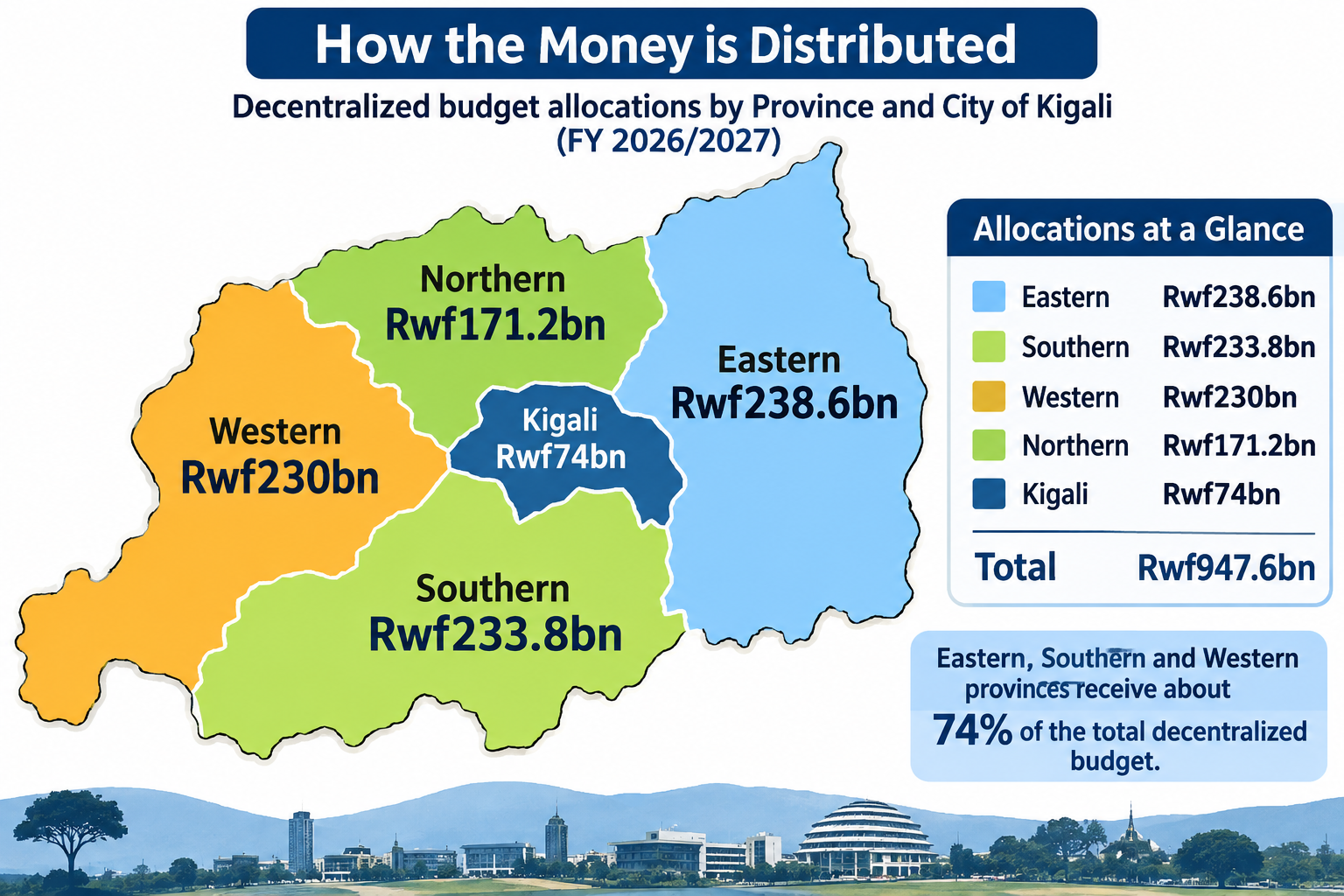
According to the Ministry of Finance and Economic Planning’s 2026/2027 Budget Factsheet, Eastern Province has been allocated Rwf238.6 billion, followed by Southern Province with Rwf233.8 billion and Western Province with Rwf230 billion.
Northern Province, meanwhile, will receive Rwf171.2 billion, while the City of Kigali has been allocated Rwf74 billion.
The difference is particularly striking when the three leading provinces are considered together. They will receive Rwf702.4 billion, representing about 74% of the Rwf947.6 billion allocated to the five areas.
How the money is distributed
Rwanda’s total national budget for the 2026/2027 financial year stands at Rwf7,796.3 billion, up from Rwf6,952.1 billion in the revised 2025/2026 budget. The decentralized allocations account for approximately 12.2% of the national budget, with the remaining resources covering national programmes, salaries, infrastructure investments and other government expenditure.
However, the Rwf947.6 billion is not the full budget available to these regions. The figures cover transfers from the central government, including earmarked funding and block grants supporting district operations. They exclude revenues that districts and the City of Kigali generate locally and approve through their respective councils.
This distinction is important because districts have different capacities to raise their own revenue. Border districts, for example, can benefit from cross-border trade and related business activities. Others, including Muhanga, Musanze and Bugesera, have growing commercial activity, tourism, residential development and economic links with Kigali that can generate local revenue.
Consequently, a district receiving a smaller central government transfer may still have significant resources from its own economic activities. The factsheet does not provide figures showing how much each district collects locally.
What explains the differences?
Part of the explanation could lie in population distribution.
Eastern Province has approximately 3.56 million residents, making it Rwanda’s most populous province. Southern Province has about three million people, while Western Province has approximately 2.9 million.
Northern Province has around 2.04 million residents, compared with approximately 1.75 million in Kigali.
The larger populations in the Eastern, Southern and Western provinces mean greater demand for public services, including schools, health facilities, water, sanitation and agricultural support.
The number of districts could also influence the distribution. Southern Province has eight districts, Eastern and Western each have seven, Northern has five, while Kigali has three.
More districts generally mean more local administrative structures and potentially greater demand for government transfers.
Rural communities and agricultural support
The rural population is another factor worth considering.
More than three-quarters of residents in each of the four provinces live in rural areas. The proportion is particularly high in Southern Province, where about 85% of the population lives in rural communities.
In contrast, only about 13% of Kigali’s population lives in rural areas.
This difference matters because decentralized funding includes programmes such as school feeding, education capitation grants, and seed and fertiliser subsidies.
These programmes can generate substantial spending in rural areas, where agriculture and access to basic services remain important development priorities.
However, rural population alone cannot explain the differences. Northern Province is also predominantly rural, yet its total allocation is considerably lower than those of the three leading provinces.
Northern Province gets more per person
Interestingly, looking at allocations against population produces a different picture.
When the figures are divided by the respective populations, Northern Province receives approximately Rwf84,000 per resident, compared with Rwf67,000 in Eastern Province.
Western and Southern provinces receive approximately Rwf79,000 and Rwf78,000 per resident, respectively.
Kigali receives approximately Rwf42,000 per resident.
This suggests that Northern Province’s lower overall allocation is partly explained by its smaller population. It does not necessarily mean that residents there receive less government support individually.
