



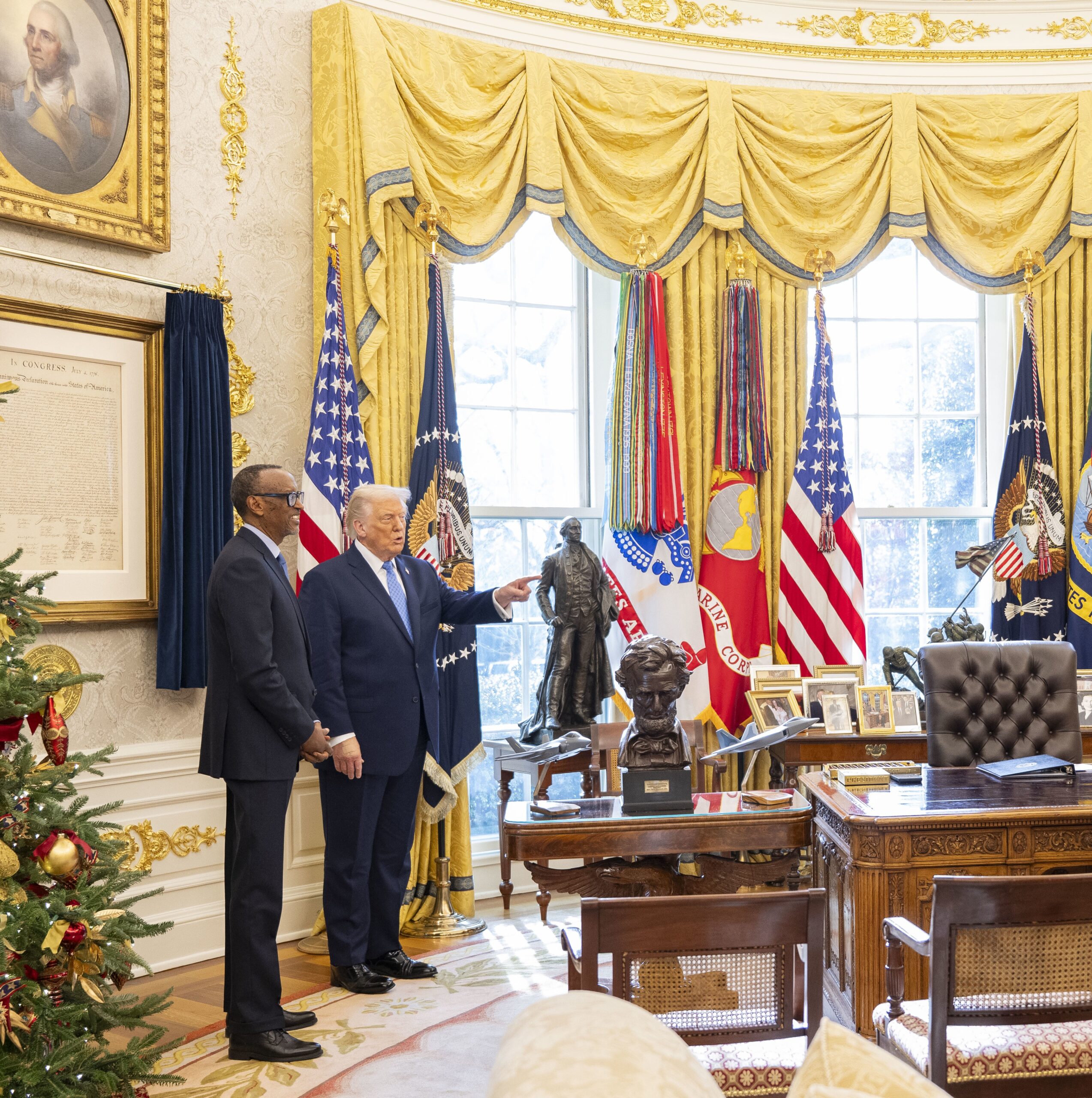
U.S. President Donald Trump taking President Kagame on tour of his office. This was ahead of the signing of the Washington Accord
The United States and Rwanda have signed a five-year, $228 million Bilateral Health Cooperation Memorandum of Understanding (MoU), marking a major step forward in the countries’ expanding strategic relationship.
The agreement was signed in Washington on December 5, 2025, by Jeremy Lewin, Senior Official and Under Secretary for Foreign Assistance, Humanitarian Affairs, and Religious Freedom, and Rwanda’s Minister of Foreign Affairs, Olivier Nduhungirehe.
The new arrangement outlines a comprehensive roadmap to save lives, strengthen Rwanda’s health system, and advance U.S. global health priorities under the America First Global Health Strategy.
The MoU commits the United States—pending congressional approval—to provide up to $158 million over five years to support Rwanda’s fight against HIV/AIDS, malaria, and other infectious diseases, while strengthening disease surveillance and outbreak response.
Rwanda, in turn, plans to increase its domestic health spending by $70 million, progressively assuming greater financial responsibility as U.S. support is scaled down.
By the fourth year of the program, Rwanda is expected to take full ownership of its HIV/AIDS response.
This new framework comes in the wake of the Washington Accord, the political and economic agreement signed earlier this year involving the United States, Rwanda, and the Democratic Republic of Congo, aimed at stabilizing the Great Lakes region and deepening U.S. engagement in East and Central Africa.
It also follows a similar U.S.–Kenya bilateral health cooperation agreement, demonstrating a broader U.S. shift toward multi-year country-to-country arrangements that prioritize accountability, national ownership, and reduced dependency on parallel NGO systems.
Rwanda’s strong record on health outcomes played a key role in shaping the partnership.
The country is among the few globally to reach the 95-95-95 HIV epidemic control targets, while also expanding its national health insurance coverage and modernizing essential health infrastructure.
The MoU aims to accelerate these gains by investing in cutting-edge systems and transitioning service delivery from NGOs to Rwandan public institutions and health workers.
The agreement also reinforces U.S. commercial and technological interests in Africa.
It builds on the State Department’s recent award to American company Zipline International, which is supporting the expansion of U.S.-made robotics for medical deliveries—technology that Rwanda will operate and maintain.
The framework further includes $10 million for Ginkgo Bioworks to enhance Rwanda’s disease surveillance capabilities, establishing a regional “biothreat radar” system to monitor potential outbreaks.
Rwanda has also expressed interest in further U.S. private-sector cooperation in next-generation HIV treatment development and artificial intelligence for healthcare.
U.S. officials described the MoU as a model for future agreements with other countries receiving American health assistance.
More multi-year bilateral health cooperation deals are expected to be signed in the coming weeks as part of Washington’s renewed push for efficient, results-driven global health investments that “eliminate dependency, ideology, and waste.”
