



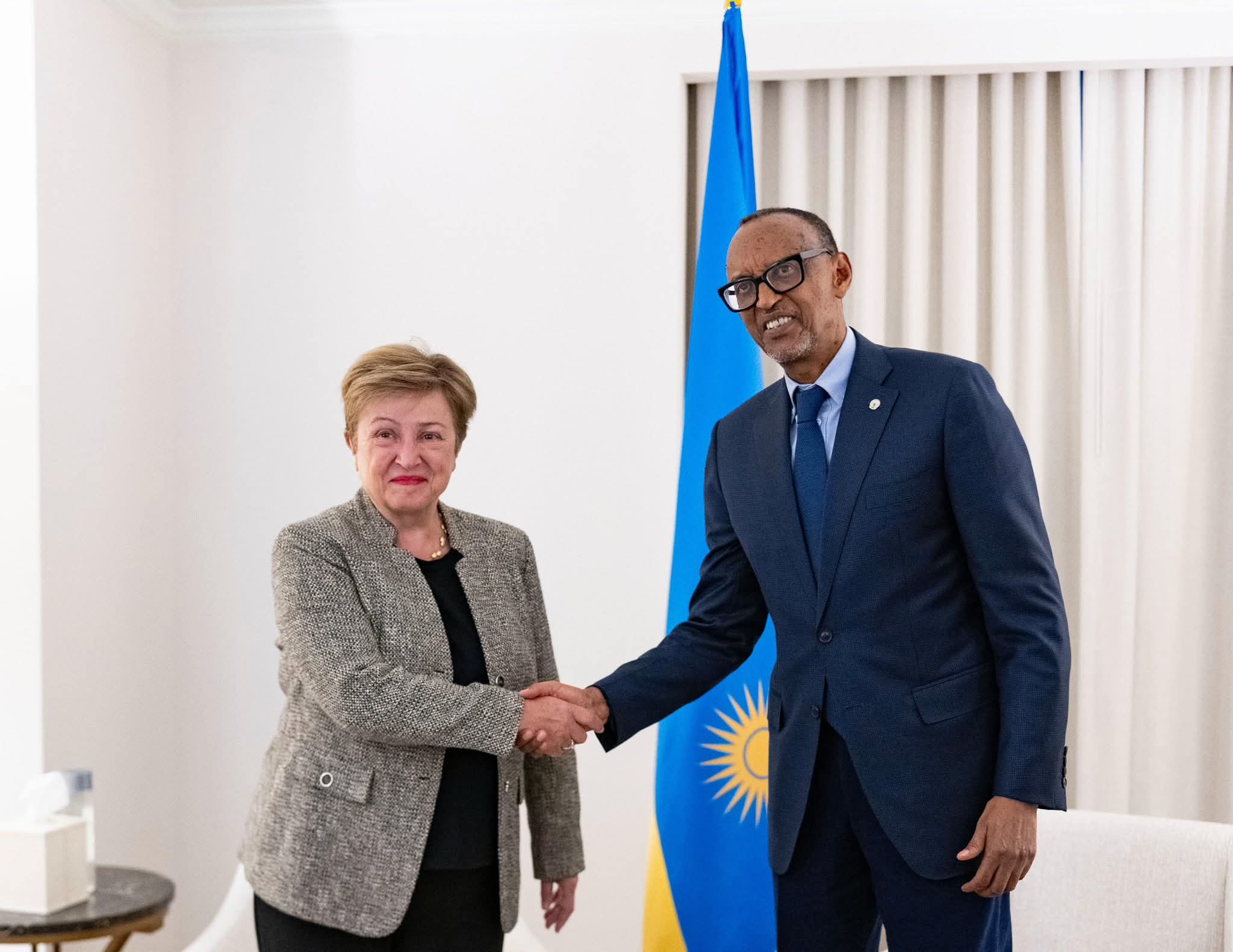
The International Monetary Fund (IMF) has endorsed Rwanda’s strong economic performance and solid policy implementation as the country successfully completed the sixth and final review of its Policy Coordination Instrument (PCI).
The announcement came as IMF Managing Director Kristalina Georgieva met President Paul Kagame in Washington.
She oommened his “unwavering commitment to prudent policymaking” and congratulating Rwanda on the program’s successful closure.
The development comes just days after Rwanda and the United States signed the Washington Accord, a partnership framework aimed at expanding strategic cooperation.
It also follows a similar U.S. health financing agreement with Kenya, placing Rwanda among key regional partners currently strengthening ties with Washington through economic and governance reforms.
“The IMF values its strong partnership with Rwanda,” said the IMF chief, in a X post.
In its detailed assessment released on December 4, the IMF said Rwanda’s economy “remains strong and resilient” despite repeated global and domestic shocks.
Real GDP grew 7.2% in 2024 and the first half of 2025, driven by robust services, construction, and coffee exports.
Inflation stayed within the National Bank of Rwanda’s 2–8% target band, while international reserves remained adequate at 4.8 months of imports.
The Fund highlighted Rwanda’s strong fiscal discipline, data-based monetary policy, and successful reforms under the PCI.
All quantitative targets were met, with significant progress in fiscal reforms, monetary policy modernization, and financial sector strengthening.
The PCI, in place since 2022, supported Rwanda through multiple shocks, including the post-COVID recovery, the 2023 floods, and the 2024 Marburg outbreak.
However, the IMF warned that pressures remain, especially due to increased imports linked to major infrastructure projects such as the New Kigali International Airport and expansion of RwandAir.
Public debt is projected to approach 80% of GDP by 2027, largely driven by foreign-financed capital expenditure.
The IMF urged continued fiscal consolidation, improved state-owned enterprise oversight, and strengthened public investment management.
Going forward, the Fund called for maintaining a tight monetary stance, allowing more exchange-rate flexibility, and accelerating reforms to boost exports, promote private sector development, and expand climate resilience initiatives.
The IMF also encouraged continued work on aligning the National Bank of Rwanda’s governance framework with international best practices.
With the PCI concluded, Rwanda will now enter a Post Financing Assessment (PFA) phase, given its level of outstanding IMF credit.
The next Article IV consultation will be held on a 12-month cycle.
