




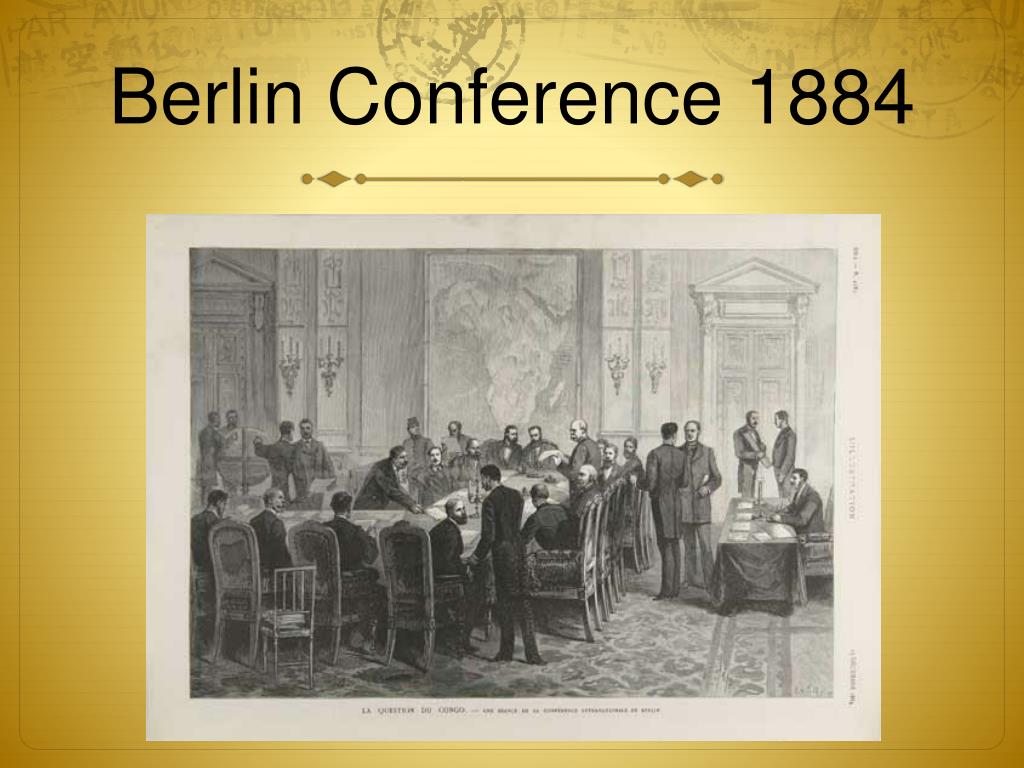
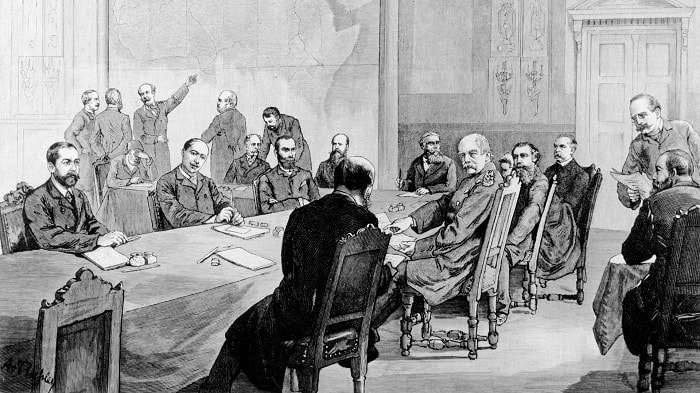
The Berlin Conference (1884–85) laid the foundations for the Congo Crisis by legitimizing European colonial control, particularly King Leopold II’s personal rule over the Congo Free State, which created long-term instability.
How the Berlin Conference Led to the Congo Crisis:

Millions of Congolese men los their limbs for desobeing Leopold’s II rules
Berlin Conference Decisions: The Berlin Conference (1884–85) was convened by European powers to regulate colonization and trade in Africa during the “Scramble for Africa”
It established the principle of “effective occupation”, meaning European powers had to demonstrate control over territories to claim them.
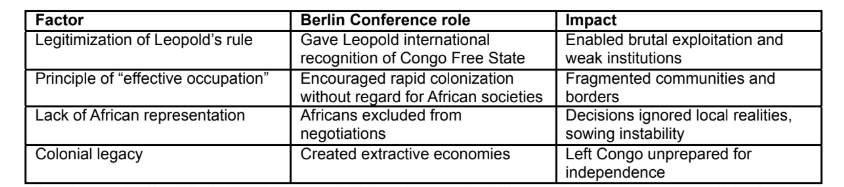
Most importantly, it recognized King Leopold II of Belgium’s claim to the Congo Basin, granting him
personal ownership under the guise of humanitarian and free-trade commitments.
Leopold II’s Exploitation of Congo: Leopold ruled the Congo Free State as his private property, exploiting rubber and ivory through forced labor, violence, and terror.
Millions of Congolese died due to brutal practices, famine, and disease during his regime. This legacy of exploitation left Congo with weak institutions, fractured communities, and deep mistrust of authority.
Connection to the Congo Crisis (1960–65): When Congo gained independence in 1960, it lacked strong political institutions, trained administrators, or a unified national identity — consequences of Leopold’s extractive rule.
The Congo Crisis (1960–65) was marked by secessionist movements (Katanga, South Kasai), Cold War interventions, and political assassinations (notably Patrice Lumumba).
Scholars argue that the roots of this instability trace back to the Berlin Conference’s decision to hand Congo to Leopold, setting up a century of exploitation and weak governance
Evaluating Responsibility:
King Leopold II of Belgium is one of history’s most ruthless colonizers, responsible for the deaths of an
estimated 10 to 15 million Congolese people—a number that dwarfs many other well-documented atrocities.
And yet, when the world speaks of mass killings, genocide, and crimes against humanity, Leopold’s name is rarely mentioned in the same breath as Hitler, Stalin, or the Spanish conquest.
This glaring omission is not accidental but symptomatic of a broader historical trend in which the suffering of African and Indigenous peoples is systematically minimized, erased, or downplayed while European atrocities are acknowledged only when politically convenient.
Risks & Lessons:
Cutting Africa like a piece of cake
Risk of external imposition: The Berlin Conference shows how foreign-imposed governance structures can destabilize societies for generations.
Lesson for modern policy: International agreements must prioritize local voices and sustainable institutions, not just geopolitical interests.
Cold War amplification: While the Berlin Conference created the structural weakness, Cold War rivalries worsened the Congo Crisis by fuelling factionalism.
The Berlin Conference should indeed be blamed as the starting point of Congo’s troubles. By legitimizing Leopold’s personal empire, it planted the seeds of exploitation and institutional fragility that exploded into the Congo Crisis decades later.
